Academic Writing

Thursday, August 02, 2012

Olympics XXX

The Olympics are marked by a number of clear and unwavering characteristics:
Competition
Suspense
Athleticism

This year NBC has decided to add some of their own:
Banality
Artificial dramatization
Homogeny
Spoilers

I’m going to preface this by saying that I love The Olympics. Both summer and winter. I remember watching Keri Strug hobble her way to victory in 1996, gawking at the awkward Svetlana Khorkina also in 1996 but then again in 2000, and the horror over the Nancy Kerrigan attack by Tanya Harding in 1994. I’m also a competitive person, so watching the ultimate competition is very exciting for me. I don’t watch or even care much to pay attention to all of the sports, but like I’m sure most people are, I have my favorites and make sure to pay attention to those. Somehow NBC has managed to so severely mangle the Olympics XXX that watching them gives me more agita than joy.

NBC’s coverage of the London 2012 Olympics has been nothing short of disappointing. They boast over 5,000 hours of content that is streamed either online or on TV throughout NBCU’s many networks.  They have a huge stronghold on the content however, that should you miss something on TV it’s nearly impossible to catch it anywhere else. They’re website is a cluttered mess. And should you G-d forbid want to watch another country’s events, forget about it. In an age with such a proliferation of video everywhere it’s bizarre to have it so unavailable. But NBC proved during the Opening Ceremony that they think Americans don’t care to know about the rest of the world so I guess it’s not that surprising, but I’ll get to that soon. In the meantime, talking about cluttered messes, their prime time coverage is a disaster of scheduling – interweaving swimming, diving and gymnastics (the big ratings grabs) with beach volleyball, rowing and basketball (smaller ratings grabs). This way they get you to watch everything just to weed out what you want. For those of us who DVR, we’re forced to record giant chunks of time (8-12pm!) and needing to delete other shows which we’ve been saving only to fast forward through most of the coverage to get to what we want. I understand that they don’t want to break it out into chucks and risk people not watching the entire. four. hours. per night, but I’m guessing a lot of people DVR it anyway to avoid the banal commentary the voice overs are offering. And of course I am severely sleep deprived this week because I have to watch everything THAT NIGHT or else risk spoilers at the hands of NBC or any other media outlet, but also more on that later.

Let’s also take a minute to talk about the Opening Ceremony. If the actual show wasn’t odd enough, we had to endure Matt Lauer and Meredith Viera’s vapid commentary. Thanks Meredith, for explaining to us simple American folk that the UK includes the British Isles, that’s Isles with an “I.” Ohhhhhh! Thanks for the explanation. Otherwise we would have surely thought the consisted of British Aisles. Then, NBC had to add to the perception of American ethnocentrism and cut a segment commemorating the July 7, 2005 terrorist attacks in London that they didn’t think would be relevant for us because we’re American and gosh darn it, we only care about ourselves. Guess what, NBC, we Americans could stand a little insight about how the rest of the world operates.  And of all things they had to replace it with a Ryan Seacrest interview of Michael Phelps. What is Seacrest even doing there?! Oh, I guess if they’re going for vapid and banal commentary it’s a requisite to have him there. I take it back, good call.

As for them games themselves, all of the prime time coverage is tape delayed by about 5 hours to accommodate the time difference which gives NBC ample time to fabricate narratives that may or may not be there. Take the women’s gymnastics. First of all, you have the disgusting and intrusive attention paid to Jordyn Wieber right after she lost the chance to compete for the individual all-around medal. You can see the camera man changing his angle to make sure he can see her crying in during Aly Raisman’s post-qualifying interview where she (rightfully) expressed pride and gratitude in her success. Then during the team competition they fabricated a sense of close competition with the Russian Women’s team to make for good television, despite the fact that it was inaccurate. As Gawker notes, NBC didn’t even show the Russian women’s floor competition in which they fell so far behind that the US was in no danger of losing the gold. However, if they had shown it as it actually happened, we simpletons at home would have lost interest and perhaps have even changed the channel. Then there are the medal ceremonies. Has anyone else felt like there have been some missing? I watched all last night as NBC dragged out the Men’s All-Around to four hours and then they didn’t even broadcast gymnast Danell Leyva’s medal ceremony! He got the bronze medal and was thrilled at placing and would have been a heartfelt sight to see him up there but apparently if it’s not our anthem being played then NBC has decided that Americans don’t need to see it.


The coverage also hones in on athletes they have decided to make celebrities and focuses on them, neglecting any others. For instance, we know pretty much all there is to know about Michael Phelps and Ryan Lochte. However, what about the rest of the US Swimmers? You wouldn’t even know they were here with a whole team. How about ANY OTHER SPORT? Other that gymnastics and swimming (at least for the first half of the Olympics) if you are an athlete in any other sport NBC doesn’t care about you. Sorry.  And if you’re a viewer who wants an all-around understanding of the American team, well you lose there too. You only get to know the handful of athletes NBC wants to introduce you to. Forget how they bragged during the march of nations at the opening ceremonies how we had so many athletes, we only really want to get introduced to 4 or 5 of them.

Fans of the games who are not impressed have taken to the internet to discuss their displeasure. Hashtags such as #shutupmattlauer and #nbcfail have become popular in the last few days. Unfortunately, however, the suits at the Peacock network don’t take the upset seriously and misinterpret it as “passion” mostly because the ratings numbers remain high. However, they don’t seem to be acknowledging that people are watching because they want to see the games and they are forced to watch it on NBC because that’s the only way to view it. Producer Jim Bell (who is also the executive producer of The Today Show) bragged to The Hollywood Reporter that despite people’s complaints about the quality of coverage they are happy with the results and that “the numbers speak for themselves."  That’s actually a little dishonest to say that despite their editorial decisions people are enjoying it – in fact fans of the Olympics have no other choice.

Last but not least: the spoilers. And this isn’t even exclusively NBC’s fault. There’s CNN which insists on sending out breaking news updates telling us how the Americans are doing. For the record, because of this, they have officially lost me as a subscriber. Didn’t they realize that rushing to be first isn’t always the best way to go when they bombed on the Supreme Court health care announcement. Information is everywhere, I don’t think “first” carries the same weight as it once did. No one actually cares except the network that’s bragging about it. NBC also did a super awesome job of spoiling their own coverage when they ran a promo for Today that featured Missy Franklin holding her gold medal. Problem? Those of us in the U.S. didn’t know that yet because we hadn’t hit prime time yet across the pond. Then there’s Facebook and Twitter. Oh yes, our love of oversharing personal information also extends to non-personal information. So here’s my plea to you, my friends and acquaintances on Facebook: Great that you don’t care about waiting to watch the games on TV. But please, consider other people’s interest of being surprised and experiencing some of the action “live,” or however NBC dictates “live” to be.

Wednesday, August 01, 2012

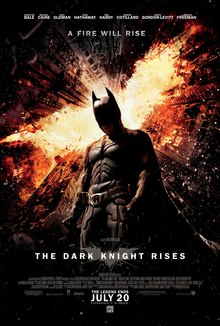
The Dark Knight Rises

Christopher Nolan’s Batman has become a respected, beloved and honored cinematic series. The Dark Knight films, all starring Christian Bale in the lead role, have taken Batman to a dark, brooding place that he had never before been taken. Much of that is due to the serious tone of the films coupled with the deeper Bruce Wayne back-story that audiences have been presented with and the vibrant and multifaceted villains that have been reintroduced to in this series. Led by Heath Ledger’s iconic and immortalized take on The Joker, the villains are now expected to offer an element of psychological depth that had yet been explored to this extent. That said, The Dark Knight set the gold standard for what all future Batman movies could and should offer.

The Dark Knight Rises opens eight years after The Dark Knight ends and the death of Harvey Dent. Police Commissioner Gordon has let Batman take the fall for it and along with the death of his beloved Rachel (Maggie Gyllenhaal in The Dark Knight)years earlier, alter ego Bruce Wayne has lost the will to carry on his mission of protecting the city and leaves that job up to the police force. He becomes a recluse, closing himself off in his mansion and neglecting his financial responsibilities and public persona. It is only when Bane, a new and powerful villain appears in Gotham does Wayne realize he is needed and dons the bat suit once again, albeit somewhat reluctantly. In addition to being at odds with this new force of evil, Batman/Bruce also has two new potential love interests/femme fatales to deal with – Marion Cotillard as Miranda and Anne Hathaway as “cat”-burglar, Selina Kyle. Because, what would a Batman movie, or any movie at that, be without a love interest?

Bane is a villain who seeks chaos, not unlike his predecessors yet his underlying motivation is not made particularly clear. He repeats the dogma that he is giving Gotham back to its citizens and in doing so decides to blow up the Gotham Stock Exchange, the symbol of financial corruption and elitism. He portends to be the ultimate 99%er and relishes at the opportunity to bring chaos to the streets by overturning the class system. This is of course rather ironic as the Right Wing Conservative pundits, namely Rush Limbaugh, have accused Nolan of embodying left wing Hollywood liberal bias for naming his latest villain after Mitt Romney’s former company and as his involvement there is being scrutinized. Aside from the fact that the film is in-fact vehemently anti-99% as it depicts the mob mentality as destructive and dangerous. Further, Bane was actually first introduced to fans of the comic book in 1993 by DC comics, nearly 20 years before the issues of the 2012 election were even a thought.

But, I digress.

Bane is more than a traditional villain from superhero comics. By today’s standard he comes off as a relentless, morally corrupt heartless terrorist. He has superhuman strength and intellect and Bruce Wayne who has been holed up in his mansion as a recluse is now no match for him. Personally I found Bane to be almost cartoonish rather than evil. The mask obstructs his face throughout the entire film which detracts from any sense of humanity that he might otherwise have and thus relinquishing some of the fear he should be demanding. Contrasted to The Joker’s mask which was merely paint, and severely smudged at that, which still allowed Ledger to convey maximum expression and create a psychologically complex villain with a dark past. Moreover, when a psychological look into Bane is offered it falls flat due to a lack of being able to see his expression – you can barely even tell it’s Tom Hardy playing him. Besides that, the mouth-mask/voice effect often made it difficult to understand what he was saying and when I could hear him he sounded a lot like Sean Connery. A great Batman movie is usually based on the strength of its villain and with Bane, it just doesn’t deliver the same punch.

Gotham has traditionally shot in multiple locations and while it has always been a gritty urban area, it has never been “outed” as being a specific locale (Chicagoans want to believe it’s supposed to be their town and New Yorkers are smug enough to just assume it is, because why would it be anywhere else). Even this film was shot in the UK, Pittsburgh and New York, as well as others yet there were moments when it’s anonymity was clearly lost in favor for identifying Gotham as Manhattan. The presence of the Freedom Tower, Brooklyn Bridge, and Empire State Building mark it as such as a very obvious way even though the city is also supposed to contain a Football stadium in its center. With the city under siege it felt more like a gritty apocalyptic and dystopic thriller based in reality and practically pulled from the headlines rather than a superhero blockbuster.

Further making it feel less like a traditional Batman movie is the apparent lack of Batman himself throughout the film. For much of the movie Bruce Wayne is either locked in his ivory tower or locked in a dungeon (not really a spoiler, don’t worry), but in neither instance is he actually Batman. I wanted to see the Bat Suit, the Batmobile and other fun Bat-gadgets, but this film is a lot more heady than it is The lack of screen-time Batman actually had was surprising and definitely felt lacking as I found myself asking, “Where is he?!” He does, of course, return for the final showdown, one which was spectacular and offered an edge of your seat thrill, which is just what the movie needed.

That being said, this dark direction seems to be making sense for the evolution of the genre in our day. With the economy still in shambles, the job market no looking particularly optimistic, our world seems dystopic. Yet, the American dream does prevail and there is still is a sense of self-reliance and helping yourself when others won’t or can’t. Batman resounds in particular as he is famous for his lack of superhero powers. He’s an ordinary man who made himself great through strength of character (and a hefty trust fund left for him), but despite that he does so without the help of supernatural features. In that regard Bane and Bruce Wayne are direct foils. They have many similarities, but it is their social status that separates them. Both are orphans, both are particularly talented in terms of their strength and intellect, yet the one born in poverty and imprisoned becomes a mass murderer and torturer while the other born in the Regency Room of Wayne Manor becomes a savior. Rises asks, can you escape your destiny? Can you break free of whatever bucket society puts you in? Should you even want to? It presents a reality where social status definitively determines how your life unravels, a markedly Un-American ethos.

Finally, I had a hard time separating my perception of the film with the shooting tragedy in Aurora, CO. The film was obviously made well before the incident occurred, yet as I was watching the film, my eyes occasionally distracted by the two police officers who surreptitiously poked their heads into the theater to make sure all was calm, I couldn’t help but be wonder about the frivolity in which our culture promotes gun violence. Perhaps I wouldn’t have thought about it in this regard without the Aurora tragedy but during the multiple sequences where Bane and his henchmen storms around Gotham shooting their guns and missiles I was profoundly uncomfortable by the blasé attitude and everyday nature we place on abject violence on screen – especially on contrast to how there is uproar over sexual promiscuity on screen. The severity of being nonchalant about violence on screen was particularly heighted and adversely effected my reaction to the film.

In all, while there were lulls during the film and stark departures from what makes a Batman film great, the third and final installment in the Nolan/Bale trilogy offers fans a satisfying conclusion to the most financial successful and culturally relevant Batman series to date. It has offered new insights into characters audiences thought they knew and brought new depth and meaning to what it means to be a superhero.

Friday, July 13, 2012

A Case for Sunday Mornings

There’s a show that I DVR every week that I love.  I hate missing an episode and while I'm watching I'm totally enthralled with what's being transmitted onto my TV screen.  I’m not anywhere close to the target demographic which means that none of the advertising is geared towards me nor is it on during a time-slot I would ever choose to be up at (hence the DVRing).  However, this show has provided me with more knowledge than almost any endeavor I’ve ever undertaken and definitely more than any other TV show.  I frequently reference the information I’ve garnered from it and impress my friends with my plethora of facts.  So, what show could possibly live up to this?  I’m talking about CBS’s Sunday Morning and it’s on (you guessed it) Sunday mornings from 9-10:30am.  If you’ve never heard of it, it’s that show with the iconic sun logo – sound familiar?  If you still don’t know what I’m talking about, ask your parents or grandparents about it, I’m sure they know it.  There’s no frills, no competition, no built in drama or conflict, no flashy graphics, but there’s a lot of heart to it and it's a quietly offers more honesty than anything else on television.

As a kid, nearly every Sunday morning I would wake up, wander into my parents room, climb into bed with my mom and dad, sometimes a sibling would join too, and we’d watch as Charles Kuralt took us through the segments of Sunday Morning.  My dad and I are both known in our circles as being the keepers of random information.  We love and absorb trivia – both trivial and significant - so this show is perfect for us.  We’d get a thorough insight into what was happening in America that week, but we’d also learn about interesting stories about celebrities, politicians, artists, and every day people that are making differences in their communities (like the woman who has sent out over 7,000 care packages to the troops overseas and the retired man who decided to start painting the houses in his poor, run down town to lift his neighbor’s spirits about where they live).  Additionally, Sunday Morning covers stories that the weekday news does not bother with, such as music, theater, and interesting architecture.  Occasionally they’ll even have entire shows around one specific theme.  For instance the money and design episodes have come to be annual events.  Now Sunday Morning is hosted by radio personality, Charles Osgood, and is just as engrossing. 

Conceived in 1979, Sunday Morning aimed to emulate the Sunday newspaper magazine section and, as opposed to the morning news shows, was meant to only focus on feature stories.  The show starts with a quick rundown of the week’s top stories, a national weather report and then goes into what is basically a table of contents for the rest of the show.  Admittedly, I fast forward through all of that so I can get to the good stuff.  Between the segments there’s weekly standards that punctuate the show every week they have the Sunday Morning Almanac, which is essentially a “today in history” segment which offers interesting milestones – for instance, did you know that earlier this month Silly Putty celebrated its 60th birthday?  Do you know how it was invented?  I do.  Fast Draw features two guys drawing pictures on a white board to inform audiences about a certain topic – recently why rain doesn’t actually “break” humidity (even though that’s what everyone thinks it does) it actually makes it worse. 

Each week there’s the Sunday Morning Cover Story which is usually the longest and most in-depth feature often about a timely issue and Sunday Morning Profiles offers a glimpse into the life of a celebrity or other public personality in an intimate interview.  Every couple of weeks Ben Stein offers his curmudgeonly advice on the economy, Mo Rocca and Bill Geist track down the random oddities in our country (like people who still build log cabins, the National Goldfish Competition or the Annual Betty Convention) which makes us unique.  Nancy Giles shows up every now and again to talk about her life, whether it’s anecdotes from when she was a struggling actress and how Nora Ephron inspired her to keep pursuing her dream.  And David Edelstein offers his reviews on that week’s movies with his wry and honest commentary.  Then, of course, there's the "Moment of Nature" which closes every episode.  Again, I admit to fast forwarding this part too, but before I do, I always wait to find out where they went this week to find that clip as it often amazes me just how diverse and beautiful the American landscape can be.

What’s special about the segments that Sunday Morning provides is that it often offers a different perspective on something which we thought we knew about.  Be it the smaller pieces or the bigger, central features, Sunday Morning offers a unique view into the world that I haven't seen offered in another context.  For instance, a couple of weeks ago there was a segment about a woman who, after six weeks of marriage, her husband was shipped off to fight in World War I.  Soon after he left he was reported missing and was never heard from again.  She called and wrote letters to the state department, congressmen, her local government officials, and nothing.  Recently her brother-in-law discovered some new information about him and finally found that not only had he been killed, identified and buried in a town in France, he was considered a hero by the locals as he gave his own life to save the entire town.  This man is a hero overseas and his widow only recently discovered this.  Now she makes a pilgrimage once a year to visit his grave, the town and it’s citizens, and the street that’s named after him.  It was a wonderful human interest story about resilience and heroism.  It also exposed a major failing of a government which is supposed to be supporting our war heroes.  In a television landscape that’s fraught with shouting it was a quiet tale that without Sunday Morning would have never been brought to the public.

These days, I no longer watch the show with my parents on snuggly Sunday mornings.  But I do watch the show every week and so does my dad.  While we don’t have a standing “recap” conversation after the show, we’ll often times find ourselves chatting about the random bits of information we’ve learned from the show.  In that sense it’s a special way that my dad and I connect with one another and always giving us something to talk about outside the normal parent-child conversations.  

The show continues to plod along, quietly and modestly, without fancy advertising or making much noise to beat out the rest of the clutter that’s out there.  But for those of us who do watch it (and don’t get me wrong, I know there’s a significant amount of us out there, I’m just a generation or two younger than them) it’s a gem of class and consistency in an otherwise bombastic and cacophonous television landscape.  So, even if it's outside of your normal viewing habits, give this show a chance - you won't be disappointed and you'll definitely learn something.

Thursday, July 05, 2012

Brave

Disney has made a name for itself being in the business of princesses.  Specifically, in girly, frilly, boy-obsessed and dainty princesses.  I loved these princesses and wanted to be all of them, have their pretty palaces and most importantly their cute (often royal and always adorable) boyfriends.   In Disney’s Pixar’s new computer animated film, Brave, the princess is the Scottish tomboy Merida (voiced by Boardwalk Empire’s Kelly Macdonald), who’s strained relationship with her mother Elinor (Emma Thompson) and her disinterest in being married off to one of the lame suitors she’s offered leads her to escape to the Scottish highlands where she encounters a witch’s cottage.  Inside, the witch offers her a spell to “change her mother” and when Merida accepts, she doesn’t expect it to literally change her into a bear.   Having to escape the castle with her newly transformed mother the feuding pair must learn to respect each other’s personalities, perspectives and talents in order to break the spell.  Instead of this princess overcoming her own predicament to find love with her prince, Merida’s challenge is to learn to respect her mother’s perspective and role while in turn Elinor must learn that her daughter’s independence does not mean disrespect of her or of her tradition.

While visually arresting, as the rolling Scottish hills are delightfully presented, Brave doesn’t have the same nods to adults as other Pixar films traditionally have had.  It’s much more a throwback to the more traditional princess films – vaguely medieval times, royal families, mysterious and possibly evil witches and, of course, the independent and impulsive princess (with trademark hair, of course).  Yet the biggest difference is that there is no central love story.  Rather than making the character development and story predicated on her relationship vis a vis a guy she’s lusting after, it’s based off of her refusal to do just that. 

Further, the mother/daughter relationship has rarely been explored in these Disney princess movies as most princesses don’t generally have their mothers.  If you think about it in almost every Disney princess film (save for Sleeping Beauty) the princess only has one living parent.  Merida has both, alive and well throughout the whole film.  Her mother undergoes a physical transformation, but the emotional connection remains strong and it is the development of that relationship and the strengthening of it is what the focus of the film is on.  It is also the particularly closer relationship she has with her mother and her father, King Fergus (Billy Connolly) that highlights the differences with her mother even further.  From external features like having inherited his bright red and unruly hair to her impulsive and carefree manner and her love of an adventure, she is directly aligned with her father and his very male characteristics (not to mention her triplet brothers also have those same personalities).  It seems like her mother is the odd one out in the family and she is desperately trying to get Merida on her side despite Merida’s constant refusals.

When Elinor tells Merida that the time has come for her to choose a husband, suitors which come from the far corners of her father’s kingdom to prove their worth to her.  They arrive and are most definitely all losers.  Arrogant, stupid, ugly, incomprehensible, useless, etc, none of them come close to being able a worthy partner for her.  These are the best her kingdom has to offer?  She understandably resents this process and refuses all of the men (boys, really) who have come to vie for her hand.  The movie’s message would have been strengthened if some she had marriage offers from Prince Eric lookalikes.  It’s not so hard to defy the advances of doofuses as a statement of female independence, but the film’s impact would have been even stronger if she had a great guy at her hands but said she had more living to do before she resigned herself to a life of needlepoint and public appearances.  In reality the tides are changing, women are getting married older after gaining success independently so it’s no wonder Disney is making the statement that this is an ok option.  It would just be nice to do so without disparaging the male counterparts.  In fact, all of them men in Brave are kind of doofusy.  Fergus is lovable and a great dad, but he’s kind of all over the place.  Merida’s brothers are little boys, but they’re huge trouble makers and the suitors, their fathers and their landsmen are all war-mongers with a penchants for violence.  Why must one gender gain independence and respect at the expense of another?  Unfortunately as media is showing stronger more liberated women, men are being disparaged and infantilized and that doesn’t isn’t really helpful either for maintaining a strong society.

Moreover, as I was watching this, I kept thinking to myself, how come the only way a girl can be independent and different is if she’s painted as a tom-boy, or more specifically, a boy?  The manner in which she is depicted as an atypical girl is doing things boys would do – archery, horseback riding (bareback, I might add), rock climbing, and going on scary adventures.  It seems to delineate gender roles even more strikingly than breaking down the barrier – if women can only break out of their proscribed roles by doing manly things (and assuming its vice versa) then it’s really just reinforcing what men’s roles are.

Also, total side note – as has become Pixar tradition, an animated short precedes the film.  This one is La Luna, the Oscar-nominated short that in only a few minutes provides visually arresting images and so much heart as three generations learn from one another in a magical setting.  If you go see Brave make sure to get there early so you can catch this short gem.

I enjoyed Brave, Merida is a strong (albeit sometimes stubborn) female role model that today’s generation of young girls can truly look up to.  She doesn’t allow herself to get pushed around or bullied by social norms (and by that I mean her mother).  At the same time she is open to learning about others and respecting their traditions while also forging her own path, and that’s a lesson everyone can learn from.

Tuesday, July 03, 2012

Rock of Ages

Converting a performance from stage to screen is not by any means uncommon, but that does not mean it’s easy nor is it always successful.  Such is the case with Rock of Ages. Not having seen the Broadway version I cannot comment on the quality of the show, but there’s no way it could be as bad as the movie translation.  When watching something on Broadway, the viewer allows certain suspensions of disbelief that moviegoers do not.  From the first frames when Sherri Christian (Julianne Hough), our lead protagonist, is sitting on the bus escaping her podunk life in Oklahoma to chase her dreams to Hollywood the needed suspension of disbelief is just too great.

The story is this: a lonely, small town girl  goes on a journey (see what I did there?) to Hollywood to explore her dream of being a singer after her grandmother tells her she has a great voice.  In the first moments of getting off the bus in what was then grungy 1980s LA she both gets mugged of suitcase filled with her most prizes possessions – her records (apparently moving cross country with actual clothing is not what was done back then) and she meets Drew (Diego Boneta), the bartender/rock star wannabe that will become the love of her life.  Drew works at The Bourbon Room, a legendary (code: grungy) bar that hosts rock icons and is preparing for the arrival of legendary (code: grungy) rock icon, Stacee Jaxx (Tom Cruise).  Jaxx is a whisky-infused, sex crazed and definitely aging rock star who still causes throngs of girls to faint at the mere sight of him.  Bourbon Room owner Dennis (Alec Baldwin) and his partner Lonny (Russell Brand) are relying on this concert to save the bar from bankruptcy and at the same time right wing, anti-fun politicians want to shut it down for being a harbinger of youth corruption. 

Rock of Ages has all the hallmarks of a run of the mill light fare musical romp/romantic comedy show.  It doesn’t offer anything really new or exciting to audiences and the filmmakers, namely director Adam Shankman was so lazy in adapting it from the stage to screen that you don’t need a lot of creativity to imagine how the original stage production was performed.

All that being said, Rock of Ages doesn’t claim to be a piece of cinematic marvel.  It’s campy and silly and it owns it, which almost makes the ridiculousness ok.  You’re immediately thrown into the 80s rock aesthetic from the hair and music to the clothing to the set design.  Honestly, that’s what I was mostly drawn to with this movie.  I wanted to all things 80s and in that regard the movie definitely delivered.  I was very pleasantly surprised by Tom Cruise’s performance – he totally pulls off the aging rock star image.  And (while I’m sure it was enhanced in post-production), he can actually sing.  The music was excellent – but that’s not surprising as they were all 80s-standards and rock classics.  I wanted to sing along and clap at the end of the big numbers, as I’m sure happened in the stage production, but alas, movies goers just don’t do that so I was left mouthing the words and sitting on my hands at the ends of the performances.

What I think was the most interesting thing about Rock of Ages was that it is the latest in a growing list of movies and TV shows which are curating our favorite songs for audiences.  Along with Glee, the upcoming Battlefield America, Pitch Perfect and not to mention musical remakes like Footloose old favorites from the original iterations are revamped in neat, easy to digest packages.  In a sense, television and film are putting together what feels like a modern day mix tape.  In today’s internet age, videos, songs, article, and pictures get shared in an instant across oceans.  However, through this, one of the most sacred sharing devices has been lost: the mix tape.  Mix tapes were given to friends, crushes, and family as a sign of affection and wanting to share something that was important to the person who spent painstaking hours waiting for songs to come on the radio and hitting “record” on their boom boxes.  Sometimes, if you were lucky enough to have the song on a preexisting tape you could record straight from there.  But in any case if someone gave you a mix tape it meant you were special to him or her and they wanted to share something sacred to them.  While the tape itself had meaning, the songs themselves were important as well.  Emotions and feelings of nostalgia are evoked by both the idea of curating songs and the songs themselves - and show runners and filmmakers know this.  By giving us music packaged in this way and as plot devices, audiences are naturally drawn to the vehicle in which they are being presented.  The music is likely the main (if not only) reason for any success of this movie.  The plot is barely existent, the acting is stilted and even the singing is generally weak but the songs are great, fun and familiar and people want fun and familiar.  Without them there’s no way it would have earned a respectable $29 million in under 2 weeks.   

There’s also something to be said about the draw that the 1980s has for people of a certain generation.  People like me, for instance, who were really children of the 1990s and only caught the end of the 1980s can still appreciate and nostalgize that era and for people who were actually teenagers in the 1980s and long for the time of their youth.  Nostalgia and a longing for the past when one can say “the good old days” is a powerful force and helps drive revenue, even if they weren’t really such good old days.  It is also for that reason that Rock of Ages, no matter how “bad” of a movie it is, had a built in audience base of people who will go see anything that can make them feel like they’re either reliving or reconnecting to their pasts.

Wednesday, June 27, 2012

Nora Ephron, Remembered

Had you asked me last week if I was a Nora Ephron fan I likely wouldn’t have been overly enthusiastic about it but I would have said something like, “Sure why not? I liked her movies and her characters.  She’s pretty funny.  So yeah, I’m a fan.” 

In less than 24 hours since her passing as the internet has become a frenzy of clips from her movies, quotes from her books and general laments over her passing it’s become clear just the extent of her impact on both cinema and women in cinema.  Her female characters were at the same time feminine and strong.  Self-assured yet vulnerable.  In a word: relatable.   Additionally, Ephron was a lover of “the movies” and her characters conveyed that to us, the audience.  From the way Rita Wilson in Sleepless in Seattle sobs over the love story in An Affair to Remember to her creative reimagining of Shop Around the Corner in You’ve Got Mail she brings the movies to life in a new and invigorated way.  When Harry Met Sally, while now almost 25 years old, remains a touchstone for examining the dynamics in male/female relationships.  

Her films are inexorably linked to modern pop culture:  When Harry Met Sally is ranked #6 as the all-time best Romantic Comedy by AFI's 10 Top 10.  In fact it’s ranked in almost all of their top 100 lists:  2000: AFI's 100 Years... 100 Laughs - #23, 2002: AFI's 100 Years... 100 Passions - #25,     2004: AFI's 100 Years... 100 Songs - #60, "It Had to Be You,"    2005: AFI's 100 Years... 100 Movie Quotes - #33, "I'll have what she's having.”   In Sleepless in Seattle she connected with a generation of children that so desperately wanted to be back in a stable family, with men and women seeking love despite logistical barriers.  You’ve got Mail told the love story of two people who were and should be at odds with one another while also taking the internet, while still in its fledgling state and predicted just how integral it would become in both building and destroying relationships.  She bridged generations of women with Julie and Julia by placing significance on their passions.  Another important hallmark of her work is that she never demonized men.  So many romantic comedies want their male leads to be bumbling idiots that women are drawn to because of their charm or good looks.  Her men are smart, encouraging and positive forces in the lives of the women at the center of the narrative.  Modern day writers should take a cue from her and understand it’s not a mutually exclusive relationship. 

Now that she’s gone and the information superhighway has been bubbling over with her work I’ve had a chance to reflect not only on her films but her legacy as well and her impact on the depiction of women in film.  She wrote women the more like women actually are than almost any other writer is offering.  She writes relationships as complex and multidimensional.  She understand that men and women are different, but can still be equal and neither has to be demonizing to the other.   So would I say I’m a Nora Ephron fan?  Now I’d offer an emphatic “Yes.”

Here are some of her great scenes:


This one from When Harry Met Sally is probably her most famous:
This one from Sleepless in Seattle gets me every time: 
  
Here's the one from Sleepless in Seattle that I mentioned with an homage to An Affair to Remember:  
 
This had to get posted because eating is one of my favorite pastimes too :) 
 
This one from You've Got Mail here, is one of the sweetest scenes in a movie: 
 

Sunday, June 03, 2012

Snow White and The Huntsman

Here we have yet another iteration of the Snow White and the Seven Dwarfs story.  I've already written about it here and here, but after seeing Snow White and The Huntsman, I thought it deserved some more real estate on this blog.  This film is very much an updated version created for the modern day.  None of the characters fit into the rather one dimensional frameworks that Disney had put them in nearly 80 years ago.  In this version, soon after The King’s beloved wife dies, he marries another in hopes of alleviating his pain and forgetting his past.  This new wife, Ravenna (Charlize Theron), turns out to be a man-hater who goes from kingdom to kingdom destroying the men there and feasting on the beauty of young virgins to maintain her youthfulness.  During her reign, The King’s daughter, Snow White (Kristen Stewart), is locked in the north tower, never seeing the light of day (maybe that’s why her skin is so fair) and waiting for the chance to escape. 

When she gets that chance and she runs away into the Dark Forest, a mysterious place filled with dangerous magical flora and fauna and from which only one man is known to have survived.  Ravenna sends that man, The Huntsman (Chris Hemsworth), to seek her out and return her so she can steal her beauty and reach immortality.  Rather than bringing her back, however, The Huntsman is taken with Snow and seeks to protect her as they navigate their way back to Snow’s childhood friend, William, and his father The Duke so they can seek vengeance on The Queen.  Along the way they encounter the seven dwarfs (originally 8, but one is lost in battle), who, while don’t hi-ho their way through the wilderness, do teach Snow the power of her inner beauty and become an integral force in their army.

Kristen Stewart does an ok job in this role.  I am generally underwhelmed by her performances and find her expressions blank and uninteresting.  She has moments of more depth in this film, but they are generally fleeting.  It's hard to understand why she even landed this role.  Additionally, audiences are supposed to believe that she is the fairest of the land, not only because of her beauty, but because of her heart.  Yet, other than a moment of compassion for an injured crow in the first scenes of the film, it is unclear why she is so wonderful.  Her character is rather one-dimensional, and in the hands of a stronger actress she could have been more interesting.  The male characters also do not provide much depth as they are mostly there to help and mentor Snow (and, let’s be honest, to provide some very much appreciated eye candy!).

Contrasted with Stewart’s lackluster performance was Charlize Theron.  Theron brought so much emotion and depth to this role; you’re almost exhausted watching her.  Most of all, I found myself often paying attention to her eyes.  Her eyes reflected her every emotion and feeling throughout the course of the film.  The bright blueness of them were in stark contrast the dark and gray world her evil brought to the kingdom.   I very well might be reading too much into it, because in fact she just has blue eyes, but , if the eyes are a window to the soul, at times they seemed to be saying that she’s really a good person deep down, but her unfortunate circumstances let her to this very dark place. 

The visual effects are impressive and in addition to the depiction of magic that they provide, it also allows viewers the opportunity to be transported into different worlds.  The film has three main locales – the palace where the queen does her bidding, the Dark Forest, where no one other than spirits or demons are known to survive, and the Enchanted Forest, which is a clear nod to the 1937 Disney film and allows Snow an opportunity to frolic with fairies and bunnies. 

It’s interesting to me that the title of the film is Snow White and The Huntsman, which would make it seem that the central and most compelling relationship is between the titular characters.   Rather, while they have very little screen time together, the most thought-provoking relationship is in fact between Ravenna and Snow.  Moreover, that central relationship is strengthened as there is never an outward struggle between William and The Huntsman as they vie for Snow’s affection.  The film is about women battling it out between themselves and to throw that love triangle into the mix would water down its message.

The film is about the relationship women have with each other, especially regarding power struggles, and how beauty plays into their societal role.  Further, the ultimate message is not that women don’t need men to survive.  It’s just the opposite.  Snow needed men throughout the entire course of the film. She needed her father.  She needed William.  They both, for reasons out of their control could not be there for her.  Then enters The Huntsman, who is there for her and who helps her survive and teaches her survival skills.  The Dwarfs also prove vital to her survival.  It’s OK for women to need men, that doesn’t make them weak.  Different people bring different skill sets to the table and that’s ok to acknowledge.

The Queen is obsessed with maintaining her beauty as she believes that will determine her place in society.  The mirror encourages this and tells Ravenna that her beauty is the source of her power so she must do all that she can to maintain her beauty.  In this case, it’s very obviously her physical beauty.  She literally feeds off of the beauty of others to keep herself physically beautiful.  While obviously dramatized, to some regard this is something women do all the time.  We live in a society where it’s very hard for women to support other women without feeling as though their power is at stake.  Often they must demean other women to assert their power.  Snow’s beauty is really about her inner splendor.  It just so happens she’s beautiful on the outside, but throughout the course of the film – both by her mother and then again by The Huntsman, she is praised for her purity of heart.  It is what inspires other around her and what Ravenna really despises about her.  Snow is everything the queen cannot be. 

Something else interesting in this line of thought is that the beauty that the queen seeks is partially about her own vanity, but also about her need to have others, mainly men, find her beautiful.  Her evil is initiated when she was stolen from her mother by soldiers.  When she stabs The King she tells him that it is men who bring the destruction of women and therefore he must be killed.  Yet, she seeks the approval of men while also destroying other women.  Her brother (with whom she has a disturbing psycho-sexual relationship with) feeds her ego, reminding her of her beauty.  Her mirror, the one who she seeks out to reassure her of her status of fairest of them all, is a male voice who consoles her and who tells her she must kill Snow White to maintain her status.  The Queen, like so many women, needs the reassurance of men to feel good about herself.  Additionally, in this story it is the queen’s sycophantic men who feed this female on female power struggle.

While they are positioned as ultimate foes and in direct contrast to one another, there is a link between Ravenna and Snow.  This is manifested through the reoccurring visual theme and use of birds.  Thanks to Alfred Hitchcock, masses of birds represent anxiety and Snow White and The Huntsman plays off of that theme.  Snow saves a crow at the beginning of the film, and later one they return to her to lead her to safety in another number of instances.  The Queen herself, Snow’s direct juxtaposition, is also aligned with birds as not only feasts on their hearts, but also summons them to aid in her dark magic.  Her name, Ravenna, conjures thoughts of Ravens, her bird of choice, and a clear image of death and darkness.  This creates a connection between Snow and The Queen.  Yes, they are vastly different, but they are also similar.  They are both considered “the fairest,” they are both torn from their families and seek vengeance.  They just go about it in different ways, offering two perspectives on how to handle a given situation.

In the original fairy tale, The Huntsman was a real danger and threat to Snow White.  In 2012, the real story is about how The Queen was her ultimate adversary.  The original Disney film portrayed a weak, victimized Snow White who solely relies on the good deeds of others and her one true love, prince charming, to save her.  This Snow White does need the help of others to teach and guide her, but she develops over the course of the film and learns that she must fight to defend herself.  She laments to William that she could never be queen because she does not know how to inspire people and yet, by the end of the film has found her voice and manages to stand up for what she believes in and be the powerful force she must be.

Friday, June 01, 2012

Are Strong Women Just Things of Fairy Tales?

America is having a hard time with women these days.  Current politics would have us believe that women are either helpless or slutty and need to be put in their places.  You want birth control pills so you can have just as much sex as men?  Well then you’re a slut.  You want to have an abortion because, for whatever reason, you don’t want to have the child you’re carrying?  Well, then you’re a murderer.  I can go on.  Jon Stewart is doing all that he can to point out the ridiculousness of the situation, but politicians have chosen their sides and are sticking to them.  Those supporting the bills often cite the bible and religion as reasons why they are justified in proposing them.  Those who oppose it have morality, compassion and reason on their side (but that’s just my totally unbiased opinion).   The policies against women’s reproductive health that are being brought to congress are made by men.  Their female counterparts in the government are doing all they can to counterbalance what they are introducing, but have yet been not been overwhelmingly successful.

Television and pop-culture, however, would have us believe that women are, in fact, anything but helpless to the whim of men and have control of their own destinies.  They don’t need the support of men to care for themselves, and without the control of men keeping them down they are stronger and stick up for themselves more.  But maybe it’s all one and the same.  Women are getting stronger and more independent and those who are imposing these offensive policy changes are trying to bring us back down to a more manageable state.  The media has picked up on this desire for women to take control of their lives despite (the often right wing) policies that are trying to keep them down.

Just a few examples to make my point:

1. Once Upon a Time:  This show is essentially about three women jockeying for power in different realms – Regina Mills (Lana Parrilla) and Emma Swan (Jennifer Morrison) in the non-magical world and The Queen (Lana Parrilla) and Snow White (Ginnifer Goodwin).   These women are strong and powerful in different ways – and need men in different ways, but none of the men in their lives effect their power.  Regina comes off as though she doesn’t need any male figures in her life.  She claims to love her son, but uses him more as a bargaining chip to assert power over Emma than a child.  She casts aside any man who shows affection or sympathy for her.  It’s only close to the end of the season when she allows herself to be vulnerable and show romantic affection for a man.  All of her actions are predicated on her lust for power and to overcome anyone who gets in her way.  Emma, as we find out, was saved from death in the magical world and then again in the non-magical world because of the help from men.  She has always been a loner, taking care of only herself and only learned to love anyone through her newly found biological son.  Then there’s Snow White, who in both worlds is a hopeless romantic but is able to cast that aside and take care of herself when need be.

Additionally, it's interesting that this show has taken a classic Fairy Tale and turned it upside down to make it relevant to today's viewers.  You can read more about that here.

2. Mad Men: In a time that is historically known for being chauvinistic and when women were just starting to find their voices, this show, especially in the current season, has highlighted the different ways women have found their voice.  For instance, Peggy (Elisabeth Moss), is sick and tired of Don (Jon Hamm) excluding her from business meetings and career growth opportunities because she is a woman.  Ultimately, she finds a bargaining chip and sought out to impact her own future despite Don’s controlling nature.  She knows her talent and seeks out other career opportunities that won’t take advantage of her as Don has done time and again.  The implicit irony, of course, is that she only can do so with the help of other men.  

In direct contrast to the asexual Peggy, there’s the voluptuous, practically oozing with sex, Joan (Christina Hendricks) who knows her power lies in her sexuality.  As much as it disgusts her to do so, she knows she must use that asset to her advantage.  She knows that since she cannot rely on her husband to care for her and her son, she agrees to sleep with a sleazy car salesman her to ensure the company lands the Jaguar account.  Again though, similar to Peggy, her available power is brokered by men, in this case the male partners of SCDP, that knew it would be good for business not taking into consideration how it would make her feel.  So while ultimately her decision was made for herself and she negotiated her terms, it was not something initially posed by her for her own good.  But she does recognize the power she has over the men in the company and uses it to the best of her ability.

3. Snow White and the Huntsman: In yet another iteration of the Snow White fairy tale, this film takes on a very different perspective of Snow’s ability to defend herself from the evils of The Queen.  Unlike the timid and helpless Disney version of Snow White and more similar to Once Upon a Time, Snow is perfectly capable of fending for herself and picking up a sword for her own protection. What is interesting here is that ultimately she does need the help of men to survive her journey to reclaim her royal birthright, but when it comes to the final showdown between her and the queen, that is a battle Snow must face on her own.   


Additionally, the relationship they have with men is also particularly interesting.  Snow needs men at every stage of her life - be it her father, The Huntsman, The Dwarfs.  They support and defend her.  The Queen on the other hand surrounds herself with men who perpetuate her lust for beauty and who propagate her need to destroy other women.  The duality is striking as the ultimate message is NOT that women do not need men, it's just the opposite, but it also comments on both the positive and negative effects of reliance on them that can bring. (For a full review of Snow White and The Huntsman, click here.)

These are just some examples, I could go on and on about how the media portrays women as self-sufficient and strong characters able to take care of themselves and won’t allow men to simply dictate how their futures will pan out .  If you want to do some research on your own, check out the women of Game of Thrones, VEEP, Law & Order: SVU, Sons of Anarchy and so on.  While these examples are from very recent memory, there have been strong female characters available on television and cinema for years.  Yet, given a seemingly overwhelming surge in these characters recently, we seem to be in somewhat of a renaissance.  More often than not women are self-sufficient and take on a strong role in popular culture and when they don’t it’s almost jarring.  Take HBO’s new series Girls.  Many critics have taken issue with the all-white character landscape of the show, but one of my issues with it is how much is seems to be sending young women back into the dark ages of relationships.  I don’t need to watch neurotic girls making the same mistakes that they’ve been making for decades.  We’re past that as a culture and a society and let’s have role models on television that while yes, do make some mistakes now and again, don’t base their entire lives on their interactions with men, asshole men, I should add.  The only guys who aren’t assholes on that show are painted as weak and lame in contrast to their female partners – Hannah’s (Lena Dunham) father and Charlie (Christopher Abbott), Marnie’s (Allison Williams) boyfriend.  Why does it have to be either/or.  Why can’t strong, positive, women exist with strong, positive, men?  And, when men are the weaker sex, why are their female partners domineering women?  Further, when a show or film are centered around just men, why are they immature man-boys?  Although I haven’t seen an episode of it yet, the new TBS series Men at Work seems as though it will fulfill that prophecy based on the promos alone. 

Bringing it back into reality, I often wonder if it’s these conflicting images of women and men that has helped contribute to the higher rates of unmarried men and women as the proposed gender roles in media are unrealistic.   Women are portrayed as strong and not needing a man.  If these strong women were to seek out a man they’d likely be stuck with some weakling.  Any man who finds a strong women would assume that that makes him weak, and what guy wants to be seen as a weakling?  Ironically, one of the most evenly matched relationships on television is between Don and Megan on Mad Men.  As misogynistic as he is, she stands up to him time and again asserting her independence.  While in other instances her loyalty to a man might come off as needy, Megan is faithful to him without giving up any part of herself and what she wants out of life.

In a world where women are becoming stronger, getting more higher degrees, earning more money and starting to put a real break in that glass ceiling, men seem to feel the need to push them down, at least on an institutional level.  Further, while the media is portraying women as strong, positive role models for other women, the representations of men have been suffering.  Why does one party have to suffer while another one thrives? 

Wednesday, May 23, 2012

Freak Shows

Sideshow Freaks.  It has been a staple of American entertainment practically since mass entertainment began.  Ringling Bros. and Barnum & Bailey Circus established ogling at the misfortunes of others as an acceptable form of entertainment.  Bearded women, midgets, pinheads, giants, and limbless individuals were all part of their “Sideshow Freaks and Human Curiosities” area of the overall show.  Not only did it make the gawkers feel better about themselves and whatever predicament they might be in, but to a certain extent it also normalized the different anomalies that would have otherwise completely marginalized those particular individuals.

Today, we don’t have the freak show like the Ringling Bros brought to us; instead they go on television so we can gawk at them from afar.  Take the most recent iteration: Tan Mom.  Here’s a horrible story of a woman accused of taking her young child into a tanning bed.  First reported as a hard hitting news story (please, is that really news?) and now has spawned into a side show attraction.  With appearances on The Today Show (which has a knack of snagging the freaks first as ratings shills) and now being stalked by paparazzi, this woman has amassed a certain amount of celebritydom that is completely unwarranted.  She has no skills and no talents and the only reason people are paying attention to her is her freakish nature.

Reality TV is another realm in which the Sideshow Freaks have been able to reemerge.  Think Jersey Shore and their beyond the realm of normalcy behavior.  Think Toddlers and Tiaras, a show which even the short clips I watch online make me cringe to think people actually allow their children to behave like that.  The parents, in fact, are just as freakish as the kids they are creating.  Think, even, The Biggest Loser, as people we can be glad we aren’t as much as we’re inspired by their transformations.  People who are on the outskirts of society, for whatever reason, have found a place where they can be accepted in a certain way, and that’s on the television screen to an even bigger audience of gawkers.

The idea of 15 minutes of fame is nothing new, but in our current media landscape this fame is being brought to those unworthy of national (and often international) recognition.  Television and the internet have created a platform for the Sideshow Freaks, who had traditionally been relegated to the circus grounds, to come to the national consciousness and rise to fame despite any actual qualifications.  Not only that, they confuse people’s sense of what is deserving of such heightened levels of attention, potentially admiring it and which would cause them to behave in turn and perpetuating this cycle.

The Ringling Bros. proved that it's definitely a part of human nature to be awed by those marginalized by society and learn to appreciate our own predicaments through their misfortunes.  Sounds harsh, but it’s clearly the truth.  But let’s also try to keep things in perspective and not make their misfortunes into celebritydom and, in certain situations, celebrate their contemptible behaviors.

Thursday, April 05, 2012

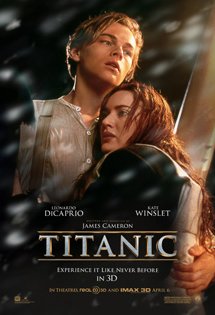
Titanic Revisited


Image source

As a movie fan, film reviewer and general cinema snob I often get asked what my favorite movie is.  I answer the same way every time – “Do you want my film geek answer or my real answer?”  The film geek answer is On the Waterfront and my real answer is Titanic.   This is generally met with smirks and nods of agreement that Titanic, while yes a huge blockbuster hit and created a generation of Leonardo DiCaprio fans, it couldn’t be taken seriously as a real piece of cinematic art.  Well, why not?  With the rerelease of the film on April 4th in 3D for the 100th anniversary of the tragedy I thought I’d take a stab at writing a meaningful review of the cultural relevance of the film and try to understand just why it was such a humongous phenomenon.  

I’m generally not a huge believer in “star theory” as being the main reason people go to the theater, it definitely has validity and especially when it came to Titanic Leo was the star responsible for most of the tickets being sold.  Up until that point his stardom was on a steady incline.  With notable performances in What’s Eating Gilbert Grape, The Basketball Diaries, and Romeo +Juliette among others, DiCaprio was establishing himself as an actor both with a pretty face and with major acting chops who wasn’t afraid to take on important and risky roles.  However, oddly enough, his acting was among some of the harshest critiques of the film.  Of course I, as a 15-year-old girl wholly and totally obsessed with him, shuddered at the thought of Leo being less than perfect and scoffed at the criticism.   He was a big part of what drew me to the theater 5 times (yes, you read that correctly), and I’m not ashamed to say it.   

Another interesting change this movie brought to the landscape was that it highlighted the buying power of not just women, but teenage girls as well.  Teenage girls came to the theaters in droves.  At the time Titanic was the most expensive movie ever made, it also made the most money in the history of the movies.  Anecdotally I can report that it was not boys driving the dollar amounts sky high for Titanic, rather it was young girls going in packs and going again and again.  I wanted to BE Kate Winslet in those days.  I wanted her wardrobe, her looks and, of course, just like her, I wanted Leo.  Leo was a teenage phenomenon in the 1990s and no doubt brought a huge legion of fans into the theaters fantasizing about what it would be like to be Rose and have Leo stare at you dreamily with those big blue eyes.  These days movies like Sex and the City and Bridesmaids have made headlines being touted as proof that women have marketplace influence, but its movies like Titanic which also appeal to teenagers with a lesser sense of fiscal responsibility prove there is another demographic that are willing to pour more and more money into the movie.
Image source

At the time of its release Titanic was a spectacle film that broke out from the clutter of other films.  It was huge, epic, a sight for the eyes!  It didn’t rely on a 3D gimmick or the promise of impressive CGI special effects to get audiences.  Today it seems that all major studio films are just that.  In the media landscape today where there are so many platforms vying for attention from the coveted audiences more movies have to make more noise than they used to.  Titanic, for the most part, relied on actual props and backgrounds – while there was definitely an element of computer enhancement, Director James Cameron wanted as much to be authentic as possible and he actually built a scale model of the ship to accomplish that.  Something that today would be unheard of.  Why make what you can digitally fabricate?  As Janet Maslin wrote in her review of the film for the NY Times on December 19, 1997: “Memos, include Cameron's having persuaded the original carpet manufacturer to make an 18,000-square-foot reproduction of its "Titanic" weave and his having insisted that every sign, uniform and logo for the Southampton sailing sequence also be created in mirror image, so that the camera could reverse the apparent direction of the nearly life-size model ship.  Sets match old photographs right down to the sculpture and woodwork; costumes incorporate fragments of vintage clothing; even the silver White Star Line ashtrays had to be right.”  The movie wasn’t without its faults, of course.  I mean, the list of goofs on the IMDB page is about as long as I’ve ever seen for a movie, but given the scope of the film it’s not particularly surprising that he missed as much as he got right.  But as a viewer it is exciting getting a glimpse into a bygone world.   

That nostalgia for the pomp and circumstance of the past is just as alive today as it was then, and while impossible to attach a cause and effect relationship, it seems likely that Cameron’s movie sparked an interest in that bygone era with legacies including Downton Abbey (whose pilot opens with the news of the Titanic sinking, not to mention the much of the plot is precipitated by effects of the disaster).  While it’s easy to bemoan the way people lived back then, with the class warfare, seemingly unnecessary strict adherence to frivolous ceremony and unmitigated proscribed gender roles, there is clearly an interest in exploring those rituals and Titanic let us peer into that world on a grand scale.  Today we live in a world completely foreign to that one so there is a romanticism placed on these formalities, which in those days, I’m sure, was despised by many, especially the youths.  

Additionally, what was no doubt one of the biggest draws of the film is the timeless love story.  It’s Romeo and Juliette retold on a boat with beautiful actors in beautiful clothing.  Cameron knew that no matter what sets, costumes, technology or even stars you have at your disposal, if the story isn’t up to par the audiences won’t show up.  In Titanic we have star crossed lovers from opposite ends of the social spectrum who fall in love and insist on being together despite all external forces pulling them apart.  Rose DeWitt Bukater (Kate Winslet) is the 17-year-old daughter of a struggling socialite widow who has been betrothed to a much older man to secure her mother’s financial future.  She is unhappy with her lot and one night, when she had had enough, almost throws herself off the back of the ship.  Jack Dawson (Leonardo DiCaprio) spots her and talks her out of ending her life.  At this point the pair begins their fated love affair.  Just as the ship has so much promise, so does their love, yet as audiences know even before they walk into the theater, they are doomed for disaster.  The way the story was structured gave another dimensionality to the story – the ship became another character.  Just as much as you want the characters to be able to survive, even though you know what happens, you want that boat to make it as well. 
Image source
Maslin also astutely notes that “Beyond its romance, "Titanic" offers an indelibly wrenching story of blind arrogance and its terrible consequences.”  The story is about what people considered to be an unsinkable ship.  They didn’t even bother putting on enough life boats, lest the sight of them hinder the beauty of the luxury liner.  This hubris has caused the downfall of men since the dawn of time until today.  Wasn’t much of the banking crisis caused when the seemingly “unpopable” bubble, popped? This story is so universal and so relatable that it’s no wonder it struck a chord with so many.  I believe that these two themes, romance and hubris, are what make Titanic so timeless and so universal.  These are issues which people face no matter what their circumstances and what era in which they live.

Finally, one last word about the music.  The theme song, sung by Celine Dion, no doubt became a phenomenon of itself.  It went on to become an Oscar winning song, played over and over again on the radio, in malls, elevators, weddings, etc, etc, etc.  But what I want to mention now is the overall score of the film, which was also an Oscar winner.  The score imbedded into the film that hearing just a few notes elicits the same emotional response that the visuals do.  It’s nearly impossible to hear the music without thinking of the narrative of the film, and that’s what makes for a great score.  It doesn’t live independently from the rest of the movie and it greatly enhanced all the elements within the narrative that so many years later it remains an iconic and essential element of the film.  

Obviously the film isn’t perfect, and over the last 15 years it hasn’t been immune to scrutiny – why didn’t Rose just stay on the life boat?  Why didn’t they switch off on the raft?  They both could have lived!  Why did Old Rose throw the diamond to the bottom of the ocean?!  And so on.  I’m not denying those frustrating questions, and I’m not claiming it’s the perfect film.  But there are obvious reasons as to why and how this film went on to make close to 2 billion dollars internationally and hopefully this essay had been able to shed some light onto that.