Academic Writing

Wednesday, April 13, 2011

Royal Wedding 2011

Image from StudioBriefing.net
Do We Care? Why or Why Not?

The Daily Beast published an article today by John Avalon entitled, “William and Kate's Royal Wedding: Enough Already!” in which the author goes details his, and many Americans’, frustration with the media hype and coverage over Price William and Kate Middleton’s upcoming nuptials.  Namely, he poses the question, “Who Cares?”  He asks, why should we as Americans, who fought a war to break from the aristocracy of England care about or pay any attention to such pomp and circumstance?  And if people do care about such frivolity, he posits, that they should perhaps move to England, as he says “And for those who fetishize the remaining whiff of aristocracy—well, there’s a continent for that. It’s called Europe.”

While I do agree with Avalon to a certain extent that the media coverage has been at time excessive, I find his reasoning to be simplistic and based on his own biases.  I should also fully disclose that I too have my own biases, being totally and utterly fascinated and charmed by the Royal family.  There was even a moment (ok, definitely longer than a moment, ask any of my high school friends) that I was beyond convinced that Prince William was the love of my life and one day I’d become his princess.   Those days have surely passed, but the vestiges of that allure remain deeply ingrained in me. 

I will say, however, that Avalon’s assertion that we as Americans made a decision to be non-UKers and therefore should not be intrigued or interested in the Royal Wedding is rather simplistic.  If that were indeed the case, Hollywood would not exist as it does today.  We would not have turned the Kennedys into our own version of royalty. I think it’s in fact just the opposite.  Americans crave pomp and circumstance from our own version of royalty.  Take Hollywood for example, as they are the closest we have to royalty.  We gape at the jewels and gowns the starlets adorn themselves with.  We are fascinated by their trysts and romantic drama.  If we as Americans really rejected the notion of royalty then Hollywood wouldn’t be the staple in our society that it is.

He quotes a CBS/Vanity Fair poll which found that 65% of Americans have “no interest” in the wedding.  That might be true, but his assumed reasoning is just that: assumed.  Maybe it’s the almost constant onslaught of information being fed to us that can be quite fatiguing.  There could be a whole host of reasons why that poll number is so high.  I’d also argue that if that was indeed the case and people were not interested in the coverage then there would not be as much.  Ratings rule the airwaves decisions and if people weren’t drawn to it news directors and network executives would pull the coverage pretty quickly.   Avalon further argues that the coverage is taking up valuable time and space that could otherwise be used to cover real news stories like murders on the Ivory Coast or in The Sudan.  He’d be right, if the American media covered that at all.  Those atrocities were occurring well before there was ever an engagement and the coverage was lacking and sparse. 

Ultimately whether people care for the wedding and its accompanying coverage is up for debate, but I do think to say that we don’t care because in 1776 we fought a war to be free of the King’s rule is probably a bit over simplistic and perhaps an overstatement of our nature as a society.

Tuesday, April 12, 2011

Jell-O's ChocoBeast

True Temptation or Advertising Faux Pas?


I don’t know if you’ve seen the new commercial for Jell-O Temptations, but I cringe every time it comes on TV and I definitely have  what to say about it.  Here’s the spot for your reference:


In the commercial, a mother is sitting in a tent with her kids telling her kids a ghost story about the “ChocoBeast,” a half-man, half-monster “who will stop at nothing to sink his fangs into people who steal other people’s chocolate temptation.”   Then the “monster” appears screaming outside the tent and the kids are sent into a panic and throw the Chocolate Temptations back towards their mom.   In the next scene the parents are sitting on the porch together, dad is eating a Chocolate Temptations Jell-O and the mom says, “Good job, ChocoBeast.” 

Advertising has a long and storied history of not only reflecting our culture but also shaping it.  The idea of cognitive discontent and advertising has taught us as consumers that there are things we’re lacking or things we should be self conscious of and the only way to remedy those short comings is to consume the products needed.  For instance, not until whitening toothpastes came on the market did we know our teeth weren’t white enough.  But now that there’s a product for it, we are sure to feel bad about ourselves until we fix it!

This commercial poses a different issue, the message it’s sending is very different from others in this genre.  First of all, think back to the Jell-O marketing of about a decade or 2 ago when the friendly, child-loving Bill Cosby was the face and voice of the brand.  This once kid-friendly product used to cater towards children’s needs (or, let’s be honest, interest in sugary, wiggly snacks) and now they’re shifting their strategy to focus on the parents and their interest in indulgence.  Furthermore, and probably the more problematic one, is that this shift also reflects (or perhaps is helping to shape) and change in parenting models.  These parents are not only putting their needs before the kids’ needs, but are actually frightening them to do so.  What parent would choose to legitimately scare their child to get what they want?  

At the risk of sounding like I’m finger-wagging (ok, maybe I am) but in an age where child on child bullying is such a hot topic in the public forum, how can this message be tolerated?  Parents are supposed to be the protectors of their children, not the perpetrators of their pain.  The parents in this ad are clearly emotionally abusing their kids, and for what? A 4 oz tub of what is probably a pretty crappy snack?  

Thoughts?

Monday, April 04, 2011

The Kennedys

Image from IMDB.com
Did the Kennedy Curse strike again? 

So last night ReelzChannel premiered the much hyped, much talked about miniseries, The Kennedys.  Originally created for The History Channel, it was picked up by Reelz after History decided it wasn’t right for their airwaves.  After watching the first episode, I came to realize just why History decided it was “off brand.”  My guess is because it’s not very good and it was boring as hell.  I am generally fascinated by the Kennedy clan.  I've spent hours at the JFK Library in Boston, watched narrative films, documentaries, read books, studied JFK’s presidency from an academic standpoint in a number of courses in college.  I am generally a huge sucker for Camelot and the mystique that surrounds it.  That’s why I was so excited to watch The Kennedys and then so disappointed when I found it beyond boring. 

The pacing was so slow, after an hour of watching I thought I must be near the end of the first night, only to look at the clock and see it was only halfway through.  Furthermore, the nonlinear narrative structure seemed uneven and forced.  This type of editing should be used to educate the audience and divulge information in a specific way, but given that this is a historical account of a story many people already know, there was no need for this kind of narrative structure, and it greatly detracted from the storytelling. 

I will say, however, that the casting was near perfect (although I’d contest the Tom Wilkinson casting as Joe Kennedy Sr.).  I was very much impressed by how much Greg Kinnear fell into his role and fully embodied JFK.  Even Katie Holmes, who I am generally not enamored with, held her own with only a few uneven missteps – but she had a very small role in this premiere episode, so we have yet to see how she will handle the more meaty parts.  Finally, most films have a really difficult time recreating the Kennedy accent, but I will admit that overall the actors stayed true to the authentic Kennedy accent.

I will continue watching because, as I said, I devour most things Kennedy, and I hope it gets better, but I’m not very optimistic about it. 

Monday, March 28, 2011

Charlie Sheen is “Losing” but what does that say about us?

This afternoon, Deadline Hollywood reported that Charlie Sheen’s “planned "Violent Torpedo Of Truth" tour, featuring a 21-venue live show, still has plenty of tickets available and are by no means sold out as previously claimed. The show itself is supposed to be a 70-minute rant by Sheen aided by the audience, multimedia and a few of Sheen's ‘goddesses.’” My initial reaction was one of pride, impressed with the American public for realizing that Sheen is an incredibly ill individual who should be hospitalized rater than celebrated for his recent behavior.  Good for us for recognizing his need for help and we will not pay him any more heed until he gets better.

However, as I thought about it a bit more we probably don’t actually deserve this pat on the back for our good will.  His decline in popularity probably means something else entirely.  First, I think that that the initial shock of his actions have worn off and since he hasn’t done anything particularly crazy the American public have moved on.  He hasn’t held anyone hostage recently, gone on an insane media rampage, or coined any new ridiculous terms lately (bi-winning, anyone?)  It’s actually a sad state of affairs that in our heightened media landscape someone has to be constantly one-upping himself in crazy antics to retain the attention of the media. 

The second thing I began to think about relates to the first, it’s an idea I started to formulate a few weeks ago, and have named it “Media A.D.D.”  It refers to the fact that the media – and by that I primarily mean cable news and network news, but even print news is not innocent – is completely unable to multitask its story-telling.  An example of this is last Wednesday, when I woke up to a CNN email alert that Elizabeth Taylor had died.  This news, while albeit a big event and the loss of a talented actress considered by most to be Hollywood royalty, completely and utterly overshadowed the rest of the day’s news.  Another big event that day was a bus bombing in Jerusalem.  This bombing, the first one of its type in a half a decade, and one which killed one woman and injured 30 others, not to mention the implications it has for peace in that region should be something people are concerned about.  Even those with no ties directly to Israel, should have an appreciation for what an act like this means, especially as the rest of the Middle East seams to be imploding at the moment.  

It’s become painfully obvious that media coverage these days has actually nothing to do with getting audiences the information they need to be an informed citizen.  Rather, it has become a sensationalistic medium, barraging viewers with images that will grab their attention.  Stories will often run for hours without offering new information, or even images, even.  We’re sucked into what they have to offer, like children or puppies, totally mesmerized by nothing more than shiny objects.  With the only thing distracting us is a new shiny object, no more substantial, but just something to look at.
                    
Our collective “over-it-ness” with Charlie Sheen unfortunately has nothing to do with our disinterest in exploiting someone who should be receiving medical attention.  Rather, the sparkle from this particular “sheen” has simply worn off as we’re drawn to the next shiny object. 

Monday, March 21, 2011

Titular Moments

It's the moment I wait for in almost every movie, especially those with cryptic or non-obvious titles.  It's the titular line of the film.  The part of the screenplay where a character says the title outright.  This clip below is compilation of 81 titular lines from classic and not so classic movies.  Some of the meanings of the titles are more obvious than others, but, for me at least, I always feel like it's a very insider moment, when the director, screenwriter, or actors are sharing something with me.

How many of the movies below in the clip have you seen??
Enjoy!!

Friday, March 18, 2011

Jimmy Does Dylan

Jimmy Fallon, the newest pop-culture hero, takes on multiple generations in this amazing video.  LOVE LOVE LOVE

Thursday, March 17, 2011

Art of the Title

Every movie and TV show has it: a title, or opening, sequence.  This video, put together by Art of the Title for SXSW this year, is a montage of the history of cinematic (and eventually TV) opening titles.  The opening to a film has long been a site of artistic potential, and a spot which often allows the director to set the tone for the entire film.  Psycho’s opening title is broken and disjointed; Juno’s is free-spirited and whimsical.  Despite it’s prevalence, in the world of cinematic criticism and has traditionally been overlooked as a place where meaning can be drawn.  This montage, putting so many iconic opening sequences together, shows that in-fact it’s an important part of the film. 

Furthermore, the presence of television opening sequences is interesting in this montage.  TV openings have always been a big part of the show (just think about how All in the Family or Friends’ openers became so iconic of their eras).  However with the advent of DVR, for many TV shows, there has been a move from extended opening sequences.  Shows today often try to grab the viewers’ attention quickly by giving them the information they need while also not really giving them enough time to fast forward through them.  Interestingly, the television opening titles that are highlighted here are a mainly from shows which air on premium cable and therefore DVR fast forwarding is relatively a non-issue (Six Feet Under, Dexter).  They are also of high artistic value.  Take Dexter for instance.  The show runners decided to use the opening sequence to introduce audiences to Dexter’s character and the dark side of his personality by showing him during his morning routine, doing things anyone else might do.  The direction of the opening however, alerts the audience to a much darker side of him. 

This montage is a fun and interesting way to honor and respect this rich aspect of our film history.  Enjoy! 

A Brief History of Title Design from Ian Albinson on Vimeo.

Friday, March 11, 2011

Glee

Image from TVSquad.com
We Like You Just The Way You Are
3/11/11


I am proud to admit that I was a full blown Gleek from the first episode back in the Spring of 2009.  I was drawn to the music, the characters, and the general camp that the show brought to television landscape.  High School shows are nothing new, but this narrative has been offering something different from the rest of them.  Glee is able to tell the stories of kids today, and all the issues they face, in a relatively realistic fashion (minus the whole breaking out into choreographed song and dance) while also being mainstream.  Historically, High School-based shows have not managed to be both commercially successful and positive messaging.  Consider the shows I grew up on that took place in high school like Saved by the Bell, where the very special episode was where Jesse was addicted to caffeine pills.  That show achieved huge commercial success, spawned multiple iterations from middle school to high school versions and eventually to the college years, and it still has legs today through reruns and a general presence in the zeitgeist.  Existing on the other end of the spectrum are shows like Freaks and Geeks and My So Called Life, which had decent cult followings but only existed for one or two seasons.  While they haven’t completely fallen off the pop cultural radar, are definitely not as pervasive as the more commercially successful shows.

Maybe it’s through its use of music, its realistic, relatable and ultimately positive characters, or true to life stories that Glee has emerged as a pop-culture phenomenon.  Whatever it is, audiences are drawn to Glee more than just Tuesday nights at nine.  In two short seasons it’s become an awards darling, spawned a concert series, 5 albums so far, and even a whole line of make-up and nail polish at Sephora.  People can’t get enough of this show about underdogs who stand up for themselves and create a world where they have value and aren’t picked on just because the greater society doesn’t have a place for them to neatly fit into.

The show offers a chance for underdog to have a voice.  It tells the stories that are relevant to today’s youth, and frankly, pretty much everyone.  But while watching this week’s show I started getting annoyed.  Now I know I shouldn’t let ultimately petty things get to me, but I couldn’t help it.  What was this offensive behavior you ask?  Well, 2 things.  First, I would just like to say, will Gwyneth Paltrow please go away.  We know you act, and now apparently you sing, but really a show about outsiders and underdogs is really not a place that you fit in.  And, if we’re being completely honest, you’re singing isn’t all that great to warrant a return to the show with three solo acts.  I get it that the version of Forget You that you sang with Cee Lo Green apparently gave you license to appear on the Grammys, record the song, and now get a music contract, but really, go away.  You should know that this musical moment you’re having is just our overhyped pop culture and marketing culture trying to squeeze any last dime out of you it can.  Ironically, Glee is about the outcasts trying to fit in with the cool kids and Gweny’s appearance made her seem like the cool kid trying to be nerdy to fit in with the cool crowd cuz she’s already alienated everyone else.  Over. It.

The second part of this commentary is a sort of open letter to Glee.  Consider this me, begging and a pleading with you to not jump the shark.  Glee, you have managed to provide just the right amount of camp, never going too far overboard (even when you did the Rocky Horror Picture Show, the movie that just about defined camp, you kept it on the level).  However, I fear that you feel like you need to keep pushing the envelope to see how far you can take the show.  Just like the kids on the show, you are great just the way you are.  Don’t feel like you need to attract big celebrity names to make the show better, you don’t.  And, for the record, I am not putting John Stamos in that category, he’s awesome.  Another suggestion, please don’t start going too nutty with the musical numbers (this week’s spontaneous foam dance got too close for comfort on that one).  We can get on board when the characters break into song, and even when they seem to instantly change costumes mid-performance.  Just don’t make things too crazy or you will alienate your viewers.

What’s reassuring is that Glee still does have all the heart and soul it always did – like the exchange Kurt and his dad had about sex and Santana’s honesty with herself and then with Brittany.  Glee manages to be both mainstream and subversive at the same time.  Challenging social taboos and bringing to light cultural issues that are relevant today is something Glee has always done, and always done well, and I just hope it stays the course.

Sunday, March 06, 2011

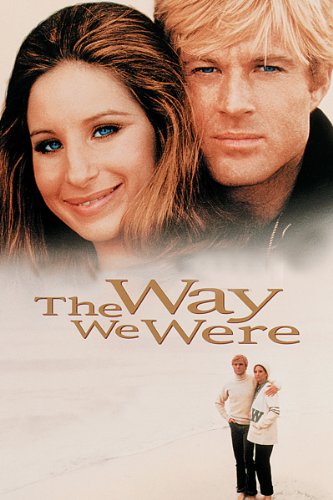
The Way We Were

Image from Amazon.com
Are We Still this Way?
3/6/11

Ask any female of a certain baby boomer age and she’s likely to tell you that The Way We Were was the ultimate chick flick of its era. Barbara Streisand and Robert Redford are gorgeous in this film, so if nothing else, just watching them is a joy. I’m also impressed by how well the story holds up. It’s a love story through the decades, beginning when the couple meets in college when Katie (Streisand) is a brainy anti-fascist student activist and Hubble (Redford) is a popular jock. Katie has fallen hard for Hubble, not even because of his striking good looks, but because of his intellectual acumen. Nothing really comes of their relationship until the two meet again about 5 years later when she’s working in Manhattan and he’s a sailor on leave.

Now, the year is around 1942 and I wonder how probable it was to have a 20-something single woman living in a one bedroom apartment holding down three or so jobs. This movie came out in 1973, during the height of the women’s lib era and it’s hard to tell if that’s a retrospective assertion on what should have been likely, or if it could actually have been the case. I was probably more distracted by that question than I should have, but nonetheless, that’s where the story went.

It is at this point when their relationship comes to fruition. However, it is not without its problems. Katie continues to be outspoken on almost every issue, causing tensions with Hubble’s friends. Eventually he has enough of it and ends things with Katie. They ultimately reconcile under the conditions that she will learn to let things go and won’t turn everything into a fight. Despite the conditions, Katie and Hubble form a contentious but passionate relationship which ultimately leads to marriage and a move out west to Hollywood where Hubble can pursue his interest in being a Hollywood screenwriter. During a protest at the trial for the “Hollywood 10” Katie can’t keep her true self contained anymore and releases her rage on the situation and the injustices being served. Hubble, a screenwriter at this point and has some obvious ulterior motives of not wanting to draw too much attention to himself during this contentious era, does not agree with Katie on this particular topic. They come to realize that despite their passion for one another they cannot get past the fundamental difference that she is a pot-stirrer while he is a status quo kinda guy. The pair splits and Katie returns to New York to resume her activist life where she left it.

I found this story to be so sad because even though they loved each other and had so much passion for one another, they were not good for each other. Hubble wanted to have the quiet WASPy wife who wouldn’t shake things up too much and just go with the things as they were. He is the go with the flow guy without and while he’s very smart, no particularly strong passions other than the desire please people. There is no real reason that these two should have been drawn to one another. It’s made clear that Katie has a strong physical attraction to him, but other than that and she is impressed by how bright he is, but often looses patience with him for not insisting on following any sort of passion for his talent. He is initially impressed with her passion for ensuring justice is served, but eventually that fades into a frustration for her insisting to make an issue out of everything. Eventually, these two really had no business being together other than the fact that they simply loved one another, and once they realized it was no longer working, they ended the relationship. It just goes to show that love can only last so long without any other commonalities.

What I also found interesting on a cultural level is that there was a lot of mention of the fact that Katie was Jewish and Hubble was “Goyish.” Katie, in many regards, is a stereotypical image of a Jewish person as intellectual, outspoken and opinionated. It was because of these character traits that she and Hubble had so much turmoil in their relationship. By the end of the film, when the pair is no longer together, we find that Katie has remarried a “David X. Cohen,” obviously a Jew, and has found what seems like will be a lasting happy marriage. It seems as though the only person who could not only tolerate her opinionated and outspoken nature, but can match it as well is another Jewish person; as if this is a Jewish-specific character trait. Ironic that a love story about two people from very different backgrounds that sets off to send a message about assimilation ends up reaffirming the reasons not to.

Truly a product of its time, the message of this movie is also not for a woman to learn her place and quiet down to get a man. She can be as strong as she wants to be, and it is the man who needs to learn to be with her. If he is unable to be with her, she will move on and not relinquish her passions to be with her supposed dream-guy. At the end of the film Katie and Hubble run into each other one last time. This is when we learn that Katie has remarried and we briefly meet Hubble’s new “girl.” Nameless to the audience, this new girl does not speak one word, but clings closely to him when she observes the passion in his eyes upon seeing Katie once more. Katie’s like a drug for him: he knows she’s bad for him, but he’s drawn to her nonetheless. That spark will always be there, which makes the ending even more tragic. They never fell out of love, they just couldn’t survive it.

The movie definitely holds up today, almost 40 years after first coming out: as long as opposites attract this story will resonate with audiences.

Saturday, March 05, 2011

The Fighter

Image from IMDB.com
Fighting for His Life
3/5/11


Boxing movies is nothing new to the cinematic landscape. It’s also not new to awards bait. From Rocky to Million Dollar Baby and now The Fighter. What is it about this genre that is so appealing to people? For the most part these movies rely on a very similar plot structure – protagonist is generally from a poor neighborhood with a somewhat unsavory home life who finds boxing as a way to overcome their less than favorable upbringings. They literally have to fight their ways out of their situations to claim a valuable spot in society. At its soul its essentially retellings of the American Dream story. The Fighter fits nicely into this mold and what’s most interesting is that these stories, no matter how repetitive they seem to be, continue to capture the fascination and interest of American audiences. Further, with each iteration, there seems to be added messages in each new film that emerges.

The movie is about half-brothers Dick Ecklund (Christian Bale) and Micky Ward (Mark Whalberg), two boxers, Dicky the has-been and Micky the rising star. They are 2 working class guys from a large Irish family in the Boston suburb of Lowell, Mass. That’s what it’s about in the simplest sense, but what gives this movie a little more is all the extras director David O. Russell put into it. So much more than just a simple plot driven story about 2 poor kids overcoming their upbringing, The Fighter is about a family struggling to stay together in the face of many challenges.

The movie opens on Dicky dragging his brother through the streets of Lowell while he preens and brags about the HBO film that he says is being made about him and his comeback. He’s training Micky to be a great fighter, but as far as Dicky is concerned, however great of a fighter Micky becomes it will all be because of him. Micky looks up to his older brother and does not have the heart to leave him for another trainer and on some level truly believes that his brother will make him a great fighter. Micky passively goes through life allowing his brother and his mother (Melissa Leo) to dictate his every move. Mother Alice, always surrounded by her cadre of her seven spinster (and ugly as hell) daughters, is not only the matriarch of this family, but uncontested top dog. She is her sons’ manager and bookie and has a death-tight grip on her youngest son and he doesn’t have the strength to combat her. It’s not until Micky meets Charlene (Amy Adams), a rough talking a no bullshit taking bartender, that he has someone who actually is interested in helping him stand up for his own needs.

There are a few elements of this film that really stood out to me. First of all, the roles the women have in this story are profound. The two leading women in this film were both nominated for Oscars, and rightly so. Melissa Leo as the fiercely aggressive mother who will stop at nothing to get her sons where she wants them to be is an interesting portraits of a mother’s love. Her character forces us to ask how far is too far? And at what point do the lines blur between wanting the best for your child and wanting the best for yourself? Her sons were her meal ticket out of the poor existence she has been living for what seems like her entire life. Her rule over her sons is challenged when Charlene comes into the picture. She’s equally as strong as Alice, and loves Micky very much but in very different ways. She sees Micky for what he is – and that’s not just a tool of his mother’s control. She wants him to be great to fulfill his potential, not so he can be a meal ticket out of Lowell for his family.

As mentioned at the top of this review, The Fighter is the ultimate in the reaffirmation of the American Dream. The Ward family is poor, working class, at the bottom of the social barrel living in a poor, but proud, town. I’m always fascinated with movies that take place in Boston because rarely is the geographical setting merely by happenstance. What I mean by this is whether the movie takes place in Southie, Cambridge, Charlestown or Lowell, the city in which the characters inhabit is almost always another character in the film, or at the very least, a central part of the plot. While it’s a reality that Ward family is from Lowell, it acts as an interesting narrative point as well. Lowell, Mass is famous for being the birthplace of the industrial revolution. It was a mill town that made a lot of people very rich. The only people who did not get rich were the actual residents of Lowell, the ones doing the hard labor. And in an almost ironic twist of history, it’s become the town that got left behind. Dicky, in many ways, is the anthropomorphic embodiment of his hometown. He started his career with so much promise, and had one great success, but eventually hit rock bottom and couldn’t pull himself out of it.

The resolution for the character could only come with redemption. For Dicky, it is only once he saw he landed in jail and was forced to get sober did he realize just the depths of his addiction and how it had hurt so many people he loved. Micky needed to break free from his mother’s grip and his brother’s delusions of grandeur to be able to reach his true potential. In the surest sense, this is the promise of the American Dream, the ability to break free from your proscribed place in society to reach unimagined heights. It’s a message that we as a society have been telling ourselves and striving to attain for centuries. It seems that in 2011it is still as strong as ever as Hollywood, our “dream factory,” continues to perpetuate.

Thursday, March 03, 2011

American Idiot

Are we all American idiots?
3/2/11
Image from AmericanIdiotonBroadway.com

I know this is a film blog, but I just got home from seeing American Idiot on Broadway, and I felt compelled to write about it. So many of the themes resonate with American pop-culture, both in theater and in film. I hope you like it.

American Idiot comes to us from the Green Day album by the same name. It opens with the titular song and an array of young people singing about how the media controls peoples actions and those people in turn blindly follow the lead of the media. Lyrics such as “I'm not a part of a redneck agenda. Now everybody do the propaganda. And sing along to the age of paranoia… Don't want to be an American idiot.  One nation controlled by the media. Information age of hysteria…” open the musical as both a call to action and a refusal to succumb to the mass media and society’s expectations.

The plot develops around three young men who, all feeling the need to escape, do so in ways that make the most sense to them. Billy finds out his girlfriend is pregnant and takes the responsible route and stays at home with her. Tunny joins the army and Johnny turns to hard drugs. Despite their varied approaches to finding meaning in life, none seem to succeed. All Billy does at home is drink and get high, Tunny gets his leg blown off, and Johnny escapes into a black hole of drug, being egged on by his new “friend” St. Jimmy. These three men all go their own ways to create a meaningful world for themselves, yet none end up happy.

I found this play to be very interesting on a number of levels. First, I find the parallels between it and Hair quite similar. Both tell the stories of disaffected youth rebelling against their families and the government. It’s interesting that in the 40 decades that separate these two musicals, they both ended up on Broadway at the same time (Hair in a revival and American Idiot in its debut). It’s also interesting to see that while there are definite differences, so many of their themes are strikingly similar. Have we really not evolved that much as a society that the young people are still hating it? Or is it just something that “the youth” will always feel? Starting in the 1950s youth rebellion emerged into the public sphere when James Dean yelled at his parents, “You’re tearing me apart!” in 1955’s Rebel without a Cause. Have we as a society spent the last half a century continuing to do just that to the youth in this country?

If the three main characters represent the three paths available in life, the play presents a rather futile existence to audiences. Even when Johnny is able to break away from his drug habit and take on a “responsible” job he feels more trapped and doomed for death than he did when he was lying on the floor drugged out of his mind. And what about Johnny? He did what he thought was the responsible thing and stayed home to be the dad to his child, but he found himself resenting his girlfriend and their situation. When she finally leaves him he laments “Nobody likes you/Everyone left you/They're all out without you/Having fun.” The grass is always greener. Little does he know that his two best friends are equally as miserable as he is.

One striking similarity between American Idiot and Hair is the relationship both the plot and the characters have to the war. Both works emerged during a time when American was fighting an unpopular war, however the main difference is that in the 1960s the young people were being drafted and forced to fight in a war they saw as unjust while in today’s war there is no draft and soldiers are going off to fight for a whole plethora of reasons which I am not about to assume to understand. That difference, however, is striking. In American Idiot, Tunny goes off to fight in today’s war to find a meaning and to bring respect for his life. He returns from the war, albeit physically damaged, but with that sense of meaning. Because of the conscious decision he has made to fight for his country, he returns a man, while scarred, someone who has found love and self respect, and appreciation for his friends. Clyde, however, in Hair does not return from Vietnam. The country and the government who forced him to fight has killed him and left no sense of optimism for his or the any of the futures of the nation’s youth.

Another interesting parallel is the relationships the youths have with their parents. Parents and adults are largely absent from both shows, yet they are alluded to. In Hair there is a complete disconnect between the parents and the children. When in relation to one another the two parties are simply referred to as 1948 and 1968, underlying the difference is based on their generations. Something interesting to note in American Idiot, is that parents are physically absent from the play entirely. They are merely mentioned as Johnny talks about his mother and father. The relationship he has with his parents differs from his mother to his father. When escaping the life he hates he brags about how he stole the money from his mother, only to amend the statement to say that she in fact gave it to him. His mother loves him and he so much wants to hate her, but he cannot. His father on the other hand is the bigger source of strain. This is not uncommon as sons have traditionally looked to their fathers for guidance and role models. Again, starting with James Dean, fathers in popular culture got the bad rap as sons couldn’t look at their fathers for guidance as they saw them solely as hypocrites and tools of society.

What Johnny learns that James Dean’s character never did is that being a so-called tool of society is a necessary evil. It’s not something that fathers like to do, but it’s something they had to do to provide for their families. The whole idea of growing up and having actual responsibilities isn’t romantic or sexy, but it’s reality. It’s how the world functions and the other alternatives, as shown by the main characters, are not always a better choice either.

So what’s the message? It’s pretty dire to think that the whole idea of the play comes down to the fact that we actually all are American idiots. We will live the nuclear lifestyle that keeps the world turning. However, to keep from being the idiot Green Day warns of, we can go through our lives, but keep an eye out for being “controlled by the media” and refusing to be a part of the “redneck agenda.” As enlightened and educated members of society it is our responsibility to refuse to get sucked into the insanity that surrounds us every day in so many ways. We must learn to filter out all of the idiocy around us and lead lives that are meaningful to us, and not just get sucked into, as the song goes, “Information age of hysteria. [That’s] calling out to idiot America.”


Addendum:


There has been some feedback from people that they aren’t clear on whether I enjoyed the show or not, so I wanted to add to my posting that yes, I did greatly enjoy the show.  From a technical standpoint, thought that the staging was interesting.  Central to it, the use of new media as a central piece of the set design was particularly interesting and added another layer of meaning to the whole notion of what it means to be an “American Idiot.”  The images were built into and projected onto the backdrop, making the media an inescapable part of both the audience’s experience as well as the characters’ lives.

To echo Shaina’s comment below, a big part of my enjoyment comes from the fact that I happen to really like Green Day’s music.  That obviously helped tremendously.  I already thought the music to be moving and powerful as a standalone album and seeing it woven together in a cohesive storyline was powerful.  While I’ll admit to being a bit unclear about what was going on for some of the show, especially as the plot was getting underway, overall the story held together nicely.  The characters were compelling and relatable.  Furthermore, one character, St. Jimmy, was particularly interesting.  Played by AFI’s Davey Havok, who just replaced Green Day front man, Billy Joe Armstrong in the role, he represents Johnny’s id, his urges to fulfill any and all of his base desires, namely heroin.  It’s is St. Jimmy that precipitates Johnny’s descent into addiction, but without that fall Johnny also would not have realized the important lesson he came to learn by the end of the play.

Monday, February 28, 2011

Oscar Night: A Recap


So the 83rd Annual Academy Awards came to a close just a few minutes ago and I was generally pleased. It would have been nice to have some surprises, as all the nominees who were expected to win did. But that also meant that my statistics were really high this year (18 correct predictions out of 21 categories considered) so I was happy with that. The show moved along at a nice, fluid pace. The acceptance speeches were gracious and, for the most part, eloquent. Even the musical performances, which are usually the most boring part of it for me, were tolerable. The Oscars were really about “The Movies” this year and it respected the generations of film goers and filmmakers that preceded this one.

One speech stood out as particularly honest and telling of the true meaning and power film can have. When David Seidler won the Oscar for his work in writing the screenplay for The King’s Speech, he thanked the Academy for the award on behalf of all of the stutters and said, “We have a voice and we have been heard.” That film was about empowerment in the face of adversity and overcoming a great personal hardship and it is also an allegory for anyone struggling with something they don't think they can overcome. Film has a long history of enlightening viewers about issues that otherwise might go unnoticed – be it in the documentary or narrative traditions. Seidler’s speech was moving both because he spoke about both his own personal struggles and because it showed how the medium of film could have such a lasting and important effect on those who have similar struggles, be it stuttering or whatever else they need a voice for.

My one complaint about the show, and it’s a big one, was the insipid and vapid hosts. In an attempt to attract a younger television audience, the show’s producers hired Anne Hathaway and (already overexposed) James Franco to take on the roles as host. Let’s start with Franco. He could not have looked more bored and uninterested in his latest gig. Maybe it’s just his general affect, but between all of his other projects – PhD student, film acting, soap opera “performance art,” etcetera, etcetera – this just seemed to be at the very bottom of his list of what he wanted to be doing at that moment. His most enthusiastic moment was when a fellow NYU film school graduate won the Oscar for best short live action film and gave NYU a shout-out. When the cameras were back on Franco he yelled, “Yeah NYU!” I mean, yes it’s cool to show school pride and all, but really? Should that be the only thing that animates the host of the Academy Awards during the telecast? His lack of fervor for this gig came across as a certain form of snobbery and general "over it"ness. Further, while watching him tonight I couldn’t help but think he was laughing at all of us watching at home and buying into the hype of Hollywood, that he was better than and above it all.

Hathaway, on the other hand, was just the opposite. She spent the night as an over enthusiastic sycophantic “Woo-girl” (see: How I Met Your Mother). Her inability to contain whatever it was -- nerves, excitement – came off as unprofessional and just plain annoying. To be fair, she did have to have the enthusiasm of two hosts as clearly Franco had no interest of being there. She stood by his side and nudged him on to show signs of life, which must have been a huge pain for her to do. But she could have toned it down a little for the rest of the show. Hathaway nearly passed out on stage and was unable to contain her excitement when Kirk Douglas told her she was beautiful, and every time she or James announced another presenter she could be heard loudly “woo-ing” into the microphone. During the inevitable lulls was she so desperate for material that she felt she had to do the twist (in her own, admittedly personal moment) to show us that her dress had fringe? How about a shred of professionalism? When she introduced Billy Crystal I found myself saying out loud, “Please stay and take over the show from here.” But alas, my wish did not come true.

Despite the shortcomings of the hosts, I, as usual, enjoyed the show tremendously. From keeping score on my personal ballot, to the catharsis of the "In Memoriam" segment, from honoring the year’s best films to admiring or hating the fashion choices, Oscar night lived up to my expectations. Now, only 12 months till the next one!

Sunday, February 27, 2011

Some Pre-Oscar thoughts


So I’m sitting here watching ABC’s pre-Oscar show, something which honestly I don’t always do. And to be perfectly honest it’s making me very upset. I love Hollywood and all the glitz and glam that it’s famous for. I love to get excited for this show and get all wrapped up in the history, glamour and beauty of it and celebrate some of the best filmmaking. Perhaps I’m feeling a bit of nostalgia for a bygone era of Hollywood where the stars embraced their place popular culture.

So much has now changed and I’m not sure what to make of it. Natalie Portman just declared how while people at home wish they could be all glammed out and dressed up for a big night out while the actresses there actually wish they could be in sweats, without makeup and with messy hair. I mean please, how about a little bit of gratitude, Nat? She has gotten some of the best press and accolades for her body of work and to make that declaration makes her seem like such a spoiled brat. I agree that the hosts of these preshows often come across as vapid, shallow and awkward when interviewing these stars. But the stars should not stoop to those levels and pander to the ridiculous questions that they are asked.

Another new element introduced into the show, in an effort to be more “relevant” to the young viewers is link to facebook and twitter and allow fans to post their own questions to be asked to their favorite stars. All of these, to me, take away from the façade of glamour of Hollywood and the superstars that we watch. Let’s remember and embrace what Hollywood really means -- the Potemkin Village of glamour and beauty and untouchable stars who are shallow but love what they do and are happy to be the face of unruffled beauty who would never even consider admitting to relaxing in sweatpants. In our current culture of over exposure and information sharing, how about we leave some things to our imaginations – the illusion of Hollywood. After all, isn’t that what “the movies” are all about anyway?

Oscar Picks!!

Every year I take on the challenge of predicting the Oscars and every year I face the same conundrum. I have separate categories -- one for who I think will win, and who I think should win. I'll do my best this year to make accurate predictions and we'll see how I do. I've chosen, for the sake of time, to only list my predictions for the top 5 categories. I'll post my full list of results after the show!

Best Picture

First up, we have our Best Picture nominated movies. Every year I struggle with how I would vote for this movie. What makes a best picture? Is it the overall acting? Direction? Writing? Ultimately, I believe that for a film to win Best Picture it has to have a cohesive and smooth synergy of all filmmaking aspects, and in addition, there should be a grounding in cultural relevance. A film which wins the best picture has to have a message of sorts for the audience. Many of this years' films had messages and that's one reason why not only is it a hard race for the nominees, but also why I won't be disappointed if any of the nominated films walk away with the statue. I saw all of the nominated films this year except for 127 Hours, I just couldn't bring myself to see it -- the trailers alone made me anxious and woozy as it was, I didn't think going to see the movie would be a wise decision. They were all strong films, but one has stood out in my mind the most and one which I believe should take home Oscar tomorrow night.

If you listen to the clamor this year, it seems as though everyone thinks the race is between The King's Speech or The Social Network. I personally thought Black Swan was a more interesting film. Academy voters take a lot into consideration when deciding which film gets their vote. While no one's giving me an official ballot (yet!), I tend to gravitate towards the films that stay with me the longest. Film as an art form has the power to take a story and tell it in a way that is visually interesting and this film plays with the audience's sense of narrative structure and toys with any notion of what they might expect a film to be able to do. However, based on that approach, maybe Inception would also have a fighting chance. I did love Inception and was really taken by the complete distruction of any sense of linear narration. But, that being said, while visually spectacular, the film was not conveying a concrete message. But more importantly, it's not a so-called Oscar film. Blockbuster movies have not traditionally had a lot of luck at the Academy Awards, and those which have tended to be the last in a series (think: Lord of the Rings) and The Academy is congratulating the filmmakers on a series well done. Not to mention Christopher Nolan was not nominated for a directing award. I often find it odd to nominate a film as being the best of the year but not the person who put it all together, (and now with the 10 nominated films and 5 nominated directors there are bound be key directors left off the list, but that's a discussion for another day). Another movie which I would be happy to see walk away with the statue is The Kids are Alright. The acting, direction, writing and overall story and is spot on and I believe it was an important message to tell the world, especially in our current heated political climate when it comes to (most things, but especially) issues of Gay Rights, especially Gay Marriage. The Social Network has a decent chance of winning, but as a film in its entirety doesn't hold up as much as some of the others. The acting's ok, the writing was excellent and the editing was interesting, but on a whole I wasn't overly wowed, and, personally, was a little turned off by its assertion as the film that defines a generation. Maybe that's the fault of the marketers, but it turned me off of the film because of it.

Do I, though, think that either of my two top pics will actually take home the statue? Nope. I think that it will ultimately go to The King's Speech. Voters love British period films, and this is one about beloved leaders to boot. Another Oscar fave that this film embodies is triumph over adversity. Who cares that it's about a royal who has all the money in the world? He had to overcome a real personal struggle and had to rely on his family and friends to do so. Not to mention the film on a whole was excellent from the acting to the direction to the costuming. So that's my prediction of who should win (Black Swan) and who will win (The King's Speech).

Best Actor

My vote for both who should and who will win goes to Colin Firth. Jeff Bridges got his award last year more, my guess, for his long and illustrious career than his performance in Crazy Heart. He was good in True Grit, but nothing spectacular and not a performance that is unlike anything ever seen in a Western. Jesse Eisenberg is another actor who is getting a lot of attention this year for The Social Network, but if you've seen him off screen being interviewed, he seems like he was just playing himself. Firth created a character that at times could be dispicable yet sympathetic, noble yet humble and strong yet vulnerable. And he did all this while putting on a very believable stutter. My vote is for Firth to take home Oscar.

Best Actress

I'm going to go with Natalie Portman on this one again, for both metrics, in Black Swan. She has swept most major awards (her biggest competition being Annette Benning) and deservingly so. Until this film I had never been overly impressed with her. When I was watching Black Swan I spent the first half of the movie just thinking, ok here we go again with another performance of Portman being Portman. It wasn't until her character's descent into madness that I realized the depth of this actress' ability to transform herself into her character. Nina Sayers had to be uninteresting at the beginning of the movie for the role to work and for ultimate demise there had to be a clear break in the character's personality. Portman played both sides of this character with ease and it wasn't until the end of the film did this become clear. My second choice for Best Actress would be Michelle Williams in Blue Valentine. In this heartbreaking film Williams plays a woman stuck in a marriage that probably shouldn't have happened in the first place and now she finds herself out of love with her husband and struggling to find her place in a world she wishes she wasn't in. Her raw and honest performance was painful to watch, but definitely deserving of this award. However, it's unlikely that she'll get it as the film did not garner the type of attention Oscar films hope to. Benning, as mentioned, is one of the biggest threats to Portman's awards domination. And while I loved The Kids are Alright, I didn't think she was the strongest or most interesting thing about it. I would have chosen Julianne Moore over Benning, for the nomination. As for Nicole Kidman in Rabbit Hole, I must just say that I find it ironic that she has chosen a career that is all about expression yet has pumped her face so full of poisonous botox and pulled it so far back that her affect is completely nonexistent. She claims to have given it up, so hopefully we can see her act in the next film and not just recite words from the script. Jennifer Lawrence is the newcomer on the scene and was good in Winter's Bone, but given the strong competition probably doesn't have much of a chance.

Best Supporting Actor

This one has got to go to Christian Bale for his part in The Fighter. One of the most prolific and daring actors in our generation, and it seems almost criminal that this is only his first acting nomination. He was great in The Fighter, and even perfectly grasped the Boston accent, which is award-worthy alone! He's definitely got my vote. Geoffrey Rush is also very deserving of this award for his performance in The King's Speech. As speech therapist to the King he was both lovable and driven. He's an accomplished actor with one Oscar already at home and while very deserving of this second one, my money's still on Bale. Jeremy Renner also turned in strong performances for The Town and his nomination is interesting as the film was not met with much other adulation (but I'll admit to being biased towards any film set in Boston). Mark Ruffalo was lukewarm in The Kids are Alright, but I'm generally not taken by his acting. John Hawkes was nominated in the category for his role as Tear Drop in Winter's Bone. I did not love this film, nor did I think this performance was anything special. Aside from the fact that he was hard to understand for most of the film, I found this role to be cliche and didn't bring anything special to the landscape.


Best Supporting Actress

This is a tough category for me as I thought all of the performances were excellent (although I cannot comment on Animal Kingdom as I haven't seen it...) I think the real fight is between Amy Adams and Melissa Leo, both for The Fighter. Their two characters were in direct opposition for much of the movie so it makes sense that they'd duke it out for the award too. Leo as the tough stage mom for her boxer sons and Adams for the tough but supportive girlfriend to boxer Micky Ward. Both women embodied their characters so fully and turned in such honest performances both would be deserving of the award. Leo will probably get it as she has been racking up the awards so far, but I wouldn't be surprised if Hailee Steinfeld pulled it in for the upset. Her performance in True Grit was impressive and as not only a newcomer, but the only major female role in the film she handled herself well in the company of such established and prominent actors. Helena Bonham Carter was also excellent in her role as the Queen Mum in The King's Speech. Her turn as the sympathetic yet strong queen-to-be who supported her husband and pushed him to be the great king she knew he could be was such a departure from her normal eccentric roles that it was surprising to see her so subdued. My pick, however, in this category will be Melissa Leo for the win she is both deserving and the likely winner.

Best Director

For this category I think Darren Aronofsky should take home the statue for Best Director for Black Swan. The way he seemingly effortlessly weaved together this story of heartbreak and madness into a coherent and cohesive story while evoking strong performances from his actors, I believe he is most deserving of this award. The win, however, will likely go to Tom Hooper for The King's Speech. Hooper is also deserving of this award for telling a story which is both heart-wrenching and heart-warming at the same time. Joel and Ethan Coen tend to be award show darlings, and True Grit was a good movie, but I thought this movie's strength was in the performances and the writing. These auteurs often bring a certain "Coen" stamp to their films and I felt that was lacking in this one. David Fincher also has a strong chance of winning this award for The Social Network as the direction was interesting, but the writing has overshadowed this movie on a whole (and almost anything Aaron Sorkin touches does) and the direction isn't what people, academy voters in particular, have been focusing on.

So there you have it, my pics for the top six categories for the Academy Awards. Can't wait to see how it all turns out!

Saturday, February 26, 2011

The King's Speech

A Voice for the Great
2/26/11

It was recently reported that Queen Elizabeth has come out in favor of awards darling, The King's Speech. Initially I was surprised that the usually fiercely private Queen made any statement at all, let alone publicly announce that a film which depicts such a personal and painful part of her parents' life. Further, as it turns out, the screenwriter, David Seidler, had asked the Queen Mum permission to turn this story into a film. Her response was, "Not in my lifetime." So after her passing in 2002, in accordance with her wishes, Seidler began putting together the screenplay. So while she might have not been completely in opposition to the story being told, she had no interest in seeing it on the screen herself.

Directed by Tom Hooper, The King's Speech is about King George VI, played by Colin Firth, who struggled with and eventually overcame a terrible stammering problem and how he reluctantly became King of England and led his country through the perils of WWII. On the outside, that is what the film is about. However, on a deeper level the film is really about both the friendship of two men coming to terms with their lots in life and a wife taking it upon herself to help her husband when he won't help himself. I particularly found The Queen Mum's character to be particularly interesting. Played by Helena Bonham Carter, she depicts a wife and mother fiercely supportive of her family, stopping at nothing until she gets what she wants. After seeing her husband struggle with this speech in particular at public speaking engagements she decided something must be done. She seeks out Lionel Logue (Geoffrey Rush), a well respected speech therapist and stops at nothing for both parties to agree to treatment. Both reluctant at first, Logue for having a patient so reluctant of his unorthodox methods of treatment and of such high status and entitlement and "Bertie" (as was his nickname) who knew since he wasn't in line for the throne did not see the need for such embarrassment in the face of his disability.

Bertie was not anticipating rising to the throne, as the second son to King George V and Queen Mary, it would be his brother who would become King. Furthermore, his father never showed much interest or support of his younger son. Bertie was happy to allow his other brother to become King, and when faced with the reality of his brother's abdication of the throne when he chose to marry a woman twice divorced, he was terrified at the prospect of becoming king.

Firth, of course, is at the center of this film. It is his performance which is getting the most attention, and probably rightly so as he painfully accurately depicts someone with a nearly debilitating stuttering problem. He portrays the reluctant King as honest and noble even when vulnerable. However, I was mostly moved by the two supporting characters: Logue and Queen Elizabeth. The eventual Queen Mum emerges from this film as a woman on a mission, a true embodiment of the phrase, "behind every great man is a great woman." It is she who pushes her husband to get the treatment he needs and it is she who is supportive of him in his times of need. Her sympathy and love for her husband is never wavering and she is the one who encourages him to step out of his comfort zone and assures him that he can in fact lead the country when he does not think he can.

I was also taken by the relationship Logue and Bertie forged. Both men dealing with a shortcoming in their lives and rather than letting it keep them down they found ways to channel it. Bertie, as mention was pushed in that direction by his wife. Logue was a failed actor who found a way to channel his exuberance into a meaningful way. As an actor he wished to bring characters to life on stage, but as a speech therapist he could bring people to life on their own stages. His support and love for his client and eventual friend is profound. His refusal to be give up on Bertie even when Bertie pushes him away and insults him Logue stands strong and encourages him to find the voice he knows he has. Despite their reluctancies, the pair form a tight friendship and Logue ultimately gives Bertie the confidence he needed to lead the country through one of Britain's most trying periods in modern history.

To me, this film was less about a King who overcame a stuttering problem and more about a man who found out the importance of having a support system around him. It's about the heights someone can reach if he has people around him who love and support him. It's also about stepping out of your comfort zone to achieve greatness, even when you don't think it's attainable because of something you perceive as a shortcoming. When thinking about the film through this lens it occurred to me that it's no wonder why the current Queen Elizabeth would have liked this film. It brings a sense of nobility back to a family dynasty which has been lacking just that in the public eye lately.

Friday, February 25, 2011

35 Movies in 2 Minutes

I came across this video and it has been distracting me ever since. It's a animated video that simplifies 35 movies into short images. The challenge is identifying all 35. I have somewhere around 20 of them -- would love to see what you can come up with!

35mm from Pascal Monaco on Vimeo.

Monday, February 14, 2011

Tangled


A Fairy Tale for the Jaded
2/14/11

A few weeks ago I went to see Disney’s latest installment of the Princess movie franchise, Tangled. I wasn’t particularly dying to go see it, but definitely had an interest in it and since I was always such a sucker for this genre as a kid, I was happy to tag along. Furthermore, as an adult I’m still waiting for my prince to come, so why not watch a movie where that catharsis is guaranteed?

The movie was cute enough, but from the eyes of this admittedly somewhat jaded movie go-er, it didn’t provide anything new to the Disney landscape. As previously mentioned, I’m a total sucker for the Disney princess musicals. I grew up watching The Little Mermaid at least twice a week (literally wearing away my VHS copy of it), dreaming of being Jasmine with those big batting eyes, wishing I could sing and dance in a spacious ballroom in a flowing golden dress, imagining one day I too would fall head over heels in love with any of the princes that my idol princesses did. Tangled seeks to hearken back to the day of those movies, providing just the right combination of rebellious and independent princess, love story, song, and cute little anthropomorphized animal side-kick. Yet, despite its best efforts, it doesn’t quite live up to its hopes. There was something lacking in it, and it could be that I've personally seen it all before on the screen, or as an adult I know things just don’t work out that way. I’m tending to lean towards it being my own prejudices that left the moving falling flat because the throngs of 7- and 8-year-olds in the theater seemed to be thoroughly enjoying it.

Tangled tells the somewhat reimagined story of Rapunzel, a princess kidnapped from her parents and locked away from the world in a tower by a woman posing as her mother. In this version, Rapunzel (voiced by Mandy Moore) has magical hair which not only brings youth but healing to whoever is in contact with it when she sings. It is to protect this magic that “The Mother” (Donna Murphy) keeps Rapunzel isolated from any human contact. One day resident thief and ladies man, Flynn Ryder (voiced by Chuck's Zachary Levi) appears in her tower hiding out from the lawmen (and horses) who are trying to capture him. Never before face to face with another human other than her “Mother,” Rapunzel is scared and unsure as to how to deal with the situation. Ultimately she decides to use him for her benefit. Itching to get out of her (literal) ivory tower and explore the outside world desperate to see, she blackmails him to bring her out on a journey to see the fire lanterns which are sent out on her birthday each year. What Rapunzel doesn’t know is that these lanterns are dispersed by her birth parents in memory of their daughter and what they hope will lead her back to them.

All of the stock characters you would expect to see in a Disney movie are present, from the rake leading man, fiercely independent but ultimately “helpless without her guy” princess, creature sidekick, and absent/dead parents, and evil step-mother. The lush landscapes, vague time period and song and dance numbers are also clear indicators that this is a Disney Princess flick. (Come to think of it, is it weird that another stock scene is a drunken bar song and dance number?) It’s for those reasons that I both enjoyed and was a tad bored by this film. I could enjoy it because I knew what to expect, it fit the mold that I’d come to know and love. However, I was slightly frustrated that there was really nothing positively nuanced about it that would set itself apart from its predecessors.

I say “positively” nuanced because I would have hoped that decades since the first princess iteration we could have evolved ourselves into idealizing a stronger female main character. Rapunzel is even needier than some who came before her, helplessly relying on her step-mother until Flynn comes along and she proves to need him to care for her. While she acts independent, ultimately she cannot save herself unless she has the support of Flynn coming to her rescue. Her most liberating moment comes at the end of the film, and without giving anything away, is not merely superficial, but also ultimately an unnecessary act. Additionally, something interesting about this film is that while Disney Mothers have always gotten a bad rap, this one is particularly haunting. The Mother is unflinchingly evil, having not even kidnapped Rapunzel due to her need for a child or for love. She kidnapped her for purely selfish reasons and needs her to stay safe for her own gain. Is that where Disney thinks women are today: either helpless victims who need men to save them, or horrible matrons who procreate for their own selfish gain?

While pondering this concept and looking around at the young girls in the theater I wondered to myself if they were reading into the film as I was and if this message was subliminally penetrating their young minds. Were they really thinking that these were their only two options? Personally, I don’t think I can point to The Little Mermaid or Aladdin as solely being responsible for formulating my wish for happily ever after. Moreover, I consider myself a strong woman despite having looked up to Ariel and Jasmine. There’s a lot of worrying about the “Disney effect” on young women and society, and the messages those films are sending. However, thinking about my past experiences growing up on these films and coming to understand the messaging as an adult I don’t know if I agree with the idea that the subliminal messages seep into the subconscious of young girls and they come to emulate their on screen heroines. If anything, it’s Hollywood on a whole that creates the idea of Happily Ever After and perpetuates the image of helpless-without-her-man female characters.

I've already said that Tangled didn’t particularly “WOW” me, but I don’t think it had to. It was meant to impress the kids in the audience. They were there to take away from it messages and themes important to them. I’m sure they got a thrill out of the 3-D (whereas I just grumbled about the higher ticket price and lack of eye-popping imagery). Too often adults judge kids’ movies based on how they see them, not by how the children their meant for see them. So what if I wasn’t enlightened by the film or found its stock characters and plot devises to be repetitive. The kids were eating it up, and for me, watching them being drawn in and awed by what was on the screen was enough for me because ultimately, that’s what reminded me of what it’s like to be a kid. As an adult who can so easily talk about how there’s nothing new in the movies anymore, to look and see how they were lapping up and being impressed by “the movies” reminded me how sometimes, especially when it comes to movies made for kids, they don’t have to be particularly nuanced, they just have to be fun and adventurous and allow kids to enjoy themselves and be, well, kids.

Whatever Happened to Baby Jane?


Still Creepy After All These Years
2/14/11

Earlier this month TCM embarked on its annual “31 Days of Oscar” schedule where they play a month’s worth of Oscar nominated films. And I, in turn, embarked on my annual, “fill up the DVR month with olde timey movies.” The first of the films which I sat down to watch was Whatever Happened to Baby Jane. Surprisingly, after 6 years of formal film education and over 25 years of personal movie-going I have never seen this particular film. I’m the first to admit that even as a film buff and scholar there is a whole cannon of films that not only have I never seen, but have no interest in seeing. This, for a long time, was one of them. You see, scary movies are not my thing at all. Some people enjoy being frightened and find scary movies to be somewhat cathartic. Again, I do not. Scary movies stay with me and penetrate my subconscious and result in nightmares and even the inability to walk down dark hallways without my back to a wall.

Despite my reservations, I thought it was time to watch this classic film with two legends of Hollywood, so I took my chances. Plus, I thought it’s a black and white film from the early 1960s, I’m probably desensitized by modern filmmaking technology and if I can handle Psycho, I can handle this.

For those of you not familiar with Whatever Happened to Baby Jane it’s a film about two washed up Hollywood actresses Jane (Bette Davis) and Blanche Hudson (Joan Crawford, both in probably semi-ironic roles as this was one of the last major film roles for both actresses). Jane was a well known child star jealous of her older sister Blanche who’s career took off later in life after her own had cooled off. Blanche is now confined to a wheel chair and left to be cared for by Jane who has been carrying the guilt thinking it was her who injured her sister so severely. But the years of guilt and drinking lead to a descent into madness and to ease the torment Jane grows to resent her sister and ultimately abuse her.

So does this movie, called “campy” by Robert Osborne when he introduced the film on TCM, hold up? Absolutely. The themes of jealousy, betrayal, family allegiance, nostalgia for a bygone era all hold up 50 years after the film’s release. I found myself having visceral reactions to the same things that the original audiences were meant to react. Bette Davis’ psychoanalytical depiction of a washed up child star clinging onto the vestiges of her former life, dressing, speaking, and singing as she did as a child and introducing herself as “Baby Jane” to people who clearly are too young to have any clue who she might be are painfully sad. She wishes for a time where she was the object of everyone’s affection and center of attention and is unable to come to terms with the fact that her glory days are behind her. Today we can recognize our own culture as celebrity obsessed, and how that celebrity can destroy the lives of those at the center of attention. It’s interesting that while we might think that in our world where the proliferation of media and celebrity culture permeates our daily lives in unprecedented ways, we’re not all that much different from those that came before us.

Furthermore, her relationship with Blanche is a catalyst for the descent. Blanche is a beloved former actress who still receives mail from adoring fans and who, despite her sister’s abuse, still treats her with respect. It’s only when Blanche realizes that Jane is keeping her visitors at bay, stealing her money, and ultimately turning violent does she futilely fight back.

At different and distinct moments in this film I found myself cringing and turning away from the actions on screen. For instance, to torment her sister, for whom she makes lunch each day, she serves her dead pets and vermin found in the basement on the fancy silver serving-ware. I mistakenly watching this movie alone at night and had to turn it off before bed and watch a light sitcom before falling asleep, and yet woke up still feeling creeped out by it. “The Movies” have yet proven, once again, that certain images and themes of human nature are timeless and cannot be rendered obsolete by decades of newer films. I can proudly say I made it through the entire movie (the same cannot be said about all scary movies I’ve embarked on), but despite its age, Baby Jane is not dated and still holds up and is eerily accurate and left me feeling the same as a number modern day movies which are supposedly more timely.

Thursday, February 10, 2011

Winter's Bone


Who's the Man?
2/10/11

Winter’s Bone was nominated for 4 Oscars this year, and they’re the big ones: 2 for acting, one for writing, and Best Picture. I’ll give it the acting noms, but I can’t say I’m in agreement with the Best Picture or Best Writing nods. I didn’t really go into this film with any great expectations, having never read the book and not really even knowing what it was about. But given the buzz that has surrounded it and its young ingĂ©nue, I was expecting to be wowed and left feeling rather under whelmed by it on a whole. It was decent, and Jennifer Lawrence in the leading role was impressive, but other than that I felt nothing particularly nuanced about this movie. Much if it is a reiteration of themes done over and over before, “country folk” are uneducated, violent, incestuous and uphold patriarchal values.

Winter’s Bone is about Ree Dolly (Lawrence) and her struggle to keep her family together in their home in the face of her father’s abandonment. 17-year-old Ree is left to care for her young siblings after her father, a well known meth addict, has gone on the lam and her mother rendered incompetent by a mental illness. When the county sheriff (Garret Dillahunt) has informed her that should her dad not appear for his court date, scheduled in a few days, Ree and her family will lose their house as he put it up as part of his bond. Facing this reality, she sets off on what turns out to be a dangerous journey to bring her father home.

It was at that point that the movie lost me. Winter’s Bone painted a vivid picture of a young girl trying to keep it together and care for her young siblings and dementia-inflicted mother. Yet, was unable to educate the viewer as to why this endeavor of tracking down her father was so dangerous and why the locals in her town, all of whom she seemed to be related to, warned her against it. Ree spends the entire film painstakingly tracking down her dad, and risks her own life to do so. The people and family members she seeks out to help her, more often than not, end up beating and threatening her. She learns to fend for herself with nearly no allies.

A reoccurring theme throughout the movie is that of family. Nearly everyone with whom Ree interacted is a cousin of sorts. Now, this might have been a comment of incest in her community, but it was often tied to issues of loyalty and protection. Initially she seeks out help from her father’s younger brother, Teardrop (played by Oscar nominated John Hawkes) who initially refuses to help her and even threatens her with violence should she continue of her search. Eventually, he decides to come to her aid and saves her from those inflicting actual harm upon her. Having her uncle on her side is going to be a good thing for Ree as people fear her uncle and know he’s not to be messed with. Unfortunately, the film is unable to articulate why he ultimately has a change of heart and the audience is just expected to sort of go with it. Furthermore, other than a few brooding moments and angry outbursts, it’s hard to understand just why this slight man with a few ominous tattoos (and a nickname which reminded me of Johnny Depp in Cry Baby) is so feared.

Tied into the family theme is that of the role of patriarchy and what that means to the family unit. This message is probably the most interesting thing about the film. Ree, this 17-year-old child who should be in school has been acting as both mother and father to her siblings: she feeds, bathes and cares for them in all ways possible. She even teaches them how to hunt and skin animals so they could one day provide for themselves. In the early scenes of the film Ree walks into her high school and observes a Home-ec class learning how to care for babies. This is almost a joke to someone who has been doing this all her life. Yet, despite her competency, she nevertheless needs to find her father to keep the house and her family in tact. In her quest to find her dad she comes across many women who claim to want to help her out, but don’t do so out of fear of their husbands’ reactions. When Ree breaks that hierarchy and tries to go to the men anyway it’s the women who turn out to inflict the most violence and who uphold this old time value almost more than their husbands.

This to me is the most powerful statement the film was making – the role of women in this staunchly patriarchal society. No matter how the men behave or how intimidating they are, or how self sustained the women seem to be, they will always protect their men. The ultimate redemption in the film only comes when some of the women who initially inflicted the most pain and upheld this order to the fullest, put that aside to bring Ree what she finally needed to survive.