Academic Writing

Thursday, August 04, 2011

Saved by the Bell


Image from TVChannelsFree.com
A friend of mine recently challenged me to write a blog post on the 90s classic sitcom, Saved by the Bell.  Well Benji, Challenge accepted!

I've been watching a lot of Saved by the Bell lately.  I’m not sure if you know this, but it’s on for 2 hours…every morning.  Yep, that’s every single day you can get 4 whole episodes of Zack, Kelly, Jessie, Slater, Lisa and Screech from 7-9 AM.  A few years ago when I learned this to be true I would watch about 3 episodes per day and after about a year, I needed a break.  But I've recently gotten back on the wagon, watching a far reduced number of episodes so I don’t feel the day to take an extreme break once again. 

Watching Saved by the Bell as an adult is a far different experience from watching it as a child.  Additionally, watching it in 2011 versus 1995 is also particularly interesting.  There’s nothing new or revolutionary about a show about teenagers taking place in a high school.  Bell was not the first and is most definitely not the last.  The stock characters also all remain the same – the jock, the nerd, the cheerleader, the spoiled fashionista, the playboy and the feminist.  Just take a look at Glee, they are all there. 

Watching Saved by the Bell today is a fun trip down memory lane.  It seems like each episode was a big one.  From the “I’m so excited…I’m so scared” episode to when Kelly falls for Jeff , the hot college guy, and who can forget the Miss Bliss years?  That show was part of pretty much my entire childhood it continued onto the college years and eventually the special “Zack and Kelly Wedding” made for TV movie.  If you count Saved by the Bell: The New Class (which I admittedly never watched), the franchise lasted an impressive 13 years, from 1987 to 2000.  It remains a cultuaral institution for those of us who grew up on it.  It inspired lingo (Tell me that “preppy” doesn’t immediately bring Zack to mind, and who hasn’t referenced a “Zack Morris cell phone to describe their outdated technology?), fashion (I’m pretty sure I started by scrunchi collection to emulate Kelly’s) and countless others.  I even dressed up as Kelly Kapowski (in her waitress uniform) this year for a costume party and I was immediately recognized as such without once having to explain the costume.

As fans, we also let a lot of things go.  We don’t question how the principle and some students of Jefferson Middle School in Indiana were suddenly and without explanation transported to Bayside High School or how Jesse and Zack could have been best friends from the time they were little if she wasn’t in the Miss Bliss episodes.  We ignore the fact that there is zero continuity of Zack and Kelly’s relationship.  Or how there was somehow an extra year of high school after graduation, but this time a biker chick named Tori was around and Kelly and Jesse were gone.  I guess, when you love something, you just let the little things go.

Image from TVBuddy.com
A lot has changed in the world since Bell has come and gone.  I remember when I was a kid there were a few shows I wasn’t allowed to watch – Married with Children, Three’s Company and The Simpsons to name a few.  At one point my dad tried to get Bell onto that list, because he thought that there would be too much drugs, sex and rock and roll on a teenager show.  We assured him that there was nothing wrong with it and that he could be confident that his children weren’t being exposed to anything beyond their years.  In retrospect, it’s hard to believe just how innocent and naïve this show was.  The “very special episode” was one in which Jesse got addicted to caffeine pills.  In the last season then NBC President Brandon Tartikoff made a special appearance to tape a PSA which tells kids to “Say Nope to Dope.”


The only show that is on the air today that I can really compare Bell to is Glee.  They both take place in high schools with only rare appearances by parents and an educator who guides the kids through those perilous High School years.  However, 15 years after Bell went off the air, these 21st Century kids are dealing with issues of bullying, teen pregnancy, drinking, homophobia and discovering their own sexuality.  It’s a near certainty that almost two decades ago kids were facing the same issues as they are now.  Moreover, there were shows of that time period that did deal with those issues head on, such as My So Called Life.  But shows like Life did not last long, definitely not as long as Bell did – this one in particular was on for one primetime season before getting axed despite its loyal, but small, audience.   It sounds cliché to say so, but it seems as though the world simply was not ready to have their kids exposed to such issues.  On the flip side, a show on broadcast television geared towards adolescents like Bell skirts these issues today would get nowhere and most likely not have the same popularity as it did back then. 

So what changed in the last number of years that would create this huge split?  My take is that the Internet changed everything.  Today, more people know more information than ever before in history.  To keep things “innocent” would be akin to lying and not being true to your target audience.  Because of the dissemination of information we, the public, know about the pervasiveness issues that were once not being spoken about openly.  For instance, bullying, especially based on kids’ sexual preferences have become a real issue in the public forum of late and the availability of information is largely to thank for that. Furthermore, with so many entertainment options, if programming, especially kids’ programming, isn’t honest and doesn’t address their needs they’ll go elsewhere for it.

So, does Saved by the Bell hold up?  Objectively?  Not really.  I can’t say for certain, but my guess is that when TBS decided to run it for 20 hours a week they weren’t looking to build a new audience of Bell fans.  More likely, they realized that the generation of kids who grew up on it were now of working age and not in the morning talk show demographics so this would give them a different and nostalgic show to watch as they got ready for their 9-5s.  I know that’s the case for me.  It reminds me of the optimism and carefree-ness I had as a kid and helps me hold onto it as I journey on into adulthood.

Thursday, July 14, 2011

Super 8

Image from fivefeetflat.com

Watching Super 8 brought me back to my childhood.  It has all of the hallmarks of a 1980s kids’ movie (even though it’s set in 1979) and it follows the familiar tropes that were commonplace back then.  As a child growing up in the 1980s and early 1990s I consumed probably more than just my fair share of movies.  Our VHS copy of E.T. was definitely well watched as was our taped-from-TV versions of The Goonies, Stand By Me, NeverEnding Story and countless others along with them.  There was something so satisfying about those films, watching kids, just like me, be the heroes of their destinies, stepping in and solving the problems that their parents or other adults could not.  The additional layer of whimsy and science fiction of many of these added an element of fantasy that was so enjoyable.  These movies also had elements of real and imminent danger that the children faced and ultimately overcame.  It was, to a large degree, inspirational to know that as a kid I could still make a positive difference to my surroundings.  Many times the children faced almost certain death or other consequences for doing what they felt was right or what needed to get done and the “grown-ups” were not doing. 

Super 8 is a clear homage to that era of filmmaking and it’s no surprise that the pioneer of those films, Steven Spielberg, was heavily involved as the producer this film.  JJ Abrams, today’s auteur of sc-fi and whimsy movies and television, wrote and directed Super 8 and clearly pulled from Spielberg’s visual and thematic landscape of precocious children.  The story is about a group of middle-schoolers who, while making a student film, witness a mysterious train crash on the outskirts of their town.  From that point on strange things begin happening – people, mechanical and electronic devices mysteriously disappear, dogs begin running away, and the US Air Force descends upon the town without explaining the true nature of their presence to the local townspeople or the authorities.  When it comes to light that an alien is to blame it’s the children who are able to effectively step up to save their town.

When one of their own is taken by the alien, the kids are not satisfied with solutions the adults offer and refuse to allow them to determine their fates.  They take off on their own to remedy the situation in a way that makes sense to them.  The adults have yet to prove their competency as time and again they have failed their children.  In this world, parents are ineffectual and absent in a number of ways – they die, drink, run away, work too hard and too often – and the kids are left to fend for themselves.  Joe (Joel Courtney), the film’s central character, recently suffered the death of his mother.  His father (played by Kyle Chandler) is the deputy sheriff who spends his time and effort trying to help everyone else he doesn’t see how much his own son needs him.  This is a world where the children do not and cannot trust their parents to take care of them so they must do it themselves. The relationships between the children and their parents are interesting as just like their filmic predecessors, these kids see their parents as completely ineffectual and more of a liability than an asset to their cause/needs.  

These young protagonists also must learn that in order to better their situation, they must do the exact opposite from their parents.  Where their parents are combative they learn to be compassionate, where the adults are divisive, the kids come together to help one another.  This was also a lesson from the movies of the 1980s: The Goonies had to find the money themselves to save their homes and Elliot had to rescue E.T. from the violence the adults were imposing on him.  In the 1980s one reason for the failings of on-screen parents was due to the failings of their real life counterparts.  The 1980s saw an upsurge in both divorce rates as well as an increase in the number of both parents working full time which resulted in the concept of latch-key kids.  Children were being left to their own devices to help themselves so it is no surprise that their on-screen depictions followed in that vein.  (For a further discussion on this matter, please see http://tinyurl.com/64joyh2).  That being said, given that parents continue to get the same bad rap 30 years later, even in retrospect, it makes me wonder how far we’ve come as a society that we’re still wrestling with these issues.

An interesting distinction between this film and those which are thematically related from three decades ago is that if this movie had come out in the 1980s it would have likely been marketed towards kids.  The violence in this film is startling as I watched it, but it wasn’t gruesome or gory, and definitely nothing that would be inappropriate for kids to watch.  It was suspenseful fright, and definitely not something foreign to what children were watching 20 years ago.  Think of Mamma Patrelli from The Goonies, or “The Nothing” from The NeverEnding Story; these were creatures you did NOT want to be messing with, yet the child protagonists in the films took them on directly and overcame them.  Kids watching those movies at the time took cues and strength from these kids knowing that they were able to have the strength and fortitude to save themselves and their families.  With this film being made for adults rather than children, is it saying that this is not a lesson we want to be imparting on our children anymore?  Are they not meant to take on these adventures?  Or, perhaps as it is directed towards adults, the children are meant to make meaning for those intended viewers, not children.  It’s a nostalgia item for people like me who grew up on the genre and maybe it’s a lesson for us, who see ourselves in those kids, and need to recapture a sense of adventure and independence that might have been lost as we’ve grown up.

Another interesting layer to this film is the movie being made within the narrative.  The kids are in the middle of making their own movie to be entered in a state-wide student film competition and the director, Charles (Riley Griffiths) has decided to make a zombie movie.  A recent article by improbable.com (reprinted at http://tinyurl.com/5r6s9eg) has found that zombie movies as a genre tend to thrive in times of war and social upheaval.  The choice to use this genre as the student film is an interesting one as in 1979 there was a relative dip in popularity for zombie movies as it was after a spike during the Vietnam War and before the AIDS epidemic made its way onto the screen.  The zombie film at hand, called “The Case” could be considered both an homage to the classic zombie movies of the 1950s, but also a cue to the audience to link that era with our own of clear social and political upheaval as the since the year 2000 there has been an unprecedented spike in the genre.

Most impressively, I must say, is this film’s ability to keep its heart while navigating through a sci-fi landscape.  Despite the fact that the kids did not have the opportunity to forge an actual relationship with the alien who all the grown-ups saw as the enemy and who they were initially scared of  as they did in E.T., or The Goonies, if you’re willing to acknowledge that Sloth was the might-as-well-be-an-alien character), there was the requisite moment of tenderness when the two parties saved each other in the way in which they needed to be saved.  The kids were also allowed to be kids despite the moments of their very adult situations.  As 14ish-year-olds they were experiencing and expressing burgeoning sexuality with crushes on the cute girl in their group, they made sarcastic cracks to one another about nerdy braces or being brainy, and they rode carefree around their neighborhood on their bikes as kids should do. 

Like any sci-fi movie, this one has its share of minor plot holes, which I won’t describe so as not to give anything away.  And I very well might be biased as I am quite sentimental when it comes to the movies of my childhood, but despite that, Abrams has managed to provide nostalgia to a generation that grew up on a specific genre of films while also infusing new life into it.  The next time around I would like to see these movies once again being made for kids to empower them as they once did for an entire generation. 

PS: Don’t leave the credits begin to roll – Abrams treats the audience to the completed student film in all its schlock and awe.


Tuesday, July 12, 2011

Sons of Anarchy


Image source
My most recent “catching up on TV shows with ungodly speed” endeavor has been FX’s Sons of Anarchy.  Thanks to Netflix and some friends’ personal collections, I was able to catch up on the three seasons of this Motorcycle Club drama.  What I have found most interesting in this show is its primal and savage nature.  The men are the hunters and protectors of their clan.  They deal in shady and dangerous business of which the women in their lives, about whom they care deeply and would protect at any cost, know little about.  Rarely is there a consideration for the good of the individual, rather every action they take is considered heavily first to determine if it is good for the club overall


This was a show I knew virtually nothing about until I started watching it.  It’s amazing that with the sheer amount of media I consume, I had practically no knowledge of this show, nor had I seen much advertising about it.  It could be that I legitimately did not see anything about it, or as it wasn’t a show I thought I would enjoy I merely tuned it out and ignored all of the marketing efforts that had been put behind it. 


Nevertheless, word of mouth is a powerful tool, and I agreed to watch it.  By episode three I was hooked.  The show is about an MC in the fictional town of Charming, California.  It centers on the Redwood Original charter, made up of a colorful group of unique characters who all have their own mythologies and backgrounds.  It is officially led by its president, Clay Morrow (Ron Perlman).  I say “officially” because his wife, Gemma (Peggy Bundy, ahem, I mean Katy Sagal) is really the power behind much of the club’s doings.  At the center of the narrative, however, is Jax Teller (Charlie Hunnam).  He is the son of Gemma and her first husband, and the club’s former president, John Teller.  Jax is next in line to take over as club president and become its leader, yet he questions his and the club’s role and whether they should continue on the path his father, as founder, had forged.  With his new born son and his burgeoning relationship with his recently returned high school sweetheart, Tara (Maggie Siff), he begins to question what his role in life is and should be and what he wants for his son’s future. 


With the Charming Police Department in their back pockets, the club has traditionally been virtually untouchable, allowing them to go about their dealings of gun-running and exacting revenge on those who have crossed them and who are deserving of incurring their wrath.  However, when ATF officials, led by the exceedingly unlikable June Stahl (Ally Walker), descend on the small town, their world becomes less autonomous and more reactionary as the federal agents pay close attention to their dealings in an attempt to shut down the MC and throw its members in jail.


Image from DVDsetonline.com
The club, also referred to as SAMCRO (Sons of Anarchy Motorcycle Club Redwood Original) is a tribe, and, for all intents and purposes, a family.  They are bound by rules and mores and as such it hearkens back to what historian Richard Slotnick has dubbed, “The Savage War.”  In his essay, “Ideology and Fiction: The Role of Cooper,” Slotkin credits James Fenimore Cooper with “mythogenesis,” or being the first to establish the cultural foundational myth which was derived from history and presented in artistic form.  He argues that much of the American character today was born out of the ethos and mores of the earliest days of American civilization, and more specifically, Native American culture.  The foundational myth highlights the idea that violence is at the core of America’s earliest culture – particularly in its relationship with the Native Americans.  The motif of savagery in art is born from the indigenous population has evolved to include specific thematic elements.  Slotkin refers to the manifestations of these themes as “The Savage War.”  This concept states that Americans embody the tribal violence born from Native American culture and applies it to our most modern life situations.  Initially, “The Savage War” motifs in art began with literature and paintings, but have since evolved into the cinematic and televisual era, and, as will be shown, are especially prevalent in Sons of Anarchy.


Furthermore, in addition to the violent core, a central theme in “The Savage War” strongly relates to the notion of tribes and class values.  It was important for the Native American tribes to have specific social codes within their own clan as well as rules for interacting with outsiders.  The natives clashed with the white man and in today’s society that conflict has evolved into a clash between classes: the white upper class versus racial minorities and urban immigrant workers.  Moreover, that struggle tends to manifest itself in ways in which the lower classes try to overcome their status and reach upper class levels.  The relationships formed by the earliest Americans have stayed with our cultural ethos and has translated itself into today’s modern day society.  SAMCRO, is very much bound by these traditional values.  They clash with other motorcycle clubs – all of which are of racial minorities.  The Mayans are the Mexican motorcycle club and the One-Niners, the African-American MC and there are many a bloody interaction between the groups.  They fight viciously with one to defend their names, their turf, and their means of income .  Yet they also create alliances when they recognize the need to partner for the greater good of their own clubs.  Just as tensions between different tribes was a crucial element to the Native American experience, so to today our society continues to experience clashes between differing ethnic groups.  This reality is shown as a microcosm through the gang-wars in Sons of Anarchy.

Image from Hitfix.com


Moreover, the visual references to savagery are quite overt.  From the most outward of their appearances to the deeper internal social mores, their doings all hearken to a tribal nature.  Similar to war paint or other tribal markers, club members are identified by their "ink," or tatoos.  Emblazoned across their backs and up and down their arms are permanent markers of their allegiance to the club and an immediate signifier of that to anyone who sees it.  Their “cuts” – the leather vests they wear that bear their club name and personal rankings – are their badges and identifiers and time and again we see members risking death rather than parting with it.  Rarely alone, they drive their bikes in packs in perfect formation.  Their appearances and behaviors immediately alert to any bystander that they are a cohesive unit, not to be messed with.  This is not an idle threat either as during the span of the show those who have crossed them definitely have felt the consequences.


Furthermore, Slotkin suggests that Cooper’s paradigm of the foundational myth contains three specific character types associated with the savage war: the captive, the hunter and the savage.  Cooper multiplied these character types and that variety allowed for a range of interrelations between the characters, such as alliance, sexual/romantic/marriage, and antagonism.  The point of these relationships is exemplified by the manner in which they are resolved by the end of the work.  This is also true in Sons of Anarchy as there are quite a few character types and all rotate in and out of those roles.  Men who in one scene portray vicious traits are a few scenes later vulnerable and helpless.  Women play significant roles of both caretakers of the men they love, keeping house and caring for the children.  They also know that their roles have the potential to step beyond that and ultimately they control much of the club’s protection and safety from outsiders. 


Image from JaxandTara.tumblr.com
Jax’s struggle with his role in the club and the club’s role in society is interesting as it fits into this model.  He wishes a better life for his son and his family, just as his father had futilely wished for him.  The inability to break the cycle highlights just how ingrained the tribal mentality is to society and how difficult it is to break free from it.  Further Jax must ask himself if he really does want to leave this life behind, for with all of its sordidness also comes a sense of security, community and family that otherwise he would be without.
                        

Taking place in California adds another layer to the comparison to “The Savage War.”  California has traditionally been considered the final frontier in American exploration as it was where pioneers looked for a better life and more opportunities.  From the earliest days of American exploration through to today with Silicon Valley, offering scores of opportunities for tech savvy individuals, California is a symbol for exploration and success for the future.  Perhaps its use in this show is a comment that despite all of the aspirations we as a nation has had for our future, we are unable to escape our past as it is rooted so deeply into our consciousness.

At its heart, Sons of Anarchy is a show about a family trying to maintain its way of life and keep itself safe.  It’s a nontraditional family in the nuclear sense, however as a tribe protecting itself it is one of the oldest stories our country knows.  This iteration is merely a retelling of this tale, yet through storytelling devices such as plot, character development, and location it has given it a fresh take for the 21st Century.  


Wednesday, June 29, 2011

"Grease" and "The Wizard of Oz" get the New Media Treatment

I wanted to share these videos because 1. I love them and 2. I think they are interesting examples of how something can live on in popular culture in ways that were likely never expected or anticipated of the original creators.  This evolution keeps them fresh and gives long standing fans another opportunity to see a favorite text while potentially introducing a whole new generation to these classic films.

The first clip is the song "Summer Lovin'" from 1978's Grease.  The big change here, however, is that it is now in stop-motion lego animation.  I've provided the original clip as well so you can see just how accurate the animation is to it's original.


This clip is called "Mellow Brick Road (Wizard of Oz Remix)".  In addition to the postmodern animation, the creators have taken all original music and spoken audio clips to create a soundtrack to the story that everyone already knows so well.  Similar to Grease, it now gets a modern and fresh treatment which breathes new life into something that has been around for over 70 years.

Tuesday, June 28, 2011

Pixar's "Brave"

This is the trailer for Pixar's Brave which comes out next summer. The tease doesn't offer much, but I am excited about the little it does show:

1. A female lead.
2. Takes place in Scotland.
3. It's from Pixar, so it's gonna be great.


Enjoy!

Monday, June 27, 2011

Best Movie Lines

Here is a compilation of 100 great lines from movies.  I think they got most of them, although a few classics are missing.  Overall it's great.  Can you think of any others you'd have liked to see?

Thursday, June 23, 2011

True Blood Season 4

True Blood anyone?!  I don’t know about you, but I’m totally psyched for the new season.  Last Fall I caught up on all three seasons in a row (as is apparently becoming my thing: Lost and Sons of Anarchy have also come into my repertoire that way.  Thank you Netflix and Hulu!).  Watching shows this way has it’s pros and cons.  On the one hand its great because I don’t have to wait for weeks or months between episodes.  On the other hand, it’s sort of like cramming for a test – you have all the info while you are mired in it, but once it’s over all is forgotten.  I watched 5 seasons on Lost in 4 weeks, finishing season 5 just in time for season 6 to start.  By the time the series ended, I knew everything and could talk about the mythology and conspiracy theories like anyone else.  However, just a few weeks later I had forgotten many details and most of the minutiae.  I feel the same thing coming on with True Blood.  I could not for the life of me remember what had happened in the last season, not to mention the last episode.  On their website, HBO has a good recap of the final season, which definitely helped me get reacquainted in anticipation of Sunday night’s showing.  

I find it interesting that I’m so enamored with this show.  I’m generally not into the vampire genre – I have not read, nor seen, any of the Twilight installments, nor do I care to.  I have zero interest in The Vampire Diaries.  It wasn’t until someone gave me the DVDs and insisted I watch them did I begin to get into them.  I soon found myself watching 3 or 4 episodes in a row, and quickly learned not to watch them close to bed time lest I wanted some of the strangest dreams…

I find it amazing that despite its relatively limited circulation, how much attention HBO’s shows gets from the entertainment news media.  In anticipation of the 4th season of HBO's True Blood, Entertainment Weekly has created a series of covers featuring Sookie (Anna Paquin) and her three potential suitors as the classic iconography of the American Gothic statue. Take a look at them here:


I often wonder when magazines choose to do this whether they give clues to the upcoming season in the imagery.  For instance, Sookie has the same expression in the Eric and Alcide covers, but a different one for Bill.  Could that be telling us something?  Bill and Eric are both wearing jackets, while Alcide is in nothing but overalls.  (BTW, thank you for that, EW.).  Why are Eric and Bill wearing glasses?  All of these beg questions that I cannot even attempt to answer, but if you have any thoughts I'd love to hear them.

Through the network's key art they have divided the cast into three groups with the tag line "Show Your True Colors."  Take a look below:


As far as I can recall, this is the first time where all the key are had groupings of the case.  In the past it's been either individuals or other imagery such as a coffee pot with blood in it or an arm with vampire bite marks on it.  Putting the cast, more than just the three characters who have been the center of the narrative is interesting.  Maybe it hints to a big shift, but I'm really not sure.  What I do know is that it adds to the intrigue for what season 4 has in store for us! 

To further whet people’s appetites for the new season, HBO has released the first 8 minutes of the premiere episode on their site.  I've posted it here so you don’t have to go digging for it.  


Season 4: The 8 Minute Sneak Peek

It seems a little campy to me, and I really and truly hope this show doesn’t jump the shark, which this tease seems awfully close to doing.  Nevertheless, I am looking forward to Sunday night to see what the constantly evolving show has in store for us!


Wednesday, June 22, 2011

Midnight in Paris

Image from BigShinyRobot.com
Midnight in Paris has all the hallmarks of a Woody Allen film. It’s a love poem to a city, with a neurotic character at its center with a love story guiding the narrative, yet with a few minor adjustments he infuses this film with a new spirit. The film opens on a montage of gorgeous scenes of modern day Paris. Images of its shops juxtaposed with its museums and historical artifacts. This blending of history and modern times will soon become allegorical to the overall storyline.

The protagonist, Gil, played by Owen Wilson, has come to Paris with his fiancée Inez (Rachel McAddams) and her family. He is a writer, frustrated that he’s only been successful at writing superficial screen plays for inane Hollywood movies and he yearns to become a respected novelist. His challenge is that he suffers from writer’s block, unable to finish his book about the owner of a nostalgia shop.

Gil is taken with the city’s beauty, yet longs for the Paris of the 1920s (preferably in the rain). As a writer he wishes to exist when the likes of Hemingway, Fitzgerald and Stein inhabited the city and mingled with other great artists. Inez, on the other hand is singularly focused on the future – the close future, mind you. She’s constantly planning that day’s activities for Gil, shuttling him around from fancy lunch to pretentious gallery while her pedantic friend Paul (Michael Sheen) acts as would-be tour guide and jabbers on and on about his expertise in nearly every arena. These two are, like the opening scenery, directly contrasted to one another yet unlike with the city of Paris, the differences don’t suit them as well.

Inez and Gil represent the two sides of the spectrum – one who is stuck in the past and the other is focused on the future. Inez is portrayed as the spoiled brat who always insists on getting her way, clearly the antagonist in this narrative. Our protagonist is more sympathetic, but ultimately succumbs to the same mistakes that Inez does, it just manifests itself differently.

One night Gil has had enough of being told where to go and makes the decision to separate himself from the group. He wanders aimlessly around Paris when an olde-timey car pulls up and the party-goers inside insist he join them to their party. He acquiesces and is whisked away to an era filled with his literary and artistic idols. (Mind you, keeping with the rather whimsical spirit of the film, Allen never explains how this time travel occurs.) At the party he listens to Cole Porter sing his original songs, speaks to Zelda and Scott Fitzgerald about parties and converses with Ernest Hemingway about bravery and what it means to be a man. Later he meets Adriana (Marion Cotillard) who is his 1920s counterpart. They romanticize about bygone eras and wish for a better time. She is the perfect contrast to Inez, who upon growing closer to Adriana begins to realize just how vapid his modern day bride to be is.  Without too much of a real story, this film manages to be sweet and charming.  And it was a fun wink and a nod when each character from the past graces the screen. 

Ultimately the message in this film is about time and idealizations and the people who romanticize the past and previous eras. Gil, nostalgizes about an era in which he never lived. He even chooses to write his would-be masterpiece about someone who does the same. There is something universal about the notion of wishing you lived in a different era. Even if 1920s Paris isn’t your ideal, chances are you’ve considered another decade or age for which you would be better suited. While technically it’s an impossibility to be “nostalgic” for a time in which an individual didn’t live, it’s a common occurrence where people idealize other eras as having been better without actually knowing what that era was like first hand. Hindsight tends to gloss over the negatives of an era as the positive romanticized images are often the ones that live from generation to generation. For example, as a child I wished I was growing up in the 1960s in America. Great music, cool clothes, outdoor concerts, what's not to love? It was only when I got older and learned of the forced draft, mounting violence, and social and political upheaval that also ruled the time. But those negatives aren’t the ones that history puts on display so they’re easier to gloss over and forget.

Time is a funny thing. As one friend of mine once said, “History is propaganda of the victors.” In this instance, “the victors” are the good times which, on an admittedly superficial level, are the ones that remain top of mind. The negatives of our own time seem to the ones that remain top of mind for us. In that context it’s interesting to think that one day, decades from now, there will be people who idealized the late 20th century and early 21st century and wished they could have lived as we live now. The lesson of Midnight in Paris, and what Gil must realize for himself, ultimately is to enjoy your moment, your generation and your time. It’s ok to appreciate eras of the past, but not at the expense of enjoying what you have in front of you.

Monday, June 20, 2011

Jon Stewart Takes on Fox News (again)

Jon Stewart does it again. He is eloquent and articulate in the face of Fox News' Chris Wallace.

Best line: "The embarrassment is that I'm given credibility in this world because of the disappointment that the public has in what the news media does. Not because I have an ideological agenda."

Stewart aptly states his frustration with the bias towards sensationalism that 24-hour news has created and feeds off of. News has not become about reporting on incidents and offering insights. Rather, it has evolved to guiding a narrative that boosts ratings based on the need to offer the viewer something based in conflict. Wallace has chosen not to acknowledge that Stewart takes on both Fox News and, what he sees as their counterpart on the other side of the spectrum, MSNBC. Stewart's on air ideology might seem to be based on anti-conservativism, but long standing viewers of Stewart's show know that he call out anyone who insists on perpetuation of on-air insanity based outside of actual news reporting.

I don't have much more to say...it's kind of long, but I highly recommend watching this. I would love to hear your thoughts on this.

Monday, June 13, 2011

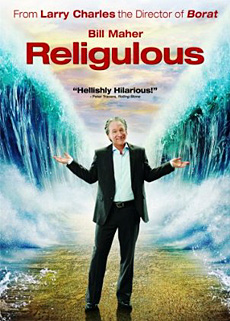
Religulous

Image from uncrate.com
The question of a filmmaker's responsibility to his or her viewer is an oft asked, yet difficultly answered, one.  It is a question that was top of mind for me as I watched Bill Maher's Religulous. In this documentary he claims to be going on a search to understand why people follow religions that are based in so much inconsistency and seeming lies. He posits at the beginning of the film that while the bible claims the end of days will one day be upon us, ultimately it will happen because of man's actions and behaviors.  He also claims through the opening montage of the film that he will be exploring the three major religions.  To a certain extent he a accomplishes this. However he spends about three quarters of the film refuting the words of Christians, while the last quarter is mainly devoted to debunking Muslim doctrine and only 2 short interviews with Jews.  

Maher is known for his comedy and political commentary, and it is clear that documentary filmmaking is not his forte.  The narrative is often disjointed, not having a clear connection from one point or interview to the next.  He jumps around, often not letting the issue to be fleshed out before he moves on or simply mocks the person he's interviewing. 

Maher's biggest weakness as documentarian is with his interview skills. He asks his subject a question and then doesn't even let them fully answer the question before he interjects to simply tell them that they're silly or naive for believing what they do.  Further, the editing is rather weak as he overly relies on the tactic of leaving the camera on the subject as they squirm uncomfortably, seemingly stumped or merely unsure as to how to answer the question.  It also makes it hard to know whether the interviewees are really ignorant on a topic they claim to be experts in or is it simply a function of Maher's editing.     

Moreover, Maher claims that he is setting out on a mission to understand religion. He claims over and over that he simply does not understand. However, as the interviews are conducted he does not seem intent on understanding as much as he just wants to prove the other guy to be an imbecile.  

Maher interviews a wide variety of individuals, and it's a wonder how he even found many of them. Yet, I personally came to question his honesty in subject choices when it came to the two Jewish interviews. Admittedly, this is the religion I am most familiar with and what I was mostly curious about how he would handle. The first Jewish interview was with a rabbi from a small (and much maligned by mainstream Judaism) group called the Neturei Karta. Members from this group are often found protesting any Israel rallies or Zionist endeavors. They believe that the Jews should not have not be in the land of Israel and they often align themselves with the Palestinians to reinforce their message.  Having one member of a fringe subset of ultra-orthodox Judaism stand in for all observant Jews is neither fair nor appropriate in a quest for a supposed understanding of a religion to which he fully admits to not being educated in. 

 The other Jewish interview he conducts is with an engineer who creates items which gets around certain legal prohibitions of the sabbath so certain items can be used. And yes, while some of the loopholes are a bit extreme, he neglects to mention the minutiae of why it is permitted and under what circumstances. For instance the ridiculous looking phone he highlights is not simply to allow observant Jews to call one another to shoot the breeze on the sabbath, but rather in emergencies where the phone might otherwise not be permitted. Seeing the dishonesty in his storytelling in these instances highlighted for me the possibility and probability of him having done the same for the other religions. 

The documentary filmmaker is not a journalist and is not legally or even officially bound to a set of ethical standards. However, they have generally taken it upon themselves to abide by honest rules of storytelling to ensure the trust of their viewers and subjects. It's in this arena Maher should take a lesson. His film making and storytelling would benefit greatly if he did so with an ounce of humility and honesty.  He asserts himself as the voice of reason and. Often does make interesting points that should be asked and discussed by and "believer."  Yet if he were truly interested in understanding his subject matter he would much benefit by allowing he interviewees speak their piece. 

Tuesday, May 24, 2011

Oprah's Farewell

I just finished watching the second of the Oprah’s Surprise Spectacular. I’m not a big Oprah fan, but given the insane hype and my devotion to keeping up to date with pop-cultural goings on, I figured I should at least take a peek.

Image from today.msnbc.com
I’m not sure what to make of it exactly. Given that the three final episodes of the show were completely produced by her producers and not by her, it can’t really be considered self-congratulatory (as I think a lot of her shows lean towards). Rather, this feels more like This is Your Life on some major steroids. It’s no question that Oprah has had a huge impact on television and what a daytime show can be. She also has proven to be an immense philanthropist, giving millions of dollars to educate those who otherwise would not have had the opportunity, as well as making great strides to impact the lives of others in different facets. Despite that, and maybe this is due to my upbringing where I was always told that the highest form of charity is where the receiver and the giver don’t know the other’s identity, but I always feel like her generosity was done through the lens of “Look at me, I’m Oprah and I’m amazing.” And while yes, she wants to do good for the world, she also doesn’t do anything that doesn’t promote her own personal brand. So there’s a sense that it’s not entirely selfless.

My second observation is a more meta one. Her producers have brought out the big guns for her. Today’s show alone features Aretha Franklin, Tom Hanks, Jerry Seinfeld, Kristen Chenowith, Michael Jordan, Maya Angelou, Will Smith, Jada PInkett-Smith and countless others. They are all there paying tribute to Oprah for her 25 years on television. Right? They acknowledge the good that she’s done, but ultimately this is because she’s going off the air and this is a tribute to her many years in front of the camera. It seems a little incongruous. This might be somewhat cynical, but given what I know about the television industry, and the importance of the relationships people have with others, this plays more like people trying to promote themselves through aligning themselves with Oprah and her brand. It doesn’t feel like a pure celebration of a person who does good, but a very public kissing-up. I don’t think this theory fits with all of the guests. Ms. Franklin and Ms. Angelou’s appearances are probably a little more honest, why would they need to promote themselves through Oprah? Then again, why would any of them? All of the stars who appeared are big names in their own right, but there’s just something about it that feels so manufactured. They might be there to say goodbye to a friend, but it’s also clear that they are probably there to help themselves as well.

The other thing that struck me so odd is that, as mentioned, this is a farewell spectacular. This is celebrities saying goodbye to Oprah. I wonder how many of these people that are saying how much they’ll miss her presence on TV actually tune in to her on a daily basis. My guess is pretty low. And, she’s not going away. She has an entire cable network now devoted to her (not to mention her ongoing magazine). Also, lets put this into perspective. This is a television show. TV. She’s not, God forbid, dying or dead. She’s not even really going anywhere. Oprah has established herself s one of the strongest entertainment brands and just because her show is going off the air doesn’t mean she’s gonna stop doing what she does best, self-promotion.

Oprah isn’t really a polarizing figure, I don’t know many people who share my feelings towards her. I can’t even really articulate completely why I’m not a fan of hers. She was on in my house on a daily basis as my mom watched her every day while preparing dinner for us as kids. Her voice, to this day, brings me back to those days sitting in our kitchen while the smell of spaghetti and meatballs filled the room. That should invoke positive memories, which it does, but they don’t transfer onto her. I think my distain towards her is partly due to her constant self-aggrandizement, which you would think would be offset by the good she does, but it doesn’t.

She’s not the first person who’s had a show go off the air, yet since it’s Oprah, it’s gotta be big. It reminds me of Boorstin’s idea of pseudo-events. It’s big because it’s gotta make a splash and it has to make a splash because it’s Oprah, and Oprah only does things if they’re big and promote her own brand and image. Something about the whole thing just doesn’t sit right to me.

Dissenters welcome (and expected).

Tuesday, May 17, 2011

I Love the 90s!

I recently came across this video thanks to the wonders of social media.  I of course am immediately drawn to any 80s or 90s pop-culture references so of course, once posted to my news feed on Facebook I had no other choice but to click the link.  It did not disappoint.  This video features so many of the most iconic TV shows and commercials from when I was a kid and would park myself in front of the television for as many hours as my parents would allow (which was eventually limited to 1 hour a week of regular TV and unlimited PBS.  I know. Not cool mom and dad!).  I was happy to see such a great cross section of content, from commercials to live action tv shows for young kids and teenagers with a smattering of the "important" commercials thrown in for good measure.  It really was like reliving my childhood!

Enjoy!  It definitely made me smile and brought back many memories!


The 1990s seemed to be a boom time for commercialism geared towards children.  This was an era where games and toys were turned into TV shows and all TV shows, especially cartoons, had an almost inherent commercial value to them.  One example, featured here, is Rescue Rangers.  Not only was there the original movie based on Chip and Dale, but then it spawned the cartoon show and a whole slew of must-have toys.  I, for one, as a small child of the 80s, but a really a consumer of 90s culture, ate it all up.  Watching this clip I realized that the commercials are just as iconic and memorable as the shows themselves.  I watch the Cheetos and Chuck E. Cheese commercials with the same familiarity that I can sing along with The Animaniacs theme song.

Something else that this got me thinking about is the shared experience of media that we kids-of-the-90s experienced.  Whoever posted this to youtube (whoever KyleKingTV is) had a relatively finite amount of material to choose from.  Cable TV existed, but was not nearly as pervasive as it is today.  The entertainment available to us was pretty much TV (primarily broadcast, PBS and limited basic cable stations), some video games and books.  We all pretty much watched the same stuff which was so concentrated that nearly 20 years later we still remember these as the iconic images of our day.  Today there are so many options for entertainment that the pool gets diluted.  It will be interesting to see what a kids' montage will look like in 20 years from now and if it has the same recognizability for the target demographic.  Maybe in the future rather than TV shows kids will look back fondly on Youtube videos, iPhone apps and Facebook statuses.  Only time will tell...

I'd love to hear what you're favorites are/were.  Feel free to post them in the comments section!

Tuesday, May 10, 2011

Water for Elephants

Image from WaterforElephantsfilm.com
It’s a rarity that I find a movie to be better than the book upon which it’s based. However, that is how I felt after watching the screen adaptation of Sara Gruen’s Water for Elephants. I read the book following an enormous amount of hype from friends and relatives, but was pretty underwhelmed by the lack of plot or character development. The movie stepped in and fulfilled some of the book’s lacking in those elements.. The film also adds a whole other dimension by creating the circus as an entirely new character in the book.

Told as an extended flashback, a la Titanic, the story centers on Jacob Jankowski (Robert Pattinson), who, despondent upon learning of his parents death in a gruesome car accident, abandons his final exams at Cornell veterinarian school and quite literally runs away with the circus. Feeling like he has no where in the world to turn, he hops a train which turns out to belong to the Benzini Brothers, a traveling circus. This introduces him to a new and foreign world filled with poor and hungry men who resort to violence as a means to an end. To pay his way, he is assigned some of the lowliest demeaning work. However, one night while shoveling horse manure he encounters Marlena (Reese Witherspoon), the mesmerizing horse trainer, with whom he is immediately entranced. Unbeknownst to him, however, she is married to August (Christoph Waltz), the tormenting and abusive ringleader.

August’s temper is fueled when he purchases what is supposed to be a new star attraction: a 52 year-old elephant named Rosie. Jacob is immediately charged as her caretaker, but August becomes enraged when Rosie doesn’t heed his orders. As Jacob continues to train Rosie and Marlena learns how to perform with her new animal the three form a tight bond. Eventually Marlena and Jacob fall in love and decide to run away from August and The Benzini Brothers once and for all.

This film does a good job at immediately bringing the viewer into the narrative world it inhabits. From the first frame of older Jacob (Hal Holbrook) standing in the rain in front of the Big Top I felt like a kid again, excited about the wonders that are about to unfold. When the movie flashes back to 1931, the aesthetic goes from a rich color palate to a muted sepia-inspired visual landscape. That enhances the viewers’ connection to the narrative and it’s an option available to a visual medium alone which director, Francis Lawrence takes full advantage of. The circus itself and the mystique which surrounds it, and has surrounded it for decades, is made palpable by seeing it in front of you in high definition. The spectacle of the animals and the men hoisting up the tent brought me back to when I used to visit the circus myself and reminded me of watching Dumbo and Toby Tyler on repeat as a child.

I also appreciated the filmmaker’s ability to introduce us to the periphery characters of the story and yet still managed to keep it moving along, whereas the book often felt bogged down by superfluous details.  Whereas often the book felt stalled because of this, the movie kept the narrative moving forward.  The supporting cast added a colorful menagerie of personalities which enhanced the feeling of what life in the circus might have been like.

The biggest problem I had with this movie, however, was the lack of chemistry between the leading characters. Rather than believing that Jacob and Marlena were truly and madly in love with one another, it seemed more that she needed an out and he was just there and was nice to her, unlike her abusive husband.  As opposed to believing that they were soul-mates, it seemed more that Marlena just needed to get away and Jacob was willing to care for her so she took him up on his offer.  The love story was more believable as one between Jacob and “The Circus.” That lifestyle was where he reclaimed his life and found a way to make sense of the world. His relationship with Rosie was also deeper and more sympathetic than the one shared between Marlena and Jacob, furthering his sense of attachment with the circus. That’s a pretty big one, considering the film has been marketed as a romantic love story, but it doesn’t detract from the film on a whole.

Ultimately, there is not much of a real story in Water for Elephants:  it's more of a snapshot of time spent with the circus.  However by using certain visual techniques and introducing the information in particular ways Lawrence makes the story his own and creates a whole new visual and ultimately satisfying experience.

Friday, May 06, 2011

The Boy in the Striped Pajamas

Image from IMDB.com
On my way up to Boston to celebrate the first days of Passover with my family I finally got around to watching The Boy in the Striped Pajamas, a movie I had received from Netflix a few months earlier. It had taken me a while to get around to watching it because I’m not often in the mood to curl up with a sad Holocaust movie. However, I thought as I traveled home to celebrate redemption from one of the darkest times in ancient Jewish History, a time which we are commanded to remember and relive to a certain extent each year, I thought it would be an appropriate time to remember a similar experience from modern times.

The film centers on Bruno (Asa Butterfield), the precocious young son of a German commandant whose family moves to the countryside so, as he is told, his father can be close to the front lines and continue to fight to keep their country safe. Bruno hates his new home. He’s bored and feels isolated from his friends and even alienated from his sister as she becomes more and more enthralled with the young Nazi soldier who guards her compound. The naturally curious Bruno sees what he calls a “farm” from his bedroom window and the budding explorer seeks out to meet the farmers who work there. He doesn’t understand why these farmers, whom he sees in person when they work in his house, are wearing pajamas. His confusion grows when he learns that one of them used to be a doctor – why would someone give up a career in medicine to be a farmer and peel potatoes, he asks his mother. His mother, played by Vera Farmiga, is also largely caught unawares of what was happening only a short distance from her new home.

One afternoon Bruno sneaks out of his home and ventures out to this farm to see what it’s all about. When he reaches his destination, at the barbed wired fence which borders the “farm” Bruno encounters Shmuel, a boy the same age as Bruno who sits alone, despondent. Bruno strikes up a conversation asking him about himself and why he wears pajamas all day and tells him how lucky he is to be able to play outside as long as he wants. As neither child truly understands what’s going on in their worlds, the naiveté shared between them is so genuine and honest and it shows how hatred is something learned by the older generation. They develop a close friendship and Bruno vows to help Shmuel find his father and Shmuel promises to help escape from his boring isolated new life.

Viewing the atrocities of The Holocaust through the eyes of a child is not a new narrative in this genre. What is interesting, however, is viewing it through the eyes of a non-Jewish child. Bruno asks his parents questions with utter bewilderment and innocence. The truth is, we ask the same questions 60 years later unable to comprehend how humans could do this to each other.

The film also takes a risk of having the viewer sympathize with a Nazi family. This is a risky endeavor – similar to the structure of The Reader – to describe the horrific plight of Jews in Eastern Europe during WWII through the lens of the perpetrator. Whereas The Reader took a defensive and almost apologetic stance against what the main character had done, this film, accomplishes just the opposite. The film does a good job keeping the suspenseful pace, leaving the audience unsure of how things well end. The one certainty is that something bad will happen and ultimately the tragedy that does occur at the end ofThe Boy in the Striped Pajamas uses the terror one family endures to highlight the utter nightmare that tens of millions of Jews endured as they watched their families being senselessly murdered at the hands of the Nazis. The twist, of course, is that the family through which the tragedy is experienced is led by a Nazi commander, the one who has committed so many crimes himself. This upheaval of the expected structure for sympathy is hard to reconcile yet makes a powerful comment as the viewer can hardly comprehend how unimaginable this one family’s pain must be, yet this was the reality for an entire nation. Even more so how much more horrific and long lasting those horrific events were.

I was deeply moved by this film, probably especially so given the context in which I watched it. Every year on Passover Jews around the world are instructed to remember, and never forget, the atrocities they suffered at the hands of the Egyptians and then the ultimate redemption at the hand of G-d. In modern times we realize that this is a pattern the Jewish people have faced time and again throughout history with the Holocaust being the latest iteration of that nightmare. In today’s world, Anti-Semitism has by no means disappeared despite the relative peace and freedom Jews enjoy today. It’s at times like these that we must remember both the ease in which the tides can turn and also how important it is to treat people of other religions and nationalities with the respect they deserve because we know how it feels to be on the other side of that spectrum. Furthermore, it’s important to remember, as we watch films about Nazi atrocities, about all the other atrocities that occur in the world and how people lose sight of the important things in life. The film is for the most part told through the eyes of a child, and in truth, we are all children struggling to understand how we can allow our world to devolve into senseless hatred of others just based on external and superficial differences.

Friday, April 15, 2011

Today's Reality

Snooki and Pseudo-Events

When reality programming started it was heralded as a cheap alternative to scripted television that would save the networks from costly and diva-esque actors.  In the past decade since the dawning of the Golden Age of Reality TV has been upon us, audiences have seen what seems like unending iterations of the genre.  Between the competitions (The Bachelor, Survivor), Hidden Camera (Undercover Boss), Self-Help (The Biggest Loser, Millionaire Matchmaker), “cinema verite” (The Real Housewives, Jersey Shore, Teen Mom), and Family Drama (Wife-Swap), Surgical (The Swan, Dr. 90210), and Do-Gooder (Extreme Home Makeover), there seems to be something to fulfill any type of voyeuristic need that a viewer might have.  But to what cultural expense?

In 1961 Daniel Boorstin published his book, The Image: A Guide to Pseudo-Events in America in which he outlines how America was living in the “Age of Contrivance.”  As explained by Transparency.com, “He claimed that America was living in an "age of contrivance," in which illusions and fabrications had become a dominant force in society. Public life, he said, was filled with "pseudo-events" -- staged and scripted events that were a kind of counterfeit version of actual happenings. Just as there were now counterfeit events, so, he said, there were also counterfeit people - celebrities - whose identities were being staged and scripted, to create illusions that often had no relationship to any underlying reality.”  Boorstin’s claim came right as television was gaining popularity and importance in American society and as America was beginning to replace images of actual importance with these so-called contrived pseudo-events.  For instance, Nixon had just lost the debate against JFK on television primarily due to his televisual presence.  Those who had heard the debate on the radio thought that Kennedy had lost because they weren’t swayed by visual images influencing their opinions. 

In our era of so much of the television landscape being dominated by reality TV, Boorstin’s words never rang truer.  The so-called reality stars are constantly trying to one up each other and themselves be it in inciting conflict or general grotesque behavior to get attention.  The media doesn’t make it any better by bringing their indiscretions to light either on the covers of their magazines or through their lip flap on their own television programs.  Most recently, Rutgers University took it to the next level when they decided chose to pay Snooki, a low class drunken party girl, $32,000 to hold two question and answer sessions while they are paying Nobel Prize winning author Toni Morrison $30,000 to give their Commencement Address.  What a statement Rutgers is making:  Snooki is famous as a walking pseudo-event and while yes, she has technically authored a book of her own, really has not contributed anything positive to our society. 

On Anderson Cooper 360, Cooper offers his take on the situation (no pun intended…)

I’m personally in complete agreement with Cooper.  He tells it like it is and points out the utter ridiculousness that is the state of reality TV.  He starts his argument by mentioning Snooki’s newly upped salary.  She will now be making $100,000 per episode to behave badly.  Charlie Sheen was recently fired in part for similar behavior on his scripted show, but now we’re saying it’s lauded when a reality star does it?  What does that say about our priorities?  Further, reality was initially meant to be a cheap alternative to scripted, this seems to be almost encouraging the next generation to take Snooki’s behavior to the next level and if they offer it up for a cheaper rate they’d be happy to take her spot in the limelight.  How can we be honoring this behavior?  It makes me cringe to think she, and others similar to her, are being celebrated for this behavior.  Calling it reality (when in fact it’s often largely scripted and produced) encourages others to behave similarly, offering the message that the more you fall down drunk and act like a moron and as long as you’re willing to do it in public, it could earn you a big paycheck.   

It’s time for us as a society to take a closer look into how we choose to show ourselves to the world.  In an era where we are competing with other world powers to produce the smartest minds, do we really want our biggest export to be someone who’s most famous acts are passing out drunk on the beach?  Boorstin predicted it 50 years ago.  At this rate, I’m not sure I’m looking forward to it’s evolution in another 50 years.

Wednesday, April 13, 2011

Royal Wedding 2011

Image from StudioBriefing.net
Do We Care? Why or Why Not?

The Daily Beast published an article today by John Avalon entitled, “William and Kate's Royal Wedding: Enough Already!” in which the author goes details his, and many Americans’, frustration with the media hype and coverage over Price William and Kate Middleton’s upcoming nuptials.  Namely, he poses the question, “Who Cares?”  He asks, why should we as Americans, who fought a war to break from the aristocracy of England care about or pay any attention to such pomp and circumstance?  And if people do care about such frivolity, he posits, that they should perhaps move to England, as he says “And for those who fetishize the remaining whiff of aristocracy—well, there’s a continent for that. It’s called Europe.”

While I do agree with Avalon to a certain extent that the media coverage has been at time excessive, I find his reasoning to be simplistic and based on his own biases.  I should also fully disclose that I too have my own biases, being totally and utterly fascinated and charmed by the Royal family.  There was even a moment (ok, definitely longer than a moment, ask any of my high school friends) that I was beyond convinced that Prince William was the love of my life and one day I’d become his princess.   Those days have surely passed, but the vestiges of that allure remain deeply ingrained in me. 

I will say, however, that Avalon’s assertion that we as Americans made a decision to be non-UKers and therefore should not be intrigued or interested in the Royal Wedding is rather simplistic.  If that were indeed the case, Hollywood would not exist as it does today.  We would not have turned the Kennedys into our own version of royalty. I think it’s in fact just the opposite.  Americans crave pomp and circumstance from our own version of royalty.  Take Hollywood for example, as they are the closest we have to royalty.  We gape at the jewels and gowns the starlets adorn themselves with.  We are fascinated by their trysts and romantic drama.  If we as Americans really rejected the notion of royalty then Hollywood wouldn’t be the staple in our society that it is.

He quotes a CBS/Vanity Fair poll which found that 65% of Americans have “no interest” in the wedding.  That might be true, but his assumed reasoning is just that: assumed.  Maybe it’s the almost constant onslaught of information being fed to us that can be quite fatiguing.  There could be a whole host of reasons why that poll number is so high.  I’d also argue that if that was indeed the case and people were not interested in the coverage then there would not be as much.  Ratings rule the airwaves decisions and if people weren’t drawn to it news directors and network executives would pull the coverage pretty quickly.   Avalon further argues that the coverage is taking up valuable time and space that could otherwise be used to cover real news stories like murders on the Ivory Coast or in The Sudan.  He’d be right, if the American media covered that at all.  Those atrocities were occurring well before there was ever an engagement and the coverage was lacking and sparse. 

Ultimately whether people care for the wedding and its accompanying coverage is up for debate, but I do think to say that we don’t care because in 1776 we fought a war to be free of the King’s rule is probably a bit over simplistic and perhaps an overstatement of our nature as a society.

Tuesday, April 12, 2011

Jell-O's ChocoBeast

True Temptation or Advertising Faux Pas?


I don’t know if you’ve seen the new commercial for Jell-O Temptations, but I cringe every time it comes on TV and I definitely have  what to say about it.  Here’s the spot for your reference:


In the commercial, a mother is sitting in a tent with her kids telling her kids a ghost story about the “ChocoBeast,” a half-man, half-monster “who will stop at nothing to sink his fangs into people who steal other people’s chocolate temptation.”   Then the “monster” appears screaming outside the tent and the kids are sent into a panic and throw the Chocolate Temptations back towards their mom.   In the next scene the parents are sitting on the porch together, dad is eating a Chocolate Temptations Jell-O and the mom says, “Good job, ChocoBeast.” 

Advertising has a long and storied history of not only reflecting our culture but also shaping it.  The idea of cognitive discontent and advertising has taught us as consumers that there are things we’re lacking or things we should be self conscious of and the only way to remedy those short comings is to consume the products needed.  For instance, not until whitening toothpastes came on the market did we know our teeth weren’t white enough.  But now that there’s a product for it, we are sure to feel bad about ourselves until we fix it!

This commercial poses a different issue, the message it’s sending is very different from others in this genre.  First of all, think back to the Jell-O marketing of about a decade or 2 ago when the friendly, child-loving Bill Cosby was the face and voice of the brand.  This once kid-friendly product used to cater towards children’s needs (or, let’s be honest, interest in sugary, wiggly snacks) and now they’re shifting their strategy to focus on the parents and their interest in indulgence.  Furthermore, and probably the more problematic one, is that this shift also reflects (or perhaps is helping to shape) and change in parenting models.  These parents are not only putting their needs before the kids’ needs, but are actually frightening them to do so.  What parent would choose to legitimately scare their child to get what they want?  

At the risk of sounding like I’m finger-wagging (ok, maybe I am) but in an age where child on child bullying is such a hot topic in the public forum, how can this message be tolerated?  Parents are supposed to be the protectors of their children, not the perpetrators of their pain.  The parents in this ad are clearly emotionally abusing their kids, and for what? A 4 oz tub of what is probably a pretty crappy snack?  

Thoughts?

Monday, April 04, 2011

The Kennedys

Image from IMDB.com
Did the Kennedy Curse strike again? 

So last night ReelzChannel premiered the much hyped, much talked about miniseries, The Kennedys.  Originally created for The History Channel, it was picked up by Reelz after History decided it wasn’t right for their airwaves.  After watching the first episode, I came to realize just why History decided it was “off brand.”  My guess is because it’s not very good and it was boring as hell.  I am generally fascinated by the Kennedy clan.  I've spent hours at the JFK Library in Boston, watched narrative films, documentaries, read books, studied JFK’s presidency from an academic standpoint in a number of courses in college.  I am generally a huge sucker for Camelot and the mystique that surrounds it.  That’s why I was so excited to watch The Kennedys and then so disappointed when I found it beyond boring. 

The pacing was so slow, after an hour of watching I thought I must be near the end of the first night, only to look at the clock and see it was only halfway through.  Furthermore, the nonlinear narrative structure seemed uneven and forced.  This type of editing should be used to educate the audience and divulge information in a specific way, but given that this is a historical account of a story many people already know, there was no need for this kind of narrative structure, and it greatly detracted from the storytelling. 

I will say, however, that the casting was near perfect (although I’d contest the Tom Wilkinson casting as Joe Kennedy Sr.).  I was very much impressed by how much Greg Kinnear fell into his role and fully embodied JFK.  Even Katie Holmes, who I am generally not enamored with, held her own with only a few uneven missteps – but she had a very small role in this premiere episode, so we have yet to see how she will handle the more meaty parts.  Finally, most films have a really difficult time recreating the Kennedy accent, but I will admit that overall the actors stayed true to the authentic Kennedy accent.

I will continue watching because, as I said, I devour most things Kennedy, and I hope it gets better, but I’m not very optimistic about it.