 |
| Image source |
I was torn about going to see Melancholia. Like for so many of my grandparents’ generation who love opera and classical music but found themselves struggling over whether they can listen to Wagner’s music knowing his political allegiances, I too was not particularly pleased with supporting someone who seems to want to bring Nazism back in vogue. Director Lars Von Trier made some horrible comments at the Cannes Film Festival a number of months back which showed allegiance to the Nazi party and was declared “persona non grata” by the festival and general social outcast. Nevertheless, as a scholar and fan of the movies and given the artistic noise the film has been making I made the decision that the art and the artist can be separated. After all, as a student of the cinema I am a strong supporter of the old adage, “Trust the art, not the artist.”
Told almost as two separate movies, Melancholia introduces us to a world where another planet, a much larger one, is on a collision course with earth. Subtitled "Part 1: Justine," the first half of the film is about a wedding. Kirsten Dunst plays Justine, the daughter of two very dysfunctional parents who is marrying Michael (Alexander Skarsgaard), the seemingly most patient and loving man she could ask for. He loves her tremendously and for the most part ignores her instabilities to be with her. Justine suffers from manic depression, and even at her own wedding finds herself in a state of melancholy (no coincidence as we will see) and often sneaking off to just be alone. The wedding is constantly being delayed due to her disappearances and her wealthy sister and brother-in-law who have funded the gala affair grow increasingly frustrated with the situation.
The second half of the film, titled "Part 2: Claire," is told from the perspective of Justine's sister, Claire (Charlotte Gainesbourg). A short amount of time has passed since the wedding and Justine has returned to her sister Claire’s house to live. Her depression has worsened and she’s in a near catatonic state. As the approaching planet nears, questions of whether the collision will actually occur still loom. No one seems quite sure what will happen.
 |
| Image source |
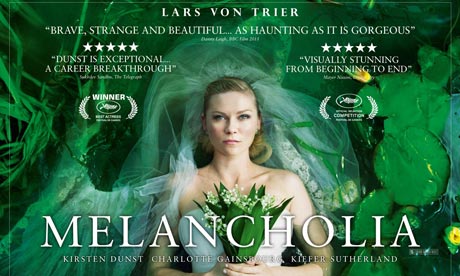
Von Trier creates an interesting aesthetic landscape for Melancholia. The opening few minutes of the film are highly stylized and almost painting-like as they introduce us to the scenes of despair for some and peacefulness for others at the moment of impact while the rest of the film is the story of one family’s life in the weeks leading up to the collision. These first images contextualize the impending situation, and while foreboding, does not offer simply a sense of doom. They are beautiful images in which, often times, the subjects are arranged to directly mirror famous works of art and therefore evoke certain emotional responses. For instance, one shot shows Justine lying in a shallow pool of water in her wedding dress holding a bouquet of flowers similar to John Everett Millais's 1852 painting Ophelia, which audiences are shown later in the film. This mise en scene directly links Justine with another fated bride. Often times throughout the entire film, Justine is found mirroring paintings or photographs on display. This use of iconic imagery in the opening of the film offers audiences a opportunity to settle into the ideas that will become prevalent through the film: depression, ominousness, being trapped, relationships with the natural world all are conveyed through these scenes and are all important themes in the film.
Further, his mis en scene is also used to directly align Justine with the approaching planet. On an emotional level, as Justine begins to exhibit emotional distance and melancholy the planet is still far away, scientists unsure of its meaning and path. However, as it gets closer Justine's mood begins to worsen. In one particularly striking scene Justine wakes up in the middle of the night and follows its light outside the house. Her sister hears the noise and follows Justine outside. In this scene Justine walks through Melancholia's light while Claire stands in line with the light of the moon. Similar to the familiar heavenly body, Claire is stable and predictable. Justine, however, is like Melancholia: erratic and has the potential to cause disaster. However, as Justine does offer much comfort to her young nephew, if the collision does not occur, and just passes through, it also has the ability to offer great relief and beauty. Moreover, the planet is further linked with Justine through its name. Called “Melancholia,” it evokes the feelings and mental state which Justine cannot pull herself out of. Even in what should be her most joyous time, her wedding, she cannot bring herself to be truly happy. People constantly ask her if she’s happy and all she can do is simply nod and smile without having the true emotion behind it. So too, Melancholia evokes a schism for people as they want to be able to appreciate the beauty and majesty of the planet, but also fear what pain it can cause.
Further, his mis en scene is also used to directly align Justine with the approaching planet. On an emotional level, as Justine begins to exhibit emotional distance and melancholy the planet is still far away, scientists unsure of its meaning and path. However, as it gets closer Justine's mood begins to worsen. In one particularly striking scene Justine wakes up in the middle of the night and follows its light outside the house. Her sister hears the noise and follows Justine outside. In this scene Justine walks through Melancholia's light while Claire stands in line with the light of the moon. Similar to the familiar heavenly body, Claire is stable and predictable. Justine, however, is like Melancholia: erratic and has the potential to cause disaster. However, as Justine does offer much comfort to her young nephew, if the collision does not occur, and just passes through, it also has the ability to offer great relief and beauty. Moreover, the planet is further linked with Justine through its name. Called “Melancholia,” it evokes the feelings and mental state which Justine cannot pull herself out of. Even in what should be her most joyous time, her wedding, she cannot bring herself to be truly happy. People constantly ask her if she’s happy and all she can do is simply nod and smile without having the true emotion behind it. So too, Melancholia evokes a schism for people as they want to be able to appreciate the beauty and majesty of the planet, but also fear what pain it can cause.
Just like the orbiting planet, Justine represents a lack of control – the planet cannot be controlled by the scientists on earth, she can neither be controlled by her family nor can she control her mental state or her actions most of the time. Her family tries to control her and make her just like them. In the first speech at her wedding she is lauded by her boss as the best copywriter he’s ever had and even gives her a promotion as a wedding gift. She is seemingly on her way to professional success, which, one would think, would bring her happiness. However, as she reacts to most things which are supposed to make her happy, she rejects it. She also recognizes that work will never satisfy her because work gives you money and money does not impress her. At times her illness seems to give her clarity, but it alarms those around her. Her sister warns her not to tell her new husband of her mental illness lest he leave her. She should repress her true self to be more mainstream. However, the more she represses this self the worse she gets, ultimately being unable to care for herself at all.
Towards the end of the film Justine begins to exhibit odd, almost prophetic, abilities. She’s completely at peace with the impending situation and offers some interesting advice to her panicked sister. Stating that no one will miss earth when it’s gone, Justine feels calmed knowing that if earth were to be eradicated ultimately it will not matter because no one will be left to mourn for it. Claire, on the other hand, is unhinged by this news fearing the possibility of death for her, but more importantly, her son. The melancholy Justine had been suffering from at last offers her peace where others cannot be placated.
 |
| Image source |
The question of outer space being the great unknown is nothing new, but I find it interesting that this year alone came two films about the existence of other planets whose existence directly and drastically impact life on earth. Another Earth explored the issue of a mirror planet and the effects it has on the self. Melancholia deals with the impact of a newly discovered planet offering a threat to our world. In a year where the trend in filmmaking seems to be looking backwards, these two stand out as looking forward, but with trepidation and a sense of despair and an inability to do anything about the inevitable tragedy which is about to befall everything we know about our world.
Melancholia does not feel like a dystopic film. As with typical dystopian films, this world has not broken into mass violence and warfare. People are not rioting in the streets. Rather, there is a quiet ominous and suspenseful feeling throughout the length of the narrative that despite best attempts to maintain order and understand the world, inevitably suffering will befall the planet due to nothing in our control. This is of course rather ironic as the suffering we face as a global marketplace in reality is all due to the misanthropic deeds of man.
The current economic situation and much of the pain and suffering on a macro level has come at the hands of man's greed and insistence of acquiring wealth. In Melancholia not even excessive wealth can bring our characters happiness or peace. John (Kiefer Sutherland), Claire’s husband, tells Justine that it was worth it for him to pay the high bill for her wedding as long as she promises to be happy. She tries to tell him she is, but in truth is not. In this literal sense, money cannot buy her happiness. Furthermore, Claire and John live on an expansive estate, with gardens and stables and house-servants. Yet despite all of this, all the money in the world cannot ensure ultimate happiness and stability should Melancholia collide with the earth.
In our reality, the greediness of people and a consumption-obsessed society has brought us to our knees and we saw how vulnerable as a society we are. However, compared to a cosmic force beyond anyone’s control which could literally destroy the planet, this is nothing. In Melancholia, nature is now working against human-kind seemingly through no fault of their own. In this sense, this movie is a lot like Hitchcock’s The Birds. There has been a lot of talk over what “The birds” represent. In his book, Hitchcock's Films Revisited, Robin Wood writes that the birds don’t represent one idea – like communism or sickness, rather they are an embodiment of a general state of anxiety. Similar to the 1960s, the whole world is anxious right now. Economies are crumbling and wars are raging and no one quite knows what our future holds or what our world will look like when and if we emerge from this current situation. The approaching planet is that anxiety. Any fear or worry can be put onto that orbiting being as it threatens to wipe out our world. So while human kind might not have literally caused this specific threat to society, the anxieties we've created are manifested into this natural disaster.
 |
| Image source |
Further, as Sigmund Freud discusses, as we repress fears and anxieties they don’t disappear. Rather, they strengthen under the surface and ultimately return as a monster. The same theory can be applied here. We are so consumed with controlling our environments and keeping order that the monster of being out of control is repressed more and more until it returns as something which cannot be controlled. Further, as we as humans continue to neglect our planet and think our actions don’t have consequences regarding global warming, or that our wastefulness won’t impact the planet in the long run, we are simply taking for granted our environment and future generations will likely suffer due to our negligence. This is another way in which Justine and nature are linked. She was told to suppress her mental illness and act “normal” to keep her husband, to keep her job, and to keep her outward appearances mainstream. We hide our garbage by burying it landfills or sending it out to space. We might even recycle at times or close lights when we leave the room, but as a global society we are just keeping up appearances thinking that we can keep up this act without any fallout. Justine and Melancholia tells us that that is not possible.
While most of the films this year look back to remind us to learn from our pasts either to remind us of where we came from or as a warning to not let history repeat itself, this film is a warning of what the future can hold if we do not recognize and appreciate our world. We must appreciate nature and recognize the direct link we as humans have with our environment. We must understand the impact of our actions upon it if we expect to be cared for by it. I think that’s the ultimate lesson of Melancholia, that we are not independent from our environments – both the natural environment and the other people we surround ourselves with. We must care for, value and respect our relationships with both and taking anything for granted can have dire consequences.

