Academic Writing

Showing posts with label Politics. Show all posts

Wednesday, August 01, 2012

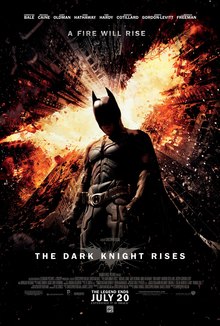
The Dark Knight Rises

Christopher Nolan’s Batman has become a respected, beloved and honored cinematic series. The Dark Knight films, all starring Christian Bale in the lead role, have taken Batman to a dark, brooding place that he had never before been taken. Much of that is due to the serious tone of the films coupled with the deeper Bruce Wayne back-story that audiences have been presented with and the vibrant and multifaceted villains that have been reintroduced to in this series. Led by Heath Ledger’s iconic and immortalized take on The Joker, the villains are now expected to offer an element of psychological depth that had yet been explored to this extent. That said, The Dark Knight set the gold standard for what all future Batman movies could and should offer.

The Dark Knight Rises opens eight years after The Dark Knight ends and the death of Harvey Dent. Police Commissioner Gordon has let Batman take the fall for it and along with the death of his beloved Rachel (Maggie Gyllenhaal in The Dark Knight)years earlier, alter ego Bruce Wayne has lost the will to carry on his mission of protecting the city and leaves that job up to the police force. He becomes a recluse, closing himself off in his mansion and neglecting his financial responsibilities and public persona. It is only when Bane, a new and powerful villain appears in Gotham does Wayne realize he is needed and dons the bat suit once again, albeit somewhat reluctantly. In addition to being at odds with this new force of evil, Batman/Bruce also has two new potential love interests/femme fatales to deal with – Marion Cotillard as Miranda and Anne Hathaway as “cat”-burglar, Selina Kyle. Because, what would a Batman movie, or any movie at that, be without a love interest?

Bane is a villain who seeks chaos, not unlike his predecessors yet his underlying motivation is not made particularly clear. He repeats the dogma that he is giving Gotham back to its citizens and in doing so decides to blow up the Gotham Stock Exchange, the symbol of financial corruption and elitism. He portends to be the ultimate 99%er and relishes at the opportunity to bring chaos to the streets by overturning the class system. This is of course rather ironic as the Right Wing Conservative pundits, namely Rush Limbaugh, have accused Nolan of embodying left wing Hollywood liberal bias for naming his latest villain after Mitt Romney’s former company and as his involvement there is being scrutinized. Aside from the fact that the film is in-fact vehemently anti-99% as it depicts the mob mentality as destructive and dangerous. Further, Bane was actually first introduced to fans of the comic book in 1993 by DC comics, nearly 20 years before the issues of the 2012 election were even a thought.

But, I digress.

Bane is more than a traditional villain from superhero comics. By today’s standard he comes off as a relentless, morally corrupt heartless terrorist. He has superhuman strength and intellect and Bruce Wayne who has been holed up in his mansion as a recluse is now no match for him. Personally I found Bane to be almost cartoonish rather than evil. The mask obstructs his face throughout the entire film which detracts from any sense of humanity that he might otherwise have and thus relinquishing some of the fear he should be demanding. Contrasted to The Joker’s mask which was merely paint, and severely smudged at that, which still allowed Ledger to convey maximum expression and create a psychologically complex villain with a dark past. Moreover, when a psychological look into Bane is offered it falls flat due to a lack of being able to see his expression – you can barely even tell it’s Tom Hardy playing him. Besides that, the mouth-mask/voice effect often made it difficult to understand what he was saying and when I could hear him he sounded a lot like Sean Connery. A great Batman movie is usually based on the strength of its villain and with Bane, it just doesn’t deliver the same punch.

Gotham has traditionally shot in multiple locations and while it has always been a gritty urban area, it has never been “outed” as being a specific locale (Chicagoans want to believe it’s supposed to be their town and New Yorkers are smug enough to just assume it is, because why would it be anywhere else). Even this film was shot in the UK, Pittsburgh and New York, as well as others yet there were moments when it’s anonymity was clearly lost in favor for identifying Gotham as Manhattan. The presence of the Freedom Tower, Brooklyn Bridge, and Empire State Building mark it as such as a very obvious way even though the city is also supposed to contain a Football stadium in its center. With the city under siege it felt more like a gritty apocalyptic and dystopic thriller based in reality and practically pulled from the headlines rather than a superhero blockbuster.

Further making it feel less like a traditional Batman movie is the apparent lack of Batman himself throughout the film. For much of the movie Bruce Wayne is either locked in his ivory tower or locked in a dungeon (not really a spoiler, don’t worry), but in neither instance is he actually Batman. I wanted to see the Bat Suit, the Batmobile and other fun Bat-gadgets, but this film is a lot more heady than it is The lack of screen-time Batman actually had was surprising and definitely felt lacking as I found myself asking, “Where is he?!” He does, of course, return for the final showdown, one which was spectacular and offered an edge of your seat thrill, which is just what the movie needed.

That being said, this dark direction seems to be making sense for the evolution of the genre in our day. With the economy still in shambles, the job market no looking particularly optimistic, our world seems dystopic. Yet, the American dream does prevail and there is still is a sense of self-reliance and helping yourself when others won’t or can’t. Batman resounds in particular as he is famous for his lack of superhero powers. He’s an ordinary man who made himself great through strength of character (and a hefty trust fund left for him), but despite that he does so without the help of supernatural features. In that regard Bane and Bruce Wayne are direct foils. They have many similarities, but it is their social status that separates them. Both are orphans, both are particularly talented in terms of their strength and intellect, yet the one born in poverty and imprisoned becomes a mass murderer and torturer while the other born in the Regency Room of Wayne Manor becomes a savior. Rises asks, can you escape your destiny? Can you break free of whatever bucket society puts you in? Should you even want to? It presents a reality where social status definitively determines how your life unravels, a markedly Un-American ethos.

Finally, I had a hard time separating my perception of the film with the shooting tragedy in Aurora, CO. The film was obviously made well before the incident occurred, yet as I was watching the film, my eyes occasionally distracted by the two police officers who surreptitiously poked their heads into the theater to make sure all was calm, I couldn’t help but be wonder about the frivolity in which our culture promotes gun violence. Perhaps I wouldn’t have thought about it in this regard without the Aurora tragedy but during the multiple sequences where Bane and his henchmen storms around Gotham shooting their guns and missiles I was profoundly uncomfortable by the blasé attitude and everyday nature we place on abject violence on screen – especially on contrast to how there is uproar over sexual promiscuity on screen. The severity of being nonchalant about violence on screen was particularly heighted and adversely effected my reaction to the film.

In all, while there were lulls during the film and stark departures from what makes a Batman film great, the third and final installment in the Nolan/Bale trilogy offers fans a satisfying conclusion to the most financial successful and culturally relevant Batman series to date. It has offered new insights into characters audiences thought they knew and brought new depth and meaning to what it means to be a superhero.

Friday, July 13, 2012

A Case for Sunday Mornings

There’s a show that I DVR every week that I love.  I hate missing an episode and while I'm watching I'm totally enthralled with what's being transmitted onto my TV screen.  I’m not anywhere close to the target demographic which means that none of the advertising is geared towards me nor is it on during a time-slot I would ever choose to be up at (hence the DVRing).  However, this show has provided me with more knowledge than almost any endeavor I’ve ever undertaken and definitely more than any other TV show.  I frequently reference the information I’ve garnered from it and impress my friends with my plethora of facts.  So, what show could possibly live up to this?  I’m talking about CBS’s Sunday Morning and it’s on (you guessed it) Sunday mornings from 9-10:30am.  If you’ve never heard of it, it’s that show with the iconic sun logo – sound familiar?  If you still don’t know what I’m talking about, ask your parents or grandparents about it, I’m sure they know it.  There’s no frills, no competition, no built in drama or conflict, no flashy graphics, but there’s a lot of heart to it and it's a quietly offers more honesty than anything else on television.

As a kid, nearly every Sunday morning I would wake up, wander into my parents room, climb into bed with my mom and dad, sometimes a sibling would join too, and we’d watch as Charles Kuralt took us through the segments of Sunday Morning.  My dad and I are both known in our circles as being the keepers of random information.  We love and absorb trivia – both trivial and significant - so this show is perfect for us.  We’d get a thorough insight into what was happening in America that week, but we’d also learn about interesting stories about celebrities, politicians, artists, and every day people that are making differences in their communities (like the woman who has sent out over 7,000 care packages to the troops overseas and the retired man who decided to start painting the houses in his poor, run down town to lift his neighbor’s spirits about where they live).  Additionally, Sunday Morning covers stories that the weekday news does not bother with, such as music, theater, and interesting architecture.  Occasionally they’ll even have entire shows around one specific theme.  For instance the money and design episodes have come to be annual events.  Now Sunday Morning is hosted by radio personality, Charles Osgood, and is just as engrossing. 

Conceived in 1979, Sunday Morning aimed to emulate the Sunday newspaper magazine section and, as opposed to the morning news shows, was meant to only focus on feature stories.  The show starts with a quick rundown of the week’s top stories, a national weather report and then goes into what is basically a table of contents for the rest of the show.  Admittedly, I fast forward through all of that so I can get to the good stuff.  Between the segments there’s weekly standards that punctuate the show every week they have the Sunday Morning Almanac, which is essentially a “today in history” segment which offers interesting milestones – for instance, did you know that earlier this month Silly Putty celebrated its 60th birthday?  Do you know how it was invented?  I do.  Fast Draw features two guys drawing pictures on a white board to inform audiences about a certain topic – recently why rain doesn’t actually “break” humidity (even though that’s what everyone thinks it does) it actually makes it worse. 

Each week there’s the Sunday Morning Cover Story which is usually the longest and most in-depth feature often about a timely issue and Sunday Morning Profiles offers a glimpse into the life of a celebrity or other public personality in an intimate interview.  Every couple of weeks Ben Stein offers his curmudgeonly advice on the economy, Mo Rocca and Bill Geist track down the random oddities in our country (like people who still build log cabins, the National Goldfish Competition or the Annual Betty Convention) which makes us unique.  Nancy Giles shows up every now and again to talk about her life, whether it’s anecdotes from when she was a struggling actress and how Nora Ephron inspired her to keep pursuing her dream.  And David Edelstein offers his reviews on that week’s movies with his wry and honest commentary.  Then, of course, there's the "Moment of Nature" which closes every episode.  Again, I admit to fast forwarding this part too, but before I do, I always wait to find out where they went this week to find that clip as it often amazes me just how diverse and beautiful the American landscape can be.

What’s special about the segments that Sunday Morning provides is that it often offers a different perspective on something which we thought we knew about.  Be it the smaller pieces or the bigger, central features, Sunday Morning offers a unique view into the world that I haven't seen offered in another context.  For instance, a couple of weeks ago there was a segment about a woman who, after six weeks of marriage, her husband was shipped off to fight in World War I.  Soon after he left he was reported missing and was never heard from again.  She called and wrote letters to the state department, congressmen, her local government officials, and nothing.  Recently her brother-in-law discovered some new information about him and finally found that not only had he been killed, identified and buried in a town in France, he was considered a hero by the locals as he gave his own life to save the entire town.  This man is a hero overseas and his widow only recently discovered this.  Now she makes a pilgrimage once a year to visit his grave, the town and it’s citizens, and the street that’s named after him.  It was a wonderful human interest story about resilience and heroism.  It also exposed a major failing of a government which is supposed to be supporting our war heroes.  In a television landscape that’s fraught with shouting it was a quiet tale that without Sunday Morning would have never been brought to the public.

These days, I no longer watch the show with my parents on snuggly Sunday mornings.  But I do watch the show every week and so does my dad.  While we don’t have a standing “recap” conversation after the show, we’ll often times find ourselves chatting about the random bits of information we’ve learned from the show.  In that sense it’s a special way that my dad and I connect with one another and always giving us something to talk about outside the normal parent-child conversations.  

The show continues to plod along, quietly and modestly, without fancy advertising or making much noise to beat out the rest of the clutter that’s out there.  But for those of us who do watch it (and don’t get me wrong, I know there’s a significant amount of us out there, I’m just a generation or two younger than them) it’s a gem of class and consistency in an otherwise bombastic and cacophonous television landscape.  So, even if it's outside of your normal viewing habits, give this show a chance - you won't be disappointed and you'll definitely learn something.

Friday, June 01, 2012

Are Strong Women Just Things of Fairy Tales?

America is having a hard time with women these days.  Current politics would have us believe that women are either helpless or slutty and need to be put in their places.  You want birth control pills so you can have just as much sex as men?  Well then you’re a slut.  You want to have an abortion because, for whatever reason, you don’t want to have the child you’re carrying?  Well, then you’re a murderer.  I can go on.  Jon Stewart is doing all that he can to point out the ridiculousness of the situation, but politicians have chosen their sides and are sticking to them.  Those supporting the bills often cite the bible and religion as reasons why they are justified in proposing them.  Those who oppose it have morality, compassion and reason on their side (but that’s just my totally unbiased opinion).   The policies against women’s reproductive health that are being brought to congress are made by men.  Their female counterparts in the government are doing all they can to counterbalance what they are introducing, but have yet been not been overwhelmingly successful.

Television and pop-culture, however, would have us believe that women are, in fact, anything but helpless to the whim of men and have control of their own destinies.  They don’t need the support of men to care for themselves, and without the control of men keeping them down they are stronger and stick up for themselves more.  But maybe it’s all one and the same.  Women are getting stronger and more independent and those who are imposing these offensive policy changes are trying to bring us back down to a more manageable state.  The media has picked up on this desire for women to take control of their lives despite (the often right wing) policies that are trying to keep them down.

Just a few examples to make my point:

1. Once Upon a Time:  This show is essentially about three women jockeying for power in different realms – Regina Mills (Lana Parrilla) and Emma Swan (Jennifer Morrison) in the non-magical world and The Queen (Lana Parrilla) and Snow White (Ginnifer Goodwin).   These women are strong and powerful in different ways – and need men in different ways, but none of the men in their lives effect their power.  Regina comes off as though she doesn’t need any male figures in her life.  She claims to love her son, but uses him more as a bargaining chip to assert power over Emma than a child.  She casts aside any man who shows affection or sympathy for her.  It’s only close to the end of the season when she allows herself to be vulnerable and show romantic affection for a man.  All of her actions are predicated on her lust for power and to overcome anyone who gets in her way.  Emma, as we find out, was saved from death in the magical world and then again in the non-magical world because of the help from men.  She has always been a loner, taking care of only herself and only learned to love anyone through her newly found biological son.  Then there’s Snow White, who in both worlds is a hopeless romantic but is able to cast that aside and take care of herself when need be.

Additionally, it's interesting that this show has taken a classic Fairy Tale and turned it upside down to make it relevant to today's viewers.  You can read more about that here.

2. Mad Men: In a time that is historically known for being chauvinistic and when women were just starting to find their voices, this show, especially in the current season, has highlighted the different ways women have found their voice.  For instance, Peggy (Elisabeth Moss), is sick and tired of Don (Jon Hamm) excluding her from business meetings and career growth opportunities because she is a woman.  Ultimately, she finds a bargaining chip and sought out to impact her own future despite Don’s controlling nature.  She knows her talent and seeks out other career opportunities that won’t take advantage of her as Don has done time and again.  The implicit irony, of course, is that she only can do so with the help of other men.  

In direct contrast to the asexual Peggy, there’s the voluptuous, practically oozing with sex, Joan (Christina Hendricks) who knows her power lies in her sexuality.  As much as it disgusts her to do so, she knows she must use that asset to her advantage.  She knows that since she cannot rely on her husband to care for her and her son, she agrees to sleep with a sleazy car salesman her to ensure the company lands the Jaguar account.  Again though, similar to Peggy, her available power is brokered by men, in this case the male partners of SCDP, that knew it would be good for business not taking into consideration how it would make her feel.  So while ultimately her decision was made for herself and she negotiated her terms, it was not something initially posed by her for her own good.  But she does recognize the power she has over the men in the company and uses it to the best of her ability.

3. Snow White and the Huntsman: In yet another iteration of the Snow White fairy tale, this film takes on a very different perspective of Snow’s ability to defend herself from the evils of The Queen.  Unlike the timid and helpless Disney version of Snow White and more similar to Once Upon a Time, Snow is perfectly capable of fending for herself and picking up a sword for her own protection. What is interesting here is that ultimately she does need the help of men to survive her journey to reclaim her royal birthright, but when it comes to the final showdown between her and the queen, that is a battle Snow must face on her own.   


Additionally, the relationship they have with men is also particularly interesting.  Snow needs men at every stage of her life - be it her father, The Huntsman, The Dwarfs.  They support and defend her.  The Queen on the other hand surrounds herself with men who perpetuate her lust for beauty and who propagate her need to destroy other women.  The duality is striking as the ultimate message is NOT that women do not need men, it's just the opposite, but it also comments on both the positive and negative effects of reliance on them that can bring. (For a full review of Snow White and The Huntsman, click here.)

These are just some examples, I could go on and on about how the media portrays women as self-sufficient and strong characters able to take care of themselves and won’t allow men to simply dictate how their futures will pan out .  If you want to do some research on your own, check out the women of Game of Thrones, VEEP, Law & Order: SVU, Sons of Anarchy and so on.  While these examples are from very recent memory, there have been strong female characters available on television and cinema for years.  Yet, given a seemingly overwhelming surge in these characters recently, we seem to be in somewhat of a renaissance.  More often than not women are self-sufficient and take on a strong role in popular culture and when they don’t it’s almost jarring.  Take HBO’s new series Girls.  Many critics have taken issue with the all-white character landscape of the show, but one of my issues with it is how much is seems to be sending young women back into the dark ages of relationships.  I don’t need to watch neurotic girls making the same mistakes that they’ve been making for decades.  We’re past that as a culture and a society and let’s have role models on television that while yes, do make some mistakes now and again, don’t base their entire lives on their interactions with men, asshole men, I should add.  The only guys who aren’t assholes on that show are painted as weak and lame in contrast to their female partners – Hannah’s (Lena Dunham) father and Charlie (Christopher Abbott), Marnie’s (Allison Williams) boyfriend.  Why does it have to be either/or.  Why can’t strong, positive, women exist with strong, positive, men?  And, when men are the weaker sex, why are their female partners domineering women?  Further, when a show or film are centered around just men, why are they immature man-boys?  Although I haven’t seen an episode of it yet, the new TBS series Men at Work seems as though it will fulfill that prophecy based on the promos alone. 

Bringing it back into reality, I often wonder if it’s these conflicting images of women and men that has helped contribute to the higher rates of unmarried men and women as the proposed gender roles in media are unrealistic.   Women are portrayed as strong and not needing a man.  If these strong women were to seek out a man they’d likely be stuck with some weakling.  Any man who finds a strong women would assume that that makes him weak, and what guy wants to be seen as a weakling?  Ironically, one of the most evenly matched relationships on television is between Don and Megan on Mad Men.  As misogynistic as he is, she stands up to him time and again asserting her independence.  While in other instances her loyalty to a man might come off as needy, Megan is faithful to him without giving up any part of herself and what she wants out of life.

In a world where women are becoming stronger, getting more higher degrees, earning more money and starting to put a real break in that glass ceiling, men seem to feel the need to push them down, at least on an institutional level.  Further, while the media is portraying women as strong, positive role models for other women, the representations of men have been suffering.  Why does one party have to suffer while another one thrives? 

Thursday, January 05, 2012

The New Girl is Adorkable

Image source
Has anyone been watching "New Girl?"  It's that new show on Fox with Zooey Deschanel which has coined the term "Adorkable."  I'm not sure why I started watching it, I'm usually not an early adapter when it comes to sitcoms.  I was late on the How I Met Your Mother train.  I am only now getting into The Big Bang Theory and while everyone seems to be loving Happy Endings, I just cannot get on board.  There's something about New Girl, however, that keeps me coming back.

A definite prerequisite of this show is that you must like Jess' (Zooey) quirkiness.  She's a total oddball, but there's something endearing and sweet to her demeanor that I totally works.  The premise of her breaking up with her boyfriend and then happening upon this apartment of three guys who agree to take her in is totally not believable, yet I let it go.  The three men (ok, boys) who she lives with are beyond sweet guys and while they also have their little character quirks and flaws, they are so relatable that they remind you of your guy friends, or the guy friends you wished you had. 

This show is about individual expression and being true to ones self.  Not once does Jess apologize for who she is, nor does she change because others are telling her to.  If anything, her being around encourages her friends to be more "out there."  What's also interesting is that her quirkiness and adorkability shines a spot light on the ridiculousness of being on the straight and narrow.  We live in an era where the conformists and the non-conformists are violently clashing.  That's essentially what the 99% Occupy Wall Street issue is raging over.  If it was merely over lack of jobs things would likely have not taken the turn they have.  The people sitting in Zucotti Park could be looking for jobs, volunteering their time, or doing something else to benefit society while they aren't working.  However, they have decided to make it known that they are nonconformists and are rebelling against those who work the system. 

That might be a bit of a stretch, but I think it's interesting that non-conformity is so much in the spotlight today, and manifests itself in different ways.  OWS has become very controversial and there is zero actual controversy in New Girl, so maybe thats the message.  That you can be different and assert your independence and not alienate mainstream society.  New Girl celebrates individuality and nonconformity but as an active member of the community.   Jess is different and quirky, but somehow she's also totally relatable.  All the characters are, in fact.  Maybe I'm just reading too much into it, but nonetheless there might be something to it.

Friday, December 16, 2011

Ides of March

Image source
George Clooney is the writer/director/producer of Ides of March, and has chosen to explore the dirty underbelly of politics and current events in his subject matter.  In this film Clooney plays Mike Morris, an idealist, energized, honest and down to earth governor hoping to win the democratic ticket in the primaries. Ryan Gosling is Stephen Meyers, Morris' idealistic, energized, honest and down to earth campaign strategist who finds himself privy to information which renders him unable to trust those around, his mentors, or even his own instincts.  Despite his best intentions to avoid it, he realizes that if he is to have any success in this field he must succumb and become a tool in the machine of political conniving and deception.

In the film, Morris turns out not to be the upstanding family man he portrays himself to be.  He is neither noble nor selfless and ultimately all of the pontificating he does about values proves to be lip service to the public so he can get what he wants.  He energizes crowds by saying what they want to hear, not what he believes in or what he intends to do. 

On basic level, March takes on the dishonesty of politicians and the lying and cheating they all do to get to the top.  In that sense it's an old story - politicians lie.  We all know that.  The interesting piece of this film, however, is when it's seen as an allegory to the current administration and leadership.  Morris is clearly meant to be an Obama figure (the imagery aligns him as such in almost every way down to the copycat iconic "Hope" poster).  Is this how Clooney has come to see Obama?  In the last 3-ish years of his presidency (even less if you stop counting when the script was written) has Obama become such a major failure that even his staunchest Hollywood supporter sees him nothing more than a liar?

Clooney has been an ardent supporter of President Obama and in this film he seems to be conveying his disappointment, possibly in Obama himself, but more likely in the political system as a whole.  Not to say that he believes that Obama has done some of the terrible things Morris has done to get to the top.  Rather it seems to be saying that no matter how impressive a candidate starts out as, they will inevitably disappoint they're supporters.  There is no nobility or altruism in this field and anyone who thinks otherwise will be disappointed. 

This film does a good job at depicting what could be a real life political cover-up and explains the inner-workings of campaign strategists and how they interact with the press and the campaign managers from other candidates.  A stellar cast rounds out the other supporting characters - Paul Giamatti, Philip Seymour Hoffman, Marisa Tomei and Evan Rachel Wood all shine in their roles bringing depth and life to their characters.  At times it seems some of the lengths they go to might not be plausible, but really I wouldn't put it past anyone running for office to be as sleazy as the movie makes them out to see, despite the shiny exterior.  And that's ultimately the message the film is going for.