Academic Writing

Wednesday, August 08, 2012

Thank You, Aly and Mazal Tov!

The IOC should be ashamed of itself.  Allowing 40 years to pass and never meaningfully recognizing and mourning the murder of the Israeli athletes and coaches from the 1972 Munich Olympics is a disgrace.  The international Jewish Community has been vocally outraged and despite thousands of signatures on a petition to do so, there was no official memorial offered by the International Olympic Committee.  Individuals and other organizations have had their own moments of silence in commemoration, but nothing from the Olympic organizers who claim there is no place for a memorial during the games.

Last night American Gymnast, Alexandra (Aly) Raisman won the Gold Medal for her floor competition.  This was the third time she’s performed this sequence at the London Games and the third time she’s done it to Hava Negilah, a traditional Jewish song that has become iconic of the Jewish people.  As she tumbled her way to gold the audience cheered and some even waved Israeli flags.  Her personal victory was, in some ways, a victory over the IOC's insistence on ignoring the Jewish voice.  Whether it was intentional on her part or not, her win, done through a salute to her heritage, honored the memory of the Israeli athletes who were so ruthlessly slain decades ago. 

Raisman’s floor exercise lasted a minute and a half, and during that time I watched with pride as I thought to myself that this was their moment of silence as all eyes were on this proud Jewish girl.  A fitting tribute with a song that has been in our tradition for hundreds of years blasting throughout the stadium, fans cheering, clapping and waving the Israeli flag showed the world that we as a people are proud of our heritage and we will not sit in silence as the world tries to keep us down. 

So, Mazal Tov to you Aly!  Thank you for honoring our people, the Israeli athletes and yourself in a magnificent display of sportsmanship and talent.

You can watch her floor routine here:

Thursday, August 02, 2012

Olympics XXX

The Olympics are marked by a number of clear and unwavering characteristics:
Competition
Suspense
Athleticism

This year NBC has decided to add some of their own:
Banality
Artificial dramatization
Homogeny
Spoilers

I’m going to preface this by saying that I love The Olympics. Both summer and winter. I remember watching Keri Strug hobble her way to victory in 1996, gawking at the awkward Svetlana Khorkina also in 1996 but then again in 2000, and the horror over the Nancy Kerrigan attack by Tanya Harding in 1994. I’m also a competitive person, so watching the ultimate competition is very exciting for me. I don’t watch or even care much to pay attention to all of the sports, but like I’m sure most people are, I have my favorites and make sure to pay attention to those. Somehow NBC has managed to so severely mangle the Olympics XXX that watching them gives me more agita than joy.

NBC’s coverage of the London 2012 Olympics has been nothing short of disappointing. They boast over 5,000 hours of content that is streamed either online or on TV throughout NBCU’s many networks.  They have a huge stronghold on the content however, that should you miss something on TV it’s nearly impossible to catch it anywhere else. They’re website is a cluttered mess. And should you G-d forbid want to watch another country’s events, forget about it. In an age with such a proliferation of video everywhere it’s bizarre to have it so unavailable. But NBC proved during the Opening Ceremony that they think Americans don’t care to know about the rest of the world so I guess it’s not that surprising, but I’ll get to that soon. In the meantime, talking about cluttered messes, their prime time coverage is a disaster of scheduling – interweaving swimming, diving and gymnastics (the big ratings grabs) with beach volleyball, rowing and basketball (smaller ratings grabs). This way they get you to watch everything just to weed out what you want. For those of us who DVR, we’re forced to record giant chunks of time (8-12pm!) and needing to delete other shows which we’ve been saving only to fast forward through most of the coverage to get to what we want. I understand that they don’t want to break it out into chucks and risk people not watching the entire. four. hours. per night, but I’m guessing a lot of people DVR it anyway to avoid the banal commentary the voice overs are offering. And of course I am severely sleep deprived this week because I have to watch everything THAT NIGHT or else risk spoilers at the hands of NBC or any other media outlet, but also more on that later.

Let’s also take a minute to talk about the Opening Ceremony. If the actual show wasn’t odd enough, we had to endure Matt Lauer and Meredith Viera’s vapid commentary. Thanks Meredith, for explaining to us simple American folk that the UK includes the British Isles, that’s Isles with an “I.” Ohhhhhh! Thanks for the explanation. Otherwise we would have surely thought the consisted of British Aisles. Then, NBC had to add to the perception of American ethnocentrism and cut a segment commemorating the July 7, 2005 terrorist attacks in London that they didn’t think would be relevant for us because we’re American and gosh darn it, we only care about ourselves. Guess what, NBC, we Americans could stand a little insight about how the rest of the world operates.  And of all things they had to replace it with a Ryan Seacrest interview of Michael Phelps. What is Seacrest even doing there?! Oh, I guess if they’re going for vapid and banal commentary it’s a requisite to have him there. I take it back, good call.

As for them games themselves, all of the prime time coverage is tape delayed by about 5 hours to accommodate the time difference which gives NBC ample time to fabricate narratives that may or may not be there. Take the women’s gymnastics. First of all, you have the disgusting and intrusive attention paid to Jordyn Wieber right after she lost the chance to compete for the individual all-around medal. You can see the camera man changing his angle to make sure he can see her crying in during Aly Raisman’s post-qualifying interview where she (rightfully) expressed pride and gratitude in her success. Then during the team competition they fabricated a sense of close competition with the Russian Women’s team to make for good television, despite the fact that it was inaccurate. As Gawker notes, NBC didn’t even show the Russian women’s floor competition in which they fell so far behind that the US was in no danger of losing the gold. However, if they had shown it as it actually happened, we simpletons at home would have lost interest and perhaps have even changed the channel. Then there are the medal ceremonies. Has anyone else felt like there have been some missing? I watched all last night as NBC dragged out the Men’s All-Around to four hours and then they didn’t even broadcast gymnast Danell Leyva’s medal ceremony! He got the bronze medal and was thrilled at placing and would have been a heartfelt sight to see him up there but apparently if it’s not our anthem being played then NBC has decided that Americans don’t need to see it.


The coverage also hones in on athletes they have decided to make celebrities and focuses on them, neglecting any others. For instance, we know pretty much all there is to know about Michael Phelps and Ryan Lochte. However, what about the rest of the US Swimmers? You wouldn’t even know they were here with a whole team. How about ANY OTHER SPORT? Other that gymnastics and swimming (at least for the first half of the Olympics) if you are an athlete in any other sport NBC doesn’t care about you. Sorry.  And if you’re a viewer who wants an all-around understanding of the American team, well you lose there too. You only get to know the handful of athletes NBC wants to introduce you to. Forget how they bragged during the march of nations at the opening ceremonies how we had so many athletes, we only really want to get introduced to 4 or 5 of them.

Fans of the games who are not impressed have taken to the internet to discuss their displeasure. Hashtags such as #shutupmattlauer and #nbcfail have become popular in the last few days. Unfortunately, however, the suits at the Peacock network don’t take the upset seriously and misinterpret it as “passion” mostly because the ratings numbers remain high. However, they don’t seem to be acknowledging that people are watching because they want to see the games and they are forced to watch it on NBC because that’s the only way to view it. Producer Jim Bell (who is also the executive producer of The Today Show) bragged to The Hollywood Reporter that despite people’s complaints about the quality of coverage they are happy with the results and that “the numbers speak for themselves."  That’s actually a little dishonest to say that despite their editorial decisions people are enjoying it – in fact fans of the Olympics have no other choice.

Last but not least: the spoilers. And this isn’t even exclusively NBC’s fault. There’s CNN which insists on sending out breaking news updates telling us how the Americans are doing. For the record, because of this, they have officially lost me as a subscriber. Didn’t they realize that rushing to be first isn’t always the best way to go when they bombed on the Supreme Court health care announcement. Information is everywhere, I don’t think “first” carries the same weight as it once did. No one actually cares except the network that’s bragging about it. NBC also did a super awesome job of spoiling their own coverage when they ran a promo for Today that featured Missy Franklin holding her gold medal. Problem? Those of us in the U.S. didn’t know that yet because we hadn’t hit prime time yet across the pond. Then there’s Facebook and Twitter. Oh yes, our love of oversharing personal information also extends to non-personal information. So here’s my plea to you, my friends and acquaintances on Facebook: Great that you don’t care about waiting to watch the games on TV. But please, consider other people’s interest of being surprised and experiencing some of the action “live,” or however NBC dictates “live” to be.


Wednesday, August 01, 2012

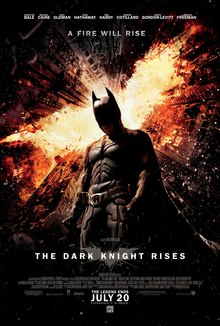
The Dark Knight Rises

Christopher Nolan’s Batman has become a respected, beloved and honored cinematic series. The Dark Knight films, all starring Christian Bale in the lead role, have taken Batman to a dark, brooding place that he had never before been taken. Much of that is due to the serious tone of the films coupled with the deeper Bruce Wayne back-story that audiences have been presented with and the vibrant and multifaceted villains that have been reintroduced to in this series. Led by Heath Ledger’s iconic and immortalized take on The Joker, the villains are now expected to offer an element of psychological depth that had yet been explored to this extent. That said, The Dark Knight set the gold standard for what all future Batman movies could and should offer.

The Dark Knight Rises opens eight years after The Dark Knight ends and the death of Harvey Dent. Police Commissioner Gordon has let Batman take the fall for it and along with the death of his beloved Rachel (Maggie Gyllenhaal in The Dark Knight)years earlier, alter ego Bruce Wayne has lost the will to carry on his mission of protecting the city and leaves that job up to the police force. He becomes a recluse, closing himself off in his mansion and neglecting his financial responsibilities and public persona. It is only when Bane, a new and powerful villain appears in Gotham does Wayne realize he is needed and dons the bat suit once again, albeit somewhat reluctantly. In addition to being at odds with this new force of evil, Batman/Bruce also has two new potential love interests/femme fatales to deal with – Marion Cotillard as Miranda and Anne Hathaway as “cat”-burglar, Selina Kyle. Because, what would a Batman movie, or any movie at that, be without a love interest?

Bane is a villain who seeks chaos, not unlike his predecessors yet his underlying motivation is not made particularly clear. He repeats the dogma that he is giving Gotham back to its citizens and in doing so decides to blow up the Gotham Stock Exchange, the symbol of financial corruption and elitism. He portends to be the ultimate 99%er and relishes at the opportunity to bring chaos to the streets by overturning the class system. This is of course rather ironic as the Right Wing Conservative pundits, namely Rush Limbaugh, have accused Nolan of embodying left wing Hollywood liberal bias for naming his latest villain after Mitt Romney’s former company and as his involvement there is being scrutinized. Aside from the fact that the film is in-fact vehemently anti-99% as it depicts the mob mentality as destructive and dangerous. Further, Bane was actually first introduced to fans of the comic book in 1993 by DC comics, nearly 20 years before the issues of the 2012 election were even a thought.

But, I digress.

Bane is more than a traditional villain from superhero comics. By today’s standard he comes off as a relentless, morally corrupt heartless terrorist. He has superhuman strength and intellect and Bruce Wayne who has been holed up in his mansion as a recluse is now no match for him. Personally I found Bane to be almost cartoonish rather than evil. The mask obstructs his face throughout the entire film which detracts from any sense of humanity that he might otherwise have and thus relinquishing some of the fear he should be demanding. Contrasted to The Joker’s mask which was merely paint, and severely smudged at that, which still allowed Ledger to convey maximum expression and create a psychologically complex villain with a dark past. Moreover, when a psychological look into Bane is offered it falls flat due to a lack of being able to see his expression – you can barely even tell it’s Tom Hardy playing him. Besides that, the mouth-mask/voice effect often made it difficult to understand what he was saying and when I could hear him he sounded a lot like Sean Connery. A great Batman movie is usually based on the strength of its villain and with Bane, it just doesn’t deliver the same punch.

Gotham has traditionally shot in multiple locations and while it has always been a gritty urban area, it has never been “outed” as being a specific locale (Chicagoans want to believe it’s supposed to be their town and New Yorkers are smug enough to just assume it is, because why would it be anywhere else). Even this film was shot in the UK, Pittsburgh and New York, as well as others yet there were moments when it’s anonymity was clearly lost in favor for identifying Gotham as Manhattan. The presence of the Freedom Tower, Brooklyn Bridge, and Empire State Building mark it as such as a very obvious way even though the city is also supposed to contain a Football stadium in its center. With the city under siege it felt more like a gritty apocalyptic and dystopic thriller based in reality and practically pulled from the headlines rather than a superhero blockbuster.

Further making it feel less like a traditional Batman movie is the apparent lack of Batman himself throughout the film. For much of the movie Bruce Wayne is either locked in his ivory tower or locked in a dungeon (not really a spoiler, don’t worry), but in neither instance is he actually Batman. I wanted to see the Bat Suit, the Batmobile and other fun Bat-gadgets, but this film is a lot more heady than it is The lack of screen-time Batman actually had was surprising and definitely felt lacking as I found myself asking, “Where is he?!” He does, of course, return for the final showdown, one which was spectacular and offered an edge of your seat thrill, which is just what the movie needed.

That being said, this dark direction seems to be making sense for the evolution of the genre in our day. With the economy still in shambles, the job market no looking particularly optimistic, our world seems dystopic. Yet, the American dream does prevail and there is still is a sense of self-reliance and helping yourself when others won’t or can’t. Batman resounds in particular as he is famous for his lack of superhero powers. He’s an ordinary man who made himself great through strength of character (and a hefty trust fund left for him), but despite that he does so without the help of supernatural features. In that regard Bane and Bruce Wayne are direct foils. They have many similarities, but it is their social status that separates them. Both are orphans, both are particularly talented in terms of their strength and intellect, yet the one born in poverty and imprisoned becomes a mass murderer and torturer while the other born in the Regency Room of Wayne Manor becomes a savior. Rises asks, can you escape your destiny? Can you break free of whatever bucket society puts you in? Should you even want to? It presents a reality where social status definitively determines how your life unravels, a markedly Un-American ethos.

Finally, I had a hard time separating my perception of the film with the shooting tragedy in Aurora, CO. The film was obviously made well before the incident occurred, yet as I was watching the film, my eyes occasionally distracted by the two police officers who surreptitiously poked their heads into the theater to make sure all was calm, I couldn’t help but be wonder about the frivolity in which our culture promotes gun violence. Perhaps I wouldn’t have thought about it in this regard without the Aurora tragedy but during the multiple sequences where Bane and his henchmen storms around Gotham shooting their guns and missiles I was profoundly uncomfortable by the blasé attitude and everyday nature we place on abject violence on screen – especially on contrast to how there is uproar over sexual promiscuity on screen. The severity of being nonchalant about violence on screen was particularly heighted and adversely effected my reaction to the film.

In all, while there were lulls during the film and stark departures from what makes a Batman film great, the third and final installment in the Nolan/Bale trilogy offers fans a satisfying conclusion to the most financial successful and culturally relevant Batman series to date. It has offered new insights into characters audiences thought they knew and brought new depth and meaning to what it means to be a superhero.

Friday, July 13, 2012

A Case for Sunday Mornings

There’s a show that I DVR every week that I love.  I hate missing an episode and while I'm watching I'm totally enthralled with what's being transmitted onto my TV screen.  I’m not anywhere close to the target demographic which means that none of the advertising is geared towards me nor is it on during a time-slot I would ever choose to be up at (hence the DVRing).  However, this show has provided me with more knowledge than almost any endeavor I’ve ever undertaken and definitely more than any other TV show.  I frequently reference the information I’ve garnered from it and impress my friends with my plethora of facts.  So, what show could possibly live up to this?  I’m talking about CBS’s Sunday Morning and it’s on (you guessed it) Sunday mornings from 9-10:30am.  If you’ve never heard of it, it’s that show with the iconic sun logo – sound familiar?  If you still don’t know what I’m talking about, ask your parents or grandparents about it, I’m sure they know it.  There’s no frills, no competition, no built in drama or conflict, no flashy graphics, but there’s a lot of heart to it and it's a quietly offers more honesty than anything else on television.

As a kid, nearly every Sunday morning I would wake up, wander into my parents room, climb into bed with my mom and dad, sometimes a sibling would join too, and we’d watch as Charles Kuralt took us through the segments of Sunday Morning.  My dad and I are both known in our circles as being the keepers of random information.  We love and absorb trivia – both trivial and significant - so this show is perfect for us.  We’d get a thorough insight into what was happening in America that week, but we’d also learn about interesting stories about celebrities, politicians, artists, and every day people that are making differences in their communities (like the woman who has sent out over 7,000 care packages to the troops overseas and the retired man who decided to start painting the houses in his poor, run down town to lift his neighbor’s spirits about where they live).  Additionally, Sunday Morning covers stories that the weekday news does not bother with, such as music, theater, and interesting architecture.  Occasionally they’ll even have entire shows around one specific theme.  For instance the money and design episodes have come to be annual events.  Now Sunday Morning is hosted by radio personality, Charles Osgood, and is just as engrossing. 

Conceived in 1979, Sunday Morning aimed to emulate the Sunday newspaper magazine section and, as opposed to the morning news shows, was meant to only focus on feature stories.  The show starts with a quick rundown of the week’s top stories, a national weather report and then goes into what is basically a table of contents for the rest of the show.  Admittedly, I fast forward through all of that so I can get to the good stuff.  Between the segments there’s weekly standards that punctuate the show every week they have the Sunday Morning Almanac, which is essentially a “today in history” segment which offers interesting milestones – for instance, did you know that earlier this month Silly Putty celebrated its 60th birthday?  Do you know how it was invented?  I do.  Fast Draw features two guys drawing pictures on a white board to inform audiences about a certain topic – recently why rain doesn’t actually “break” humidity (even though that’s what everyone thinks it does) it actually makes it worse. 

Each week there’s the Sunday Morning Cover Story which is usually the longest and most in-depth feature often about a timely issue and Sunday Morning Profiles offers a glimpse into the life of a celebrity or other public personality in an intimate interview.  Every couple of weeks Ben Stein offers his curmudgeonly advice on the economy, Mo Rocca and Bill Geist track down the random oddities in our country (like people who still build log cabins, the National Goldfish Competition or the Annual Betty Convention) which makes us unique.  Nancy Giles shows up every now and again to talk about her life, whether it’s anecdotes from when she was a struggling actress and how Nora Ephron inspired her to keep pursuing her dream.  And David Edelstein offers his reviews on that week’s movies with his wry and honest commentary.  Then, of course, there's the "Moment of Nature" which closes every episode.  Again, I admit to fast forwarding this part too, but before I do, I always wait to find out where they went this week to find that clip as it often amazes me just how diverse and beautiful the American landscape can be.

What’s special about the segments that Sunday Morning provides is that it often offers a different perspective on something which we thought we knew about.  Be it the smaller pieces or the bigger, central features, Sunday Morning offers a unique view into the world that I haven't seen offered in another context.  For instance, a couple of weeks ago there was a segment about a woman who, after six weeks of marriage, her husband was shipped off to fight in World War I.  Soon after he left he was reported missing and was never heard from again.  She called and wrote letters to the state department, congressmen, her local government officials, and nothing.  Recently her brother-in-law discovered some new information about him and finally found that not only had he been killed, identified and buried in a town in France, he was considered a hero by the locals as he gave his own life to save the entire town.  This man is a hero overseas and his widow only recently discovered this.  Now she makes a pilgrimage once a year to visit his grave, the town and it’s citizens, and the street that’s named after him.  It was a wonderful human interest story about resilience and heroism.  It also exposed a major failing of a government which is supposed to be supporting our war heroes.  In a television landscape that’s fraught with shouting it was a quiet tale that without Sunday Morning would have never been brought to the public.

These days, I no longer watch the show with my parents on snuggly Sunday mornings.  But I do watch the show every week and so does my dad.  While we don’t have a standing “recap” conversation after the show, we’ll often times find ourselves chatting about the random bits of information we’ve learned from the show.  In that sense it’s a special way that my dad and I connect with one another and always giving us something to talk about outside the normal parent-child conversations.  

The show continues to plod along, quietly and modestly, without fancy advertising or making much noise to beat out the rest of the clutter that’s out there.  But for those of us who do watch it (and don’t get me wrong, I know there’s a significant amount of us out there, I’m just a generation or two younger than them) it’s a gem of class and consistency in an otherwise bombastic and cacophonous television landscape.  So, even if it's outside of your normal viewing habits, give this show a chance - you won't be disappointed and you'll definitely learn something.

Thursday, July 05, 2012

Brave

Disney has made a name for itself being in the business of princesses.  Specifically, in girly, frilly, boy-obsessed and dainty princesses.  I loved these princesses and wanted to be all of them, have their pretty palaces and most importantly their cute (often royal and always adorable) boyfriends.   In Disney’s Pixar’s new computer animated film, Brave, the princess is the Scottish tomboy Merida (voiced by Boardwalk Empire’s Kelly Macdonald), who’s strained relationship with her mother Elinor (Emma Thompson) and her disinterest in being married off to one of the lame suitors she’s offered leads her to escape to the Scottish highlands where she encounters a witch’s cottage.  Inside, the witch offers her a spell to “change her mother” and when Merida accepts, she doesn’t expect it to literally change her into a bear.   Having to escape the castle with her newly transformed mother the feuding pair must learn to respect each other’s personalities, perspectives and talents in order to break the spell.  Instead of this princess overcoming her own predicament to find love with her prince, Merida’s challenge is to learn to respect her mother’s perspective and role while in turn Elinor must learn that her daughter’s independence does not mean disrespect of her or of her tradition.

While visually arresting, as the rolling Scottish hills are delightfully presented, Brave doesn’t have the same nods to adults as other Pixar films traditionally have had.  It’s much more a throwback to the more traditional princess films – vaguely medieval times, royal families, mysterious and possibly evil witches and, of course, the independent and impulsive princess (with trademark hair, of course).  Yet the biggest difference is that there is no central love story.  Rather than making the character development and story predicated on her relationship vis a vis a guy she’s lusting after, it’s based off of her refusal to do just that. 

Further, the mother/daughter relationship has rarely been explored in these Disney princess movies as most princesses don’t generally have their mothers.  If you think about it in almost every Disney princess film (save for Sleeping Beauty) the princess only has one living parent.  Merida has both, alive and well throughout the whole film.  Her mother undergoes a physical transformation, but the emotional connection remains strong and it is the development of that relationship and the strengthening of it is what the focus of the film is on.  It is also the particularly closer relationship she has with her mother and her father, King Fergus (Billy Connolly) that highlights the differences with her mother even further.  From external features like having inherited his bright red and unruly hair to her impulsive and carefree manner and her love of an adventure, she is directly aligned with her father and his very male characteristics (not to mention her triplet brothers also have those same personalities).  It seems like her mother is the odd one out in the family and she is desperately trying to get Merida on her side despite Merida’s constant refusals.

When Elinor tells Merida that the time has come for her to choose a husband, suitors which come from the far corners of her father’s kingdom to prove their worth to her.  They arrive and are most definitely all losers.  Arrogant, stupid, ugly, incomprehensible, useless, etc, none of them come close to being able a worthy partner for her.  These are the best her kingdom has to offer?  She understandably resents this process and refuses all of the men (boys, really) who have come to vie for her hand.  The movie’s message would have been strengthened if some she had marriage offers from Prince Eric lookalikes.  It’s not so hard to defy the advances of doofuses as a statement of female independence, but the film’s impact would have been even stronger if she had a great guy at her hands but said she had more living to do before she resigned herself to a life of needlepoint and public appearances.  In reality the tides are changing, women are getting married older after gaining success independently so it’s no wonder Disney is making the statement that this is an ok option.  It would just be nice to do so without disparaging the male counterparts.  In fact, all of them men in Brave are kind of doofusy.  Fergus is lovable and a great dad, but he’s kind of all over the place.  Merida’s brothers are little boys, but they’re huge trouble makers and the suitors, their fathers and their landsmen are all war-mongers with a penchants for violence.  Why must one gender gain independence and respect at the expense of another?  Unfortunately as media is showing stronger more liberated women, men are being disparaged and infantilized and that doesn’t isn’t really helpful either for maintaining a strong society.

Moreover, as I was watching this, I kept thinking to myself, how come the only way a girl can be independent and different is if she’s painted as a tom-boy, or more specifically, a boy?  The manner in which she is depicted as an atypical girl is doing things boys would do – archery, horseback riding (bareback, I might add), rock climbing, and going on scary adventures.  It seems to delineate gender roles even more strikingly than breaking down the barrier – if women can only break out of their proscribed roles by doing manly things (and assuming its vice versa) then it’s really just reinforcing what men’s roles are.

Also, total side note – as has become Pixar tradition, an animated short precedes the film.  This one is La Luna, the Oscar-nominated short that in only a few minutes provides visually arresting images and so much heart as three generations learn from one another in a magical setting.  If you go see Brave make sure to get there early so you can catch this short gem.

I enjoyed Brave, Merida is a strong (albeit sometimes stubborn) female role model that today’s generation of young girls can truly look up to.  She doesn’t allow herself to get pushed around or bullied by social norms (and by that I mean her mother).  At the same time she is open to learning about others and respecting their traditions while also forging her own path, and that’s a lesson everyone can learn from.

Tuesday, July 03, 2012

Rock of Ages

Converting a performance from stage to screen is not by any means uncommon, but that does not mean it’s easy nor is it always successful.  Such is the case with Rock of Ages. Not having seen the Broadway version I cannot comment on the quality of the show, but there’s no way it could be as bad as the movie translation.  When watching something on Broadway, the viewer allows certain suspensions of disbelief that moviegoers do not.  From the first frames when Sherri Christian (Julianne Hough), our lead protagonist, is sitting on the bus escaping her podunk life in Oklahoma to chase her dreams to Hollywood the needed suspension of disbelief is just too great.

The story is this: a lonely, small town girl  goes on a journey (see what I did there?) to Hollywood to explore her dream of being a singer after her grandmother tells her she has a great voice.  In the first moments of getting off the bus in what was then grungy 1980s LA she both gets mugged of suitcase filled with her most prizes possessions – her records (apparently moving cross country with actual clothing is not what was done back then) and she meets Drew (Diego Boneta), the bartender/rock star wannabe that will become the love of her life.  Drew works at The Bourbon Room, a legendary (code: grungy) bar that hosts rock icons and is preparing for the arrival of legendary (code: grungy) rock icon, Stacee Jaxx (Tom Cruise).  Jaxx is a whisky-infused, sex crazed and definitely aging rock star who still causes throngs of girls to faint at the mere sight of him.  Bourbon Room owner Dennis (Alec Baldwin) and his partner Lonny (Russell Brand) are relying on this concert to save the bar from bankruptcy and at the same time right wing, anti-fun politicians want to shut it down for being a harbinger of youth corruption. 

Rock of Ages has all the hallmarks of a run of the mill light fare musical romp/romantic comedy show.  It doesn’t offer anything really new or exciting to audiences and the filmmakers, namely director Adam Shankman was so lazy in adapting it from the stage to screen that you don’t need a lot of creativity to imagine how the original stage production was performed.

All that being said, Rock of Ages doesn’t claim to be a piece of cinematic marvel.  It’s campy and silly and it owns it, which almost makes the ridiculousness ok.  You’re immediately thrown into the 80s rock aesthetic from the hair and music to the clothing to the set design.  Honestly, that’s what I was mostly drawn to with this movie.  I wanted to all things 80s and in that regard the movie definitely delivered.  I was very pleasantly surprised by Tom Cruise’s performance – he totally pulls off the aging rock star image.  And (while I’m sure it was enhanced in post-production), he can actually sing.  The music was excellent – but that’s not surprising as they were all 80s-standards and rock classics.  I wanted to sing along and clap at the end of the big numbers, as I’m sure happened in the stage production, but alas, movies goers just don’t do that so I was left mouthing the words and sitting on my hands at the ends of the performances.

What I think was the most interesting thing about Rock of Ages was that it is the latest in a growing list of movies and TV shows which are curating our favorite songs for audiences.  Along with Glee, the upcoming Battlefield America, Pitch Perfect and not to mention musical remakes like Footloose old favorites from the original iterations are revamped in neat, easy to digest packages.  In a sense, television and film are putting together what feels like a modern day mix tape.  In today’s internet age, videos, songs, article, and pictures get shared in an instant across oceans.  However, through this, one of the most sacred sharing devices has been lost: the mix tape.  Mix tapes were given to friends, crushes, and family as a sign of affection and wanting to share something that was important to the person who spent painstaking hours waiting for songs to come on the radio and hitting “record” on their boom boxes.  Sometimes, if you were lucky enough to have the song on a preexisting tape you could record straight from there.  But in any case if someone gave you a mix tape it meant you were special to him or her and they wanted to share something sacred to them.  While the tape itself had meaning, the songs themselves were important as well.  Emotions and feelings of nostalgia are evoked by both the idea of curating songs and the songs themselves - and show runners and filmmakers know this.  By giving us music packaged in this way and as plot devices, audiences are naturally drawn to the vehicle in which they are being presented.  The music is likely the main (if not only) reason for any success of this movie.  The plot is barely existent, the acting is stilted and even the singing is generally weak but the songs are great, fun and familiar and people want fun and familiar.  Without them there’s no way it would have earned a respectable $29 million in under 2 weeks.   

There’s also something to be said about the draw that the 1980s has for people of a certain generation.  People like me, for instance, who were really children of the 1990s and only caught the end of the 1980s can still appreciate and nostalgize that era and for people who were actually teenagers in the 1980s and long for the time of their youth.  Nostalgia and a longing for the past when one can say “the good old days” is a powerful force and helps drive revenue, even if they weren’t really such good old days.  It is also for that reason that Rock of Ages, no matter how “bad” of a movie it is, had a built in audience base of people who will go see anything that can make them feel like they’re either reliving or reconnecting to their pasts.