Academic Writing

Wednesday, June 27, 2012

Nora Ephron, Remembered

Had you asked me last week if I was a Nora Ephron fan I likely wouldn’t have been overly enthusiastic about it but I would have said something like, “Sure why not? I liked her movies and her characters.  She’s pretty funny.  So yeah, I’m a fan.” 

In less than 24 hours since her passing as the internet has become a frenzy of clips from her movies, quotes from her books and general laments over her passing it’s become clear just the extent of her impact on both cinema and women in cinema.  Her female characters were at the same time feminine and strong.  Self-assured yet vulnerable.  In a word: relatable.   Additionally, Ephron was a lover of “the movies” and her characters conveyed that to us, the audience.  From the way Rita Wilson in Sleepless in Seattle sobs over the love story in An Affair to Remember to her creative reimagining of Shop Around the Corner in You’ve Got Mail she brings the movies to life in a new and invigorated way.  When Harry Met Sally, while now almost 25 years old, remains a touchstone for examining the dynamics in male/female relationships.  

Her films are inexorably linked to modern pop culture:  When Harry Met Sally is ranked #6 as the all-time best Romantic Comedy by AFI's 10 Top 10.  In fact it’s ranked in almost all of their top 100 lists:  2000: AFI's 100 Years... 100 Laughs - #23, 2002: AFI's 100 Years... 100 Passions - #25,     2004: AFI's 100 Years... 100 Songs - #60, "It Had to Be You,"    2005: AFI's 100 Years... 100 Movie Quotes - #33, "I'll have what she's having.”   In Sleepless in Seattle she connected with a generation of children that so desperately wanted to be back in a stable family, with men and women seeking love despite logistical barriers.  You’ve got Mail told the love story of two people who were and should be at odds with one another while also taking the internet, while still in its fledgling state and predicted just how integral it would become in both building and destroying relationships.  She bridged generations of women with Julie and Julia by placing significance on their passions.  Another important hallmark of her work is that she never demonized men.  So many romantic comedies want their male leads to be bumbling idiots that women are drawn to because of their charm or good looks.  Her men are smart, encouraging and positive forces in the lives of the women at the center of the narrative.  Modern day writers should take a cue from her and understand it’s not a mutually exclusive relationship. 

Now that she’s gone and the information superhighway has been bubbling over with her work I’ve had a chance to reflect not only on her films but her legacy as well and her impact on the depiction of women in film.  She wrote women the more like women actually are than almost any other writer is offering.  She writes relationships as complex and multidimensional.  She understand that men and women are different, but can still be equal and neither has to be demonizing to the other.   So would I say I’m a Nora Ephron fan?  Now I’d offer an emphatic “Yes.”

Here are some of her great scenes:


This one from When Harry Met Sally is probably her most famous:
This one from Sleepless in Seattle gets me every time: 
  
Here's the one from Sleepless in Seattle that I mentioned with an homage to An Affair to Remember:  
 
This had to get posted because eating is one of my favorite pastimes too :) 
 
This one from You've Got Mail here, is one of the sweetest scenes in a movie: 
 

Sunday, June 03, 2012

Snow White and The Huntsman

Here we have yet another iteration of the Snow White and the Seven Dwarfs story.  I've already written about it here and here, but after seeing Snow White and The Huntsman, I thought it deserved some more real estate on this blog.  This film is very much an updated version created for the modern day.  None of the characters fit into the rather one dimensional frameworks that Disney had put them in nearly 80 years ago.  In this version, soon after The King’s beloved wife dies, he marries another in hopes of alleviating his pain and forgetting his past.  This new wife, Ravenna (Charlize Theron), turns out to be a man-hater who goes from kingdom to kingdom destroying the men there and feasting on the beauty of young virgins to maintain her youthfulness.  During her reign, The King’s daughter, Snow White (Kristen Stewart), is locked in the north tower, never seeing the light of day (maybe that’s why her skin is so fair) and waiting for the chance to escape. 

When she gets that chance and she runs away into the Dark Forest, a mysterious place filled with dangerous magical flora and fauna and from which only one man is known to have survived.  Ravenna sends that man, The Huntsman (Chris Hemsworth), to seek her out and return her so she can steal her beauty and reach immortality.  Rather than bringing her back, however, The Huntsman is taken with Snow and seeks to protect her as they navigate their way back to Snow’s childhood friend, William, and his father The Duke so they can seek vengeance on The Queen.  Along the way they encounter the seven dwarfs (originally 8, but one is lost in battle), who, while don’t hi-ho their way through the wilderness, do teach Snow the power of her inner beauty and become an integral force in their army.

Kristen Stewart does an ok job in this role.  I am generally underwhelmed by her performances and find her expressions blank and uninteresting.  She has moments of more depth in this film, but they are generally fleeting.  It's hard to understand why she even landed this role.  Additionally, audiences are supposed to believe that she is the fairest of the land, not only because of her beauty, but because of her heart.  Yet, other than a moment of compassion for an injured crow in the first scenes of the film, it is unclear why she is so wonderful.  Her character is rather one-dimensional, and in the hands of a stronger actress she could have been more interesting.  The male characters also do not provide much depth as they are mostly there to help and mentor Snow (and, let’s be honest, to provide some very much appreciated eye candy!).

Contrasted with Stewart’s lackluster performance was Charlize Theron.  Theron brought so much emotion and depth to this role; you’re almost exhausted watching her.  Most of all, I found myself often paying attention to her eyes.  Her eyes reflected her every emotion and feeling throughout the course of the film.  The bright blueness of them were in stark contrast the dark and gray world her evil brought to the kingdom.   I very well might be reading too much into it, because in fact she just has blue eyes, but , if the eyes are a window to the soul, at times they seemed to be saying that she’s really a good person deep down, but her unfortunate circumstances let her to this very dark place. 

The visual effects are impressive and in addition to the depiction of magic that they provide, it also allows viewers the opportunity to be transported into different worlds.  The film has three main locales – the palace where the queen does her bidding, the Dark Forest, where no one other than spirits or demons are known to survive, and the Enchanted Forest, which is a clear nod to the 1937 Disney film and allows Snow an opportunity to frolic with fairies and bunnies. 

It’s interesting to me that the title of the film is Snow White and The Huntsman, which would make it seem that the central and most compelling relationship is between the titular characters.   Rather, while they have very little screen time together, the most thought-provoking relationship is in fact between Ravenna and Snow.  Moreover, that central relationship is strengthened as there is never an outward struggle between William and The Huntsman as they vie for Snow’s affection.  The film is about women battling it out between themselves and to throw that love triangle into the mix would water down its message.

The film is about the relationship women have with each other, especially regarding power struggles, and how beauty plays into their societal role.  Further, the ultimate message is not that women don’t need men to survive.  It’s just the opposite.  Snow needed men throughout the entire course of the film. She needed her father.  She needed William.  They both, for reasons out of their control could not be there for her.  Then enters The Huntsman, who is there for her and who helps her survive and teaches her survival skills.  The Dwarfs also prove vital to her survival.  It’s OK for women to need men, that doesn’t make them weak.  Different people bring different skill sets to the table and that’s ok to acknowledge.

The Queen is obsessed with maintaining her beauty as she believes that will determine her place in society.  The mirror encourages this and tells Ravenna that her beauty is the source of her power so she must do all that she can to maintain her beauty.  In this case, it’s very obviously her physical beauty.  She literally feeds off of the beauty of others to keep herself physically beautiful.  While obviously dramatized, to some regard this is something women do all the time.  We live in a society where it’s very hard for women to support other women without feeling as though their power is at stake.  Often they must demean other women to assert their power.  Snow’s beauty is really about her inner splendor.  It just so happens she’s beautiful on the outside, but throughout the course of the film – both by her mother and then again by The Huntsman, she is praised for her purity of heart.  It is what inspires other around her and what Ravenna really despises about her.  Snow is everything the queen cannot be. 

Something else interesting in this line of thought is that the beauty that the queen seeks is partially about her own vanity, but also about her need to have others, mainly men, find her beautiful.  Her evil is initiated when she was stolen from her mother by soldiers.  When she stabs The King she tells him that it is men who bring the destruction of women and therefore he must be killed.  Yet, she seeks the approval of men while also destroying other women.  Her brother (with whom she has a disturbing psycho-sexual relationship with) feeds her ego, reminding her of her beauty.  Her mirror, the one who she seeks out to reassure her of her status of fairest of them all, is a male voice who consoles her and who tells her she must kill Snow White to maintain her status.  The Queen, like so many women, needs the reassurance of men to feel good about herself.  Additionally, in this story it is the queen’s sycophantic men who feed this female on female power struggle.

While they are positioned as ultimate foes and in direct contrast to one another, there is a link between Ravenna and Snow.  This is manifested through the reoccurring visual theme and use of birds.  Thanks to Alfred Hitchcock, masses of birds represent anxiety and Snow White and The Huntsman plays off of that theme.  Snow saves a crow at the beginning of the film, and later one they return to her to lead her to safety in another number of instances.  The Queen herself, Snow’s direct juxtaposition, is also aligned with birds as not only feasts on their hearts, but also summons them to aid in her dark magic.  Her name, Ravenna, conjures thoughts of Ravens, her bird of choice, and a clear image of death and darkness.  This creates a connection between Snow and The Queen.  Yes, they are vastly different, but they are also similar.  They are both considered “the fairest,” they are both torn from their families and seek vengeance.  They just go about it in different ways, offering two perspectives on how to handle a given situation.

In the original fairy tale, The Huntsman was a real danger and threat to Snow White.  In 2012, the real story is about how The Queen was her ultimate adversary.  The original Disney film portrayed a weak, victimized Snow White who solely relies on the good deeds of others and her one true love, prince charming, to save her.  This Snow White does need the help of others to teach and guide her, but she develops over the course of the film and learns that she must fight to defend herself.  She laments to William that she could never be queen because she does not know how to inspire people and yet, by the end of the film has found her voice and manages to stand up for what she believes in and be the powerful force she must be.

Friday, June 01, 2012

Are Strong Women Just Things of Fairy Tales?

America is having a hard time with women these days.  Current politics would have us believe that women are either helpless or slutty and need to be put in their places.  You want birth control pills so you can have just as much sex as men?  Well then you’re a slut.  You want to have an abortion because, for whatever reason, you don’t want to have the child you’re carrying?  Well, then you’re a murderer.  I can go on.  Jon Stewart is doing all that he can to point out the ridiculousness of the situation, but politicians have chosen their sides and are sticking to them.  Those supporting the bills often cite the bible and religion as reasons why they are justified in proposing them.  Those who oppose it have morality, compassion and reason on their side (but that’s just my totally unbiased opinion).   The policies against women’s reproductive health that are being brought to congress are made by men.  Their female counterparts in the government are doing all they can to counterbalance what they are introducing, but have yet been not been overwhelmingly successful.

Television and pop-culture, however, would have us believe that women are, in fact, anything but helpless to the whim of men and have control of their own destinies.  They don’t need the support of men to care for themselves, and without the control of men keeping them down they are stronger and stick up for themselves more.  But maybe it’s all one and the same.  Women are getting stronger and more independent and those who are imposing these offensive policy changes are trying to bring us back down to a more manageable state.  The media has picked up on this desire for women to take control of their lives despite (the often right wing) policies that are trying to keep them down.

Just a few examples to make my point:

1. Once Upon a Time:  This show is essentially about three women jockeying for power in different realms – Regina Mills (Lana Parrilla) and Emma Swan (Jennifer Morrison) in the non-magical world and The Queen (Lana Parrilla) and Snow White (Ginnifer Goodwin).   These women are strong and powerful in different ways – and need men in different ways, but none of the men in their lives effect their power.  Regina comes off as though she doesn’t need any male figures in her life.  She claims to love her son, but uses him more as a bargaining chip to assert power over Emma than a child.  She casts aside any man who shows affection or sympathy for her.  It’s only close to the end of the season when she allows herself to be vulnerable and show romantic affection for a man.  All of her actions are predicated on her lust for power and to overcome anyone who gets in her way.  Emma, as we find out, was saved from death in the magical world and then again in the non-magical world because of the help from men.  She has always been a loner, taking care of only herself and only learned to love anyone through her newly found biological son.  Then there’s Snow White, who in both worlds is a hopeless romantic but is able to cast that aside and take care of herself when need be.

Additionally, it's interesting that this show has taken a classic Fairy Tale and turned it upside down to make it relevant to today's viewers.  You can read more about that here.

2. Mad Men: In a time that is historically known for being chauvinistic and when women were just starting to find their voices, this show, especially in the current season, has highlighted the different ways women have found their voice.  For instance, Peggy (Elisabeth Moss), is sick and tired of Don (Jon Hamm) excluding her from business meetings and career growth opportunities because she is a woman.  Ultimately, she finds a bargaining chip and sought out to impact her own future despite Don’s controlling nature.  She knows her talent and seeks out other career opportunities that won’t take advantage of her as Don has done time and again.  The implicit irony, of course, is that she only can do so with the help of other men.  

In direct contrast to the asexual Peggy, there’s the voluptuous, practically oozing with sex, Joan (Christina Hendricks) who knows her power lies in her sexuality.  As much as it disgusts her to do so, she knows she must use that asset to her advantage.  She knows that since she cannot rely on her husband to care for her and her son, she agrees to sleep with a sleazy car salesman her to ensure the company lands the Jaguar account.  Again though, similar to Peggy, her available power is brokered by men, in this case the male partners of SCDP, that knew it would be good for business not taking into consideration how it would make her feel.  So while ultimately her decision was made for herself and she negotiated her terms, it was not something initially posed by her for her own good.  But she does recognize the power she has over the men in the company and uses it to the best of her ability.

3. Snow White and the Huntsman: In yet another iteration of the Snow White fairy tale, this film takes on a very different perspective of Snow’s ability to defend herself from the evils of The Queen.  Unlike the timid and helpless Disney version of Snow White and more similar to Once Upon a Time, Snow is perfectly capable of fending for herself and picking up a sword for her own protection. What is interesting here is that ultimately she does need the help of men to survive her journey to reclaim her royal birthright, but when it comes to the final showdown between her and the queen, that is a battle Snow must face on her own.   


Additionally, the relationship they have with men is also particularly interesting.  Snow needs men at every stage of her life - be it her father, The Huntsman, The Dwarfs.  They support and defend her.  The Queen on the other hand surrounds herself with men who perpetuate her lust for beauty and who propagate her need to destroy other women.  The duality is striking as the ultimate message is NOT that women do not need men, it's just the opposite, but it also comments on both the positive and negative effects of reliance on them that can bring. (For a full review of Snow White and The Huntsman, click here.)

These are just some examples, I could go on and on about how the media portrays women as self-sufficient and strong characters able to take care of themselves and won’t allow men to simply dictate how their futures will pan out .  If you want to do some research on your own, check out the women of Game of Thrones, VEEP, Law & Order: SVU, Sons of Anarchy and so on.  While these examples are from very recent memory, there have been strong female characters available on television and cinema for years.  Yet, given a seemingly overwhelming surge in these characters recently, we seem to be in somewhat of a renaissance.  More often than not women are self-sufficient and take on a strong role in popular culture and when they don’t it’s almost jarring.  Take HBO’s new series Girls.  Many critics have taken issue with the all-white character landscape of the show, but one of my issues with it is how much is seems to be sending young women back into the dark ages of relationships.  I don’t need to watch neurotic girls making the same mistakes that they’ve been making for decades.  We’re past that as a culture and a society and let’s have role models on television that while yes, do make some mistakes now and again, don’t base their entire lives on their interactions with men, asshole men, I should add.  The only guys who aren’t assholes on that show are painted as weak and lame in contrast to their female partners – Hannah’s (Lena Dunham) father and Charlie (Christopher Abbott), Marnie’s (Allison Williams) boyfriend.  Why does it have to be either/or.  Why can’t strong, positive, women exist with strong, positive, men?  And, when men are the weaker sex, why are their female partners domineering women?  Further, when a show or film are centered around just men, why are they immature man-boys?  Although I haven’t seen an episode of it yet, the new TBS series Men at Work seems as though it will fulfill that prophecy based on the promos alone. 

Bringing it back into reality, I often wonder if it’s these conflicting images of women and men that has helped contribute to the higher rates of unmarried men and women as the proposed gender roles in media are unrealistic.   Women are portrayed as strong and not needing a man.  If these strong women were to seek out a man they’d likely be stuck with some weakling.  Any man who finds a strong women would assume that that makes him weak, and what guy wants to be seen as a weakling?  Ironically, one of the most evenly matched relationships on television is between Don and Megan on Mad Men.  As misogynistic as he is, she stands up to him time and again asserting her independence.  While in other instances her loyalty to a man might come off as needy, Megan is faithful to him without giving up any part of herself and what she wants out of life.

In a world where women are becoming stronger, getting more higher degrees, earning more money and starting to put a real break in that glass ceiling, men seem to feel the need to push them down, at least on an institutional level.  Further, while the media is portraying women as strong, positive role models for other women, the representations of men have been suffering.  Why does one party have to suffer while another one thrives? 

Wednesday, May 23, 2012

Freak Shows

Sideshow Freaks.  It has been a staple of American entertainment practically since mass entertainment began.  Ringling Bros. and Barnum & Bailey Circus established ogling at the misfortunes of others as an acceptable form of entertainment.  Bearded women, midgets, pinheads, giants, and limbless individuals were all part of their “Sideshow Freaks and Human Curiosities” area of the overall show.  Not only did it make the gawkers feel better about themselves and whatever predicament they might be in, but to a certain extent it also normalized the different anomalies that would have otherwise completely marginalized those particular individuals.

Today, we don’t have the freak show like the Ringling Bros brought to us; instead they go on television so we can gawk at them from afar.  Take the most recent iteration: Tan Mom.  Here’s a horrible story of a woman accused of taking her young child into a tanning bed.  First reported as a hard hitting news story (please, is that really news?) and now has spawned into a side show attraction.  With appearances on The Today Show (which has a knack of snagging the freaks first as ratings shills) and now being stalked by paparazzi, this woman has amassed a certain amount of celebritydom that is completely unwarranted.  She has no skills and no talents and the only reason people are paying attention to her is her freakish nature.

Reality TV is another realm in which the Sideshow Freaks have been able to reemerge.  Think Jersey Shore and their beyond the realm of normalcy behavior.  Think Toddlers and Tiaras, a show which even the short clips I watch online make me cringe to think people actually allow their children to behave like that.  The parents, in fact, are just as freakish as the kids they are creating.  Think, even, The Biggest Loser, as people we can be glad we aren’t as much as we’re inspired by their transformations.  People who are on the outskirts of society, for whatever reason, have found a place where they can be accepted in a certain way, and that’s on the television screen to an even bigger audience of gawkers.

The idea of 15 minutes of fame is nothing new, but in our current media landscape this fame is being brought to those unworthy of national (and often international) recognition.  Television and the internet have created a platform for the Sideshow Freaks, who had traditionally been relegated to the circus grounds, to come to the national consciousness and rise to fame despite any actual qualifications.  Not only that, they confuse people’s sense of what is deserving of such heightened levels of attention, potentially admiring it and which would cause them to behave in turn and perpetuating this cycle.

The Ringling Bros. proved that it's definitely a part of human nature to be awed by those marginalized by society and learn to appreciate our own predicaments through their misfortunes.  Sounds harsh, but it’s clearly the truth.  But let’s also try to keep things in perspective and not make their misfortunes into celebritydom and, in certain situations, celebrate their contemptible behaviors.

Thursday, April 05, 2012

Titanic Revisited


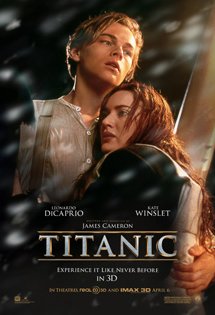
Image source

As a movie fan, film reviewer and general cinema snob I often get asked what my favorite movie is.  I answer the same way every time – “Do you want my film geek answer or my real answer?”  The film geek answer is On the Waterfront and my real answer is Titanic.   This is generally met with smirks and nods of agreement that Titanic, while yes a huge blockbuster hit and created a generation of Leonardo DiCaprio fans, it couldn’t be taken seriously as a real piece of cinematic art.  Well, why not?  With the rerelease of the film on April 4th in 3D for the 100th anniversary of the tragedy I thought I’d take a stab at writing a meaningful review of the cultural relevance of the film and try to understand just why it was such a humongous phenomenon.  

I’m generally not a huge believer in “star theory” as being the main reason people go to the theater, it definitely has validity and especially when it came to Titanic Leo was the star responsible for most of the tickets being sold.  Up until that point his stardom was on a steady incline.  With notable performances in What’s Eating Gilbert Grape, The Basketball Diaries, and Romeo +Juliette among others, DiCaprio was establishing himself as an actor both with a pretty face and with major acting chops who wasn’t afraid to take on important and risky roles.  However, oddly enough, his acting was among some of the harshest critiques of the film.  Of course I, as a 15-year-old girl wholly and totally obsessed with him, shuddered at the thought of Leo being less than perfect and scoffed at the criticism.   He was a big part of what drew me to the theater 5 times (yes, you read that correctly), and I’m not ashamed to say it.   

Another interesting change this movie brought to the landscape was that it highlighted the buying power of not just women, but teenage girls as well.  Teenage girls came to the theaters in droves.  At the time Titanic was the most expensive movie ever made, it also made the most money in the history of the movies.  Anecdotally I can report that it was not boys driving the dollar amounts sky high for Titanic, rather it was young girls going in packs and going again and again.  I wanted to BE Kate Winslet in those days.  I wanted her wardrobe, her looks and, of course, just like her, I wanted Leo.  Leo was a teenage phenomenon in the 1990s and no doubt brought a huge legion of fans into the theaters fantasizing about what it would be like to be Rose and have Leo stare at you dreamily with those big blue eyes.  These days movies like Sex and the City and Bridesmaids have made headlines being touted as proof that women have marketplace influence, but its movies like Titanic which also appeal to teenagers with a lesser sense of fiscal responsibility prove there is another demographic that are willing to pour more and more money into the movie.
Image source

At the time of its release Titanic was a spectacle film that broke out from the clutter of other films.  It was huge, epic, a sight for the eyes!  It didn’t rely on a 3D gimmick or the promise of impressive CGI special effects to get audiences.  Today it seems that all major studio films are just that.  In the media landscape today where there are so many platforms vying for attention from the coveted audiences more movies have to make more noise than they used to.  Titanic, for the most part, relied on actual props and backgrounds – while there was definitely an element of computer enhancement, Director James Cameron wanted as much to be authentic as possible and he actually built a scale model of the ship to accomplish that.  Something that today would be unheard of.  Why make what you can digitally fabricate?  As Janet Maslin wrote in her review of the film for the NY Times on December 19, 1997: “Memos, include Cameron's having persuaded the original carpet manufacturer to make an 18,000-square-foot reproduction of its "Titanic" weave and his having insisted that every sign, uniform and logo for the Southampton sailing sequence also be created in mirror image, so that the camera could reverse the apparent direction of the nearly life-size model ship.  Sets match old photographs right down to the sculpture and woodwork; costumes incorporate fragments of vintage clothing; even the silver White Star Line ashtrays had to be right.”  The movie wasn’t without its faults, of course.  I mean, the list of goofs on the IMDB page is about as long as I’ve ever seen for a movie, but given the scope of the film it’s not particularly surprising that he missed as much as he got right.  But as a viewer it is exciting getting a glimpse into a bygone world.   

That nostalgia for the pomp and circumstance of the past is just as alive today as it was then, and while impossible to attach a cause and effect relationship, it seems likely that Cameron’s movie sparked an interest in that bygone era with legacies including Downton Abbey (whose pilot opens with the news of the Titanic sinking, not to mention the much of the plot is precipitated by effects of the disaster).  While it’s easy to bemoan the way people lived back then, with the class warfare, seemingly unnecessary strict adherence to frivolous ceremony and unmitigated proscribed gender roles, there is clearly an interest in exploring those rituals and Titanic let us peer into that world on a grand scale.  Today we live in a world completely foreign to that one so there is a romanticism placed on these formalities, which in those days, I’m sure, was despised by many, especially the youths.  

Additionally, what was no doubt one of the biggest draws of the film is the timeless love story.  It’s Romeo and Juliette retold on a boat with beautiful actors in beautiful clothing.  Cameron knew that no matter what sets, costumes, technology or even stars you have at your disposal, if the story isn’t up to par the audiences won’t show up.  In Titanic we have star crossed lovers from opposite ends of the social spectrum who fall in love and insist on being together despite all external forces pulling them apart.  Rose DeWitt Bukater (Kate Winslet) is the 17-year-old daughter of a struggling socialite widow who has been betrothed to a much older man to secure her mother’s financial future.  She is unhappy with her lot and one night, when she had had enough, almost throws herself off the back of the ship.  Jack Dawson (Leonardo DiCaprio) spots her and talks her out of ending her life.  At this point the pair begins their fated love affair.  Just as the ship has so much promise, so does their love, yet as audiences know even before they walk into the theater, they are doomed for disaster.  The way the story was structured gave another dimensionality to the story – the ship became another character.  Just as much as you want the characters to be able to survive, even though you know what happens, you want that boat to make it as well. 
Image source
Maslin also astutely notes that “Beyond its romance, "Titanic" offers an indelibly wrenching story of blind arrogance and its terrible consequences.”  The story is about what people considered to be an unsinkable ship.  They didn’t even bother putting on enough life boats, lest the sight of them hinder the beauty of the luxury liner.  This hubris has caused the downfall of men since the dawn of time until today.  Wasn’t much of the banking crisis caused when the seemingly “unpopable” bubble, popped? This story is so universal and so relatable that it’s no wonder it struck a chord with so many.  I believe that these two themes, romance and hubris, are what make Titanic so timeless and so universal.  These are issues which people face no matter what their circumstances and what era in which they live.

Finally, one last word about the music.  The theme song, sung by Celine Dion, no doubt became a phenomenon of itself.  It went on to become an Oscar winning song, played over and over again on the radio, in malls, elevators, weddings, etc, etc, etc.  But what I want to mention now is the overall score of the film, which was also an Oscar winner.  The score imbedded into the film that hearing just a few notes elicits the same emotional response that the visuals do.  It’s nearly impossible to hear the music without thinking of the narrative of the film, and that’s what makes for a great score.  It doesn’t live independently from the rest of the movie and it greatly enhanced all the elements within the narrative that so many years later it remains an iconic and essential element of the film.  

Obviously the film isn’t perfect, and over the last 15 years it hasn’t been immune to scrutiny – why didn’t Rose just stay on the life boat?  Why didn’t they switch off on the raft?  They both could have lived!  Why did Old Rose throw the diamond to the bottom of the ocean?!  And so on.  I’m not denying those frustrating questions, and I’m not claiming it’s the perfect film.  But there are obvious reasons as to why and how this film went on to make close to 2 billion dollars internationally and hopefully this essay had been able to shed some light onto that.

Wednesday, March 28, 2012

And Introducing...Famous Faces in their Film Debuts

The famous faces we see and know as Hollywood Royalty had to get their starts somewhere, right?  Here's a great video edited by Jason Bailey for FlavorWire that has lots of great first appearances by well-known actors and actresses.  They go by really quickly so I had to keep my mouse on the pause button so I could really see their faces, but it was really fun to see these favorites in unknown roles!

Enjoy!


Friday, March 23, 2012

The Hunger Games

Image source
After what seemed like an endless stream of casting and filming news, the film adaptation of the first of Suzanne Collins’ massive trilogy, The Hunger Games, has finally been released.  Telling the story of a dystopic and post-apocalyptic future where North America has been transformed into a new country called, Panem.  Divided into 12 districts, the country’s teenagers are forced to compete in an annual televised, and literal, fight to the death as punishment for the now defunct 13th District’s uprising. 

Every year a boy and girl from each district between 12 and 18 years of age are chosen at random in what has become known as “The Reaping” to be named participants in the games.  The Capital administers the games and treats their “tributes” as celebrities, as though the opportunity of becoming a martyr is some sort of noble position.  Katniss Everdeen (Jennifer Lawrence), a hardened 17-year old from District 12 volunteers herself when her younger sister is chosen to participate.  She and fellow District 12 tribute, Peeta Mellark (Josh Hutchinson) head to the capital to face their fate.

Filmed in a blue-tinted sepia aesthetic, District 12 is one of the poorest districts and as the visual landscape offered during the reaping in District 12 was so reminiscent to footage, both original and Hollywood-made, of The Holocaust.  Whether intentional or not, the similarities are clear.  As the children of District 12 are herded into their lines for the reaping, given the medical examinations needed to prove their identities and are unable to escape this prescribed role they’ve been assigned the file into the courtyard of the government quad like sheep to the slaughter to hear their names being called.  I couldn’t help but make this comparison watching people being forced to give their lives as martyrs whether they wanted to or not.

Upon arrival to the Capital Katniss and Peeta immediately find that they are on very different ground from what they’re used to.  Unlike the hardened faces of the coal mining community from whence they come, they are greeted with overly made up and adorned faces of Capital inhabitants.  The wealthiest of the districts, these privileged citizens seem to only concern themselves with fashion, food and taking enjoyment from the sport of the games and placing bets on which tribute will come out victorious.  Katniss and Peeta are whisked into a make-over area where they are plucked, waxed and shined up to be presentable on television.  This scene was very “we’re not in Kansas anymore” similar to when Dorothy et al were buffed and curled before meeting Oz.  How far we’ve come, huh?

As we peer into the world of Panem and the citizens of its 12 districts we are looking into a world that, while might seem very foreign to us, it has a number of similarities that we as a society might not be willing to admit.  Each district has its role in society.  While District 12 are the coal miners, and on the lowest rung of the social totem pole, there are others responsible for luxury items, grain, agriculture, lumber, etc.  Everyone has their role and purpose to making sure the country survives.  In contrast, it seems that the citizens of the capital control all the power and have the easiest lives because of the hard work the other districts contribute.  They are, one could consider, the 1%.  Despite this, and as much as we viewers would like to distance ourselves from them and their grotesque features and outlandish fashion choices, their obsession with the games and the level of joy and entertainment they garner from watching this ultimate reality television show, they are more similar to us than we’d like to think.

Additionally, cinema has a long tradition of playing with one’s voyeuristic needs, just watch any Hitchcock film, and this one is no exception.  What’s great about staring at someone in a movie is that there’s no risk of getting caught.  The characters are not going to “catch” you gawking at and judging them.  Most notably I found the citizens of The Capital the object of my voyeurism.  These people adorned in the most overly stylized and outrageous manners are hard to look away from.  But the harder I looked at them, the more I realized I was looking into the future of “us.”  We as a society are on a path headed right into the Capital, both from a social/cultural perspective and a cosmetic/aesthetic perspective.   The people of the Capital are by far the richest in Panem.  They dress lavishly and, to them, beautifully.  Seeing what they have accepted as the aesthetic norm initially is shocking, but as I continued to watch I understood how they could have gotten to that place as we are slowly approaching ridiculousness ourselves.  Just turn on any Hollywood movie featuring a woman over 45 and it’s like you are watching stretched and pulled plastic figurines strutting across the screen.  Pop stars are constantly trying to one-up each other with what looks more bizarre, hiding under the veil they call art.  Lady Gaga? Ke$ha? Nikki Minaj?  They are our “Capital” citizens.  While the people of The Capital might be an extreme, the books and now film are definitely commenting on where too much of a focus on physical looks will take us.

Secondly, and I think the more important message is the cultural effects of where our reality television obsessed culture is headed.  Ceasar Flickerman (Stanley Tucci), the Master of Ceremonies and perennial host of The Hunger Games is a vapid sycophant that unfortunately is not foreign to the television screen.  With his blue hair and shiny veneers he preens across the stage grasping for the attention of those watching him and feigning sympathy when the narrative calls for it.  The people of Panem are held in rapt attention as he narrates The Hunger Games as they are televised nationally across the nation on every screen imaginably (oddly, the people all seem to be without smartphones, rather screens magically appear on walls, windows and other surfaces so even though it’s not in the palm of their hands they are able to watch anywhere they want).  They cheer and swoon as children are sent to their deaths and celebrate as victors are presented in the most morbid and literal version of “Elimination.” 

Moreover, throughout the “Games” the children also must remember that they are in fact on television and while fighting for their lives they must create telegenic personalities to ensure they are sent medicine, weapons and other gifts from “sponsors.”  The premise initially seems outlandish, and a gut instinct would want me to think that this is ridiculous and would never happen.  But upon further consideration we are almost there in a sense.  While people are not literally killing each other (although the tragic suicide of one “character” from The Real Housewives franchise is an exception), reality TV is figuratively doing just that.  Bad behavior from people on reality programs is encouraged for ratings.  On-screen cat fighting, name calling and general conflict are insisted upon by networks and producers if it means pulling in more eyeballs.  Appealing to the lowest common denominator is celebrated and encouraged in our current landscape of reality television.  So it only makes sense to keep pushing that common denominator down as people get bored with the status quo, so it almost seems like a natural progression to take it to the next level, which The Hunger Games does.

There is little shown of the reactions by the other districts from around Panem, other than The Capital, but it is made clear that not all of them are in support of these annual games.  While the children from District 1 are prepped for this their entire lives, being called “Careers,” and celebrate the opportunity to live up to what they’ve been primed for since infancy, others mourn the loss of their children.  In District 11, after one of theirs is killed, we watch the riots that occurred while lawmakers and “peacekeepers” tried to quell the revolts of the people who were rebelling against what they considered to be immoral behavior on the part of the government.  The so-called peace keepers sprayed them with an unidentified substance, (maybe it was just water, but it’s unclear), physically intimidated them and did whatever else was needed to do in order to “keep the peace.”  When people aren’t permitted to protest what they see as immoral what kind of humanity do they have?  Who is the immoral party in this situation? Are the inmates STILL running the asylum?  These are important issues our country has been facing for decades, long before Ken Kesey asked it in One Flew Over the Cuckoo’s Nest, and clearly ones we are still grappling with.

Interestingly, and similar to themes common in the 1950s cinema and then again in the 1980s, this film tackles the issues of what happens when adults, those supposed to be the caregivers, mentors and protectors of children are in fact posing more of a threat to them than any other influence.  In addition to the direct danger the government is putting them in to be pawns in their games, Katniss faces an ineffectual mother as she has been emotionally vacant since her father’s death and even her mentors, Haymitch who is more often drunk than he is sober and Effie Trinket (Elizabeth Banks), her Capital representative who looks like Katie Perry met Jem and the Holograms, is more concerned with public appearances than actual survival.  The kids have to save themselves because there is no one else to do it for them.  This is also a story about children staying true to their own values and not giving in to social pressures of immorality.  There’s a lot of talk these days of children inheriting a flawed economy and having to deal with the fallout from the mistakes the adults around them made, so it’s no wonder these themes would be permeating our popular culture.

Any adapted film has to unfortunately cut out what sometimes feels like important details and plot points, and The Hunger Games is no exception, this adaptation works very well as a film.  It maintains the dark and dystopic overtones of the books and was not “glammed up” to fit Hollywood’s standards.  The topic of killing children could be easy to shy away from and gloss over, however director Gary Ross tackles it with cinematic grace and sensitivity without losing the gravitas of the moments of slaughter.  My one criticism of the film is that it felt very rushed.  Clocking in at around 2.5 hours, it’s hard to imagine it would feel like more time was needed, but it was.  I was disappointed that there didn’t seem to be enough time to really get to know some of the more peripheral, yet still important characters.  One of my favorite casting calls was Woody Harrelson as Haymitch, and I feel robbed that he did not have enough screen time.  Even Gale (Liam Hemsorth) wasn’t as present in the film as he was in the books.  His relationship with Katniss didn’t have a chance to get fully fleshed out, which is think is unfortunate especially given how important their background becomes in the upcoming two books. 

The Hunger Games offers a glimpse into a worst-case-scenario situation for where a media/conflict/looks based society can head.  It’s an extreme case of fiction and dystopia, but it’s also our responsibility to make sure it stays that way.


Tuesday, March 20, 2012

Letter and Number based films

Below are two videos which I find totally and completely mezmerizing and exciting in the way familiar works are reimagined.  They are short animations that ask you to guess the titles of films based on audio and visual cues.  Additionally it speaks to the iconography of classic films and how little you need to alert a fan to the specific piece. Take a look at the them and let me know if you can guess what movies are being referenced!  I was able to get most of them and will post in the comments sections.

The first one is number-based film titles from 1-13.   The second video is an alphabetical order of films from A-Z.

Enjoy!


ABCinema from Evan Seitz on Vimeo.


Tuesday, February 28, 2012

The Oscars Recap

Image source
Ok, so what did you all think about The Oscars this year?  Here are my thoughts.  I apologize in advance for being so curmudgeony.  I honestly didn't think it would come across this way when I set down to write this piece...

I always look forward to the Oscars.  It's my personal highest of Holy-days.  I sit with my printed ballot and mark who I want to win, who should win and who will win.  It's color coded and carefully considered well before the night of the telecast.  I listen to all of the acceptance speeches (yes, even in the technical categories) and cry at the In Memoriam section.  I love the pomp and circumstance of The Oscars as all of the actors get all glammed up and celebrate their craft and their industry. 

However, something felt different this year.  Something caused the whole night to fall flat.  I think part of it was the fact that the movies this year, on a whole, were not great.  So the first piece of it was that I wasn't particularly invested in any of the winners.  I didn't feel so passionately about any of the movies.  Hugo was my favorite, The Artist was interesting and it was cool to see an homage to Hollywood past.  Clooney did a good job in The DescendantsThe Help was good too, but other than that, eh.  I couldn't bring myself to see Iron Lady, Moneyball or War Horse - they all just looks so painfully boring.  So I didn't even really care all that much about who won or lost.

There were some high points.  I love that Christopher Plummer finally got his due.  His speech was thoughtful, sensitive and eloquent.  Esperanza Spalding's "What a Wonderful World" was heartfelt and provided a beautiful soundtrack to the memorial moment of the night.  I loved the surprise win by Brett McKenzie and his gratitude to Jim Henson was something all us Gen-X, Gen-Y and Millenials could appreciate. And, while I think I'm one of the few, I liked the movie montages they included.  After all, shouldn't a celebration of "the movies" showcase and honor those which laid the groundwork for future generations of film?  I only wish there was more.

I think what really irked me though was that all that pomp and circumstance was ultimately for a year's worth of work that wasn't really all that deserving.  As Billy Crystal said in the beginning of the show, we're watching millionaires hand out little gold statues to one another.  For the first time, for me at least, the show felt woefully out of touch.  Billy Crystal and the producers did a good job trying to make it feel more relevant and give it a little lift without obviously pandering to the 18-25 demo (Can we all agree to erase the James Franco/Anne Hathaway debacle from the record).  I thought the addition of Cirque Du Soliel was great and the little comedic snippets like with Kermit and Miss Piggy or the Wizard of Oz "focus group" were clever.  But ultimately I felt like we were rewarding people for a lot of mediocrity.  Sure, the awards have to happen so someone has to win, but it feels so lame watch the self-congratulatory nature of this group recognizing and honoring what is ultimately overall sub-par work.

Another point I'd also like to make now that I have the floor is that the documentaries, doc shorts, and animated shorts should be more available to the public.  Often times these are the categories doing the most important and creative work and yet there is a limited to no feasible way to actually view the content.

And finally, will someone PLEASE feed Angelina Jolie?

I just hope next year's crop of films will be better so we can put this whole mess behind us.

Tuesday, January 24, 2012

Oscar Nominations


Image source
 Anecdotally, this year's Oscar noms have already started spurring a lot of heated debates.  According to my very scientific research on Twitter and Facebook, people seem to be overwhelmingly unhappy about the results.  Understandably, upset is generally over those who were either overlooked or who undeservingly got nominated.  Additionally, people get annoyed when the nominations are too predictable, but conversely also are irritated when nods are given to those who seem to come from obscurity.  The Internet exploded with wrath that Ryan Gosling wasn't nominated for any of his work this year.  How could Leo or Clint be neglected in this race?  The Tree of Life, seriously?  In short, The Academy can never win.  But do movie fans win either?

I always set my alarm early the morning of the announcements to see the announcements.  Often having seen most of the movies I get excited when my favorites are also the favorites of those who make the decisions.  Then, why this year did I not bother to wake up till after the announcements had been made?  Probably because on a whole, I am underwhelmed by this year's films and therefore I don’t have a tremendous amount invested in who is nominated and who isn’t.   

The only standout films, for me, this year were Hugo and The ArtistThe others, such as The Descendants or the much hyped The Girl with the Dragon Tattoo left me feeling as though something was lacking in the narrative.  I will say that I was surprised by a few of the choices, like Leo’s acting nom omission.  But J. Edgar wasn’t all that great of a film even though he happened to shine in it.

Also interesting, this years’ nominated best picture films are among the lowest grossing nominated films in Academy history. Some have been calling this a further example that the voters are out of touch with the movie-goers, but I would disagree. There really have been no stand out record breaking movies this year, and those which have done well tended to skew the numbers because they were in 3D and the tickets cost more to begin with. I hate to say it, but movies have just not been that good this year. 

The Academy has often been accused of neglecting the masses, that the movies they choose are not what the people are seeing.  I don't think that's a huge problem.  Take Bridesmaids for instance.  Funny movie, lots of people saw it and loved it.  Do I think it's best picture worthy?  Definitely not.  The Oscars are about celebrating the craft and artistry of film and filmmaking.  I hate to sound like a snob, but when it comes to those qualifications, Bridesmaids does not fit the bill.  And should no be nominated solely based on the fact that a lot of people saw it.  It's finding the crossover that is important, that's the sweet spot between mass adoration and quality artwork. 

I’d also like to add that in a cinematic landscape where the independent films are continuing to hold ground and make an impression on voters and viewers (http://www.deadline.com/2012/01/oscars-indies-capture-60-nominations/), I find it increasingly frustrating that there are little to no opportunity to see the documentaries or foreign films before the Oscar telecast. Art house films should be distributed more widely and offered to a larger audience than is now.

So there’s my take on this morning’s announcements. Would love to hear your thoughts.

Here’s the complete list of nominations:


Best Motion Picture of the Year
The Artist (2011): Thomas Langmann
The Descendants (2011): Jim Burke, Alexander Payne, Jim Taylor
Extremely Loud and Incredibly Close (2011): Scott Rudin
The Help (2011): Brunson Green, Chris Columbus, Michael Barnathan
Hugo (2011/II): Graham King, Martin Scorsese
Midnight in Paris (2011): Letty Aronson, Stephen Tenenbaum
Moneyball (2011): Michael De Luca, Rachael Horovitz, Brad Pitt
The Tree of Life (2011): Nominees to be determined
War Horse (2011): Steven Spielberg, Kathleen Kennedy

Best Performance by an Actor in a Leading Role
Demián Bichir for A Better Life (2011)
George Clooney for The Descendants (2011)
Jean Dujardin for The Artist (2011)
Gary Oldman for Tinker Tailor Soldier Spy (2011)
Brad Pitt for Moneyball (2011)

Best Performance by an Actress in a Leading Role
Glenn Close for Albert Nobbs (2011)
Viola Davis for The Help (2011)
Rooney Mara for The Girl with the Dragon Tattoo (2011)
Meryl Streep for The Iron Lady (2011)
Michelle Williams for My Week with Marilyn (2011)

Best Performance by an Actor in a Supporting Role
Kenneth Branagh for My Week with Marilyn (2011)
Jonah Hill for Moneyball (2011)
Nick Nolte for Warrior (2011)
Christopher Plummer for Beginners (2010)
Max von Sydow for Extremely Loud and Incredibly Close (2011)

Best Performance by an Actress in a Supporting Role
Bérénice Bejo for The Artist (2011)
Jessica Chastain for The Help (2011)
Melissa McCarthy for Bridesmaids (2011)
Janet McTeer for Albert Nobbs (2011)
Octavia Spencer for The Help (2011)

Best Achievement in Directing
Woody Allen for Midnight in Paris (2011)
Michel Hazanavicius for The Artist (2011)
Terrence Malick for The Tree of Life (2011)
Alexander Payne for The Descendants (2011)
Martin Scorsese for Hugo (2011/II)

Best Writing, Screenplay Written Directly for the Screen
The Artist (2011): Michel Hazanavicius
Bridesmaids (2011): Kristen Wiig, Annie Mumolo
Margin Call (2011): J.C. Chandor
Midnight in Paris (2011): Woody Allen
A Separation (2011): Asghar Farhadi

Best Writing, Screenplay Based on Material Previously Produced or Published
The Descendants (2011): Alexander Payne, Nat Faxon, Jim Rash
Hugo (2011/II): John Logan
The Ides of March (2011): George Clooney, Grant Heslov, Beau Willimon
Moneyball (2011): Steven Zaillian, Aaron Sorkin, Stan Chervin
Tinker Tailor Soldier Spy (2011): Bridget O'Connor, Peter Straughan

Best Animated Feature Film of the Year
A Cat in Paris (2010): Alain Gagnol, Jean-Loup Felicioli
Chico & Rita (2010): Fernando Trueba, Javier Mariscal
Kung Fu Panda 2 (2011): Jennifer Yuh
Puss in Boots (2011): Chris Miller
Rango (2011): Gore Verbinski

Best Foreign Language Film of the Year
Bullhead (2011): Michael R. Roskam(Belgium)
Footnote (2011): Joseph Cedar(Israel)
In Darkness (2011): Agnieszka Holland(Poland)
Monsieur Lazhar (2011): Philippe Falardeau(Canada)
A Separation (2011): Asghar Farhadi(Iran)

Best Achievement in Cinematography
The Artist (2011): Guillaume Schiffman
The Girl with the Dragon Tattoo (2011): Jeff Cronenweth
Hugo (2011/II): Robert Richardson
The Tree of Life (2011): Emmanuel Lubezki
War Horse (2011): Janusz Kaminski

Best Achievement in Editing
The Artist (2011): Anne-Sophie Bion, Michel Hazanavicius
The Descendants (2011): Kevin Tent
The Girl with the Dragon Tattoo (2011): Angus Wall, Kirk Baxter
Hugo (2011/II): Thelma Schoonmaker
Moneyball (2011): Christopher Tellefsen

Best Achievement in Art Direction
The Artist (2011): Laurence Bennett, Robert Gould
Harry Potter and the Deathly Hallows: Part 2 (2011): Stuart Craig, Stephenie McMillan
Hugo (2011/II): Dante Ferretti, Francesca Lo Schiavo
Midnight in Paris (2011): Anne Seibel, Hélène Dubreuil
War Horse (2011): Rick Carter, Lee Sandales

Best Achievement in Costume Design
Anonymous (2011/I): Lisy Christl
The Artist (2011): Mark Bridges
Hugo (2011/II): Sandy Powell
Jane Eyre (2011): Michael O'Connor
W.E. (2011): Arianne Phillips

Best Achievement in Makeup
Albert Nobbs (2011): Martial Corneville, Lynn Johnson, Matthew W. Mungle
Harry Potter and the Deathly Hallows: Part 2 (2011): Nick Dudman, Amanda Knight, Lisa Tomblin
The Iron Lady (2011): Mark Coulier, J. Roy Helland

Best Achievement in Music Written for Motion Pictures, Original Score
The Adventures of Tintin (2011): John Williams
The Artist (2011): Ludovic Bource
Hugo (2011/II): Howard Shore
Tinker Tailor Soldier Spy (2011): Alberto Iglesias
War Horse (2011): John Williams

Best Achievement in Music Written for Motion Pictures, Original Song
The Muppets (2011): Bret McKenzie("Man or Muppet")
Rio (2011): Sergio Mendes, Carlinhos Brown, Siedah Garrett("Real in Rio")

Best Achievement in Sound Mixing
The Girl with the Dragon Tattoo (2011): David Parker, Michael Semanick, Ren Klyce, Bo Persson
Hugo (2011/II): Tom Fleischman, John Midgley
Moneyball (2011): Deb Adair, Ron Bochar, David Giammarco, Ed Novick
Transformers: Dark of the Moon (2011): Greg P. Russell, Gary Summers, Jeffrey J. Haboush, Peter J. Devlin
War Horse (2011): Gary Rydstrom, Andy Nelson, Tom Johnson, Stuart Wilson

Best Achievement in Sound Editing
Drive (2011): Lon Bender, Victor Ray Ennis
The Girl with the Dragon Tattoo (2011): Ren Klyce
Hugo (2011/II): Philip Stockton, Eugene Gearty
Transformers: Dark of the Moon (2011): Ethan Van der Ryn, Erik Aadahl
War Horse (2011): Richard Hymns, Gary Rydstrom

Best Achievement in Visual Effects
Harry Potter and the Deathly Hallows: Part 2 (2011): Tim Burke, David Vickery, Greg Butler, John Richardson
Hugo (2011/II): Robert Legato, Joss Williams, Ben Grossmann, Alex Henning
Real Steel (2011): Erik Nash, John Rosengrant, Danny Gordon Taylor, Swen Gillberg
Rise of the Planet of the Apes (2011): Joe Letteri, Dan Lemmon, R. Christopher White, Daniel Barrett
Transformers: Dark of the Moon (2011): Scott Farrar, Scott Benza, Matthew E. Butler, John Frazier

Best Documentary, Features
Hell and Back Again (2011): Danfung Dennis, Mike Lerner
If a Tree Falls: A Story of the Earth Liberation Front (2011): Marshall Curry, Sam Cullman
Paradise Lost 3: Purgatory (2011): Joe Berlinger, Bruce Sinofsky
Pina (2011): Wim Wenders, Gian-Piero Ringel
Undefeated (2011): Daniel Lindsay, T.J. Martin, Rich Middlemas

Best Documentary, Short Subjects
The Barber of Birmingham: Foot Soldier of the Civil Rights Movement (2011): Robin Fryday, Gail Dolgin
God Is the Bigger Elvis: Rebecca Cammisa, Julie Anderson
Incident in New Baghdad (2011): James Spione
Saving Face (2011/II): Daniel Junge, Sharmeen Obaid-Chinoy
The Tsunami and the Cherry Blossom (2011): Lucy Walker, Kira Carstensen

Best Short Film, Animated
Dimanche (2011): Patrick Doyon
The Fantastic Flying Books of Mr. Morris Lessmore (2011): William Joyce, Brandon Oldenburg
La Luna (2011): Enrico Casarosa
A Morning Stroll (2011): Grant Orchard, Sue Goffe
Wild Life (2011): Amanda Forbis, Wendy Tilby

Best Short Film, Live Action
Pentecost (2011): Peter McDonald
Raju (2011): Max Zähle, Stefan Gieren
The Shore: Terry George, Oorlagh George
Time Freak (2011): Andrew Bowler, Gigi Causey
Tuba Atlantic (2010): Hallvar Witzø

Friday, January 06, 2012

The Girl with the Dragon Tattoo

Image source
The American adaptation of Steig Larsson's The Girl with the Dragon Tattoo was probably one of the most highly anticipated films of the 2011 awards season.  The Swedish mystery novel has been extremely popular since it's debut in 2008 and has spawned 2 sequels and Swedish film versions of all three books.  This American film, directed by David Fincher (The Social Network), is just the latest iteration of the stories about expert hacker Lisbeth Salander (Rooney Mara) and investigative journalist Mikael Blomkvist (Daniel Craig). 

In Dragon Tattoo, Blomkvist is tasked with tracking down the murderer of Harriet Vanger, the niece of business tycoon and millionaire Henrik Vanger (Christopher Plummer).  Blomkvist hires Salander as a research assistant and the two begin unraveling a story that turns out to be much more than a missing person's case.  Blomkvist becomes uncomfortably familiar with the innerworkings of this family whose lineage contains more than its fair share of molesters, Nazis and other unsavory folks.  He delves into the details of the fateful day when Harriet disappeared, trying to understand the events that led up to her supposed murder.  Salander, a girl lacking normal social skills and mores, comes on as Blomkvist's research assistant.  She is chosen for her expert hacking skills and almost obsessive attention to detail.

The casting information came with bursts of excitement as people buzzed about how they thought the choices lived up to their expectations.  I've been underwhelmed by this series since its debut and I was actually looking forward to this installment as a Fincher, Craig and Mara fan.  Unfortunately when the content isn't compelling no matter how much dressing up gets done to it, not much changes.  For me, the most compelling part of the whole movie were the visually intriguing opening credits set to Trent Reznor's jarring score.  I had hopes that it would be foreshadowing to a visually compelling film...unfortunately I was disappointed.

I must say that often times I feel like this story is like the Emperor's New Clothes - almost that I have to say I like it or else I'll be deemed some sort of idiot.  But this is my blog and I'll say what I want.  I don't like this series at all.  I found the books boring, the writing style extraneous, and finally, I simply did not connect to the characters or even the story line.  Of all the characters in this story, Salander is probably the most interesting, and her story isn't even fully explained until the second installment.  Furthermore, she's billed as some kick-ass heroine who swoops in and saves the day.  While there are some elements of that, it is definitely not the focus of the narrative.  This film also does not highlight her hacking skills as much as it thinks it does and instead paints her more as an anti-social outcast with a history of being being abused by men. 

To me the story feels forced, with the discoveries of each nuance of the mystery quite contrived.  I don't believe that after Henrik spending 40 years and loads of money trying to uncover the mystery, Blomkvist is able to do so with relatively little effort.  Furthermore, Larsson's writing style often contains extraneous sequences of irrelevant details and his narratives include scenes that are eventually unrelated to the overall plot, and unfortunately the movie did not do a good job of purging that information from the final project.

Additionally, and most frustrating for me, this film does not add anything to the cinematic landscape.  I'm not sure exactly what I was expecting with this movie, but I think it should have offered something new.  This feels like they might as well have dubbed over the original movie with English voice-overs.  The Swedish movie, while not perfect, offered a visual glimpse into the world Larsson created.  The American version pretty much duplicated it down to the color palate the film was shot in.  Interestingly though, this film was more violent and contained more graphic nudity than the Swedish version, a surprising turn for Hollywood, more often known for sanitizing its subject matters.   Moreover, the film and story claims to be a lot about female empowerment, as Blomkvist convinced Lisbeth to help him by telling her that they'd be catching "a killer of women."  Lisbeth is supposed to be an empowered female as well, but her greatest moments of badass-itude are uncontextualized and float in the story totally unconnected to the rest of the plot, this being the fault of either Larsson or director David Fincher.

What I did find impressive about the story after reading the book and seeing two film versions is just how attentive to details Larsson was when it came to constructing his narrative.  The entirety of the mystery relies on the unraveling of details based on photographs - a visual medium.  As an author, he needed to create vivid images for the reader to understand how the mystery unfolded.  The task of the filmmaker is much simpler, presenting the visuals directly to the viewer.  Ironically, the story works better as a novel as it allows the the viewer to take a more active role in understanding the story.  So it is interesting that a story which relies so heavily on visual components actually works better in the written form as opposed to a visual one.


So here it is, my declaration of dislike for this series.  I know I am going against the grain of almost every media outlet and critic out there, but here it is.  I see the Emperor and he's not wearing any clothes.